In Brief
- Narration: Alex Jennings navigates Nietzsche's shifts between aphorism, argument, and provocation, letting the text's rhetorical range come through clearly.
- Themes: critique of inherited morality, the limits of past philosophy, the case for a 'philosophy of the future'
- Mood: Demanding and combative, built for close attention rather than background listening
- Verdict: A serious, well-translated audiobook edition of a genuinely difficult philosophical text, best suited to listeners already comfortable with sustained abstract argument.
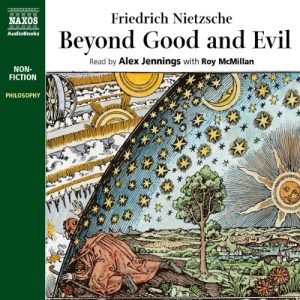
Where Thus Spoke Zarathustra leaves off is exactly where this audiobook picks up, and Friedrich Nietzsche wastes no time restating his target: morality itself, framed as nothing more than 'institutionalised weakness,' a phrase that sets the combative tone for everything that follows. Beyond Good and Evil is one of the most influential, and most contested, philosophical texts of the nineteenth century, built around Nietzsche's sustained attack on earlier philosophers for what he saw as their unquestioning acceptance of inherited moral precepts. This particular audiobook uses a new translation by Ian Johnston, read by Alex Jennings, and runs a little over eight hours covering some of the densest, most quotable argumentation in the Western philosophical canon.
Reviewer Ronald K. Byers frames the book's real significance directly, calling it a 'seminal book of Modernity and 20th Century Philosophy' and arguing that it should be understood 'not as an aberration but almost a prophecy of the changes that were to come about in the world very soon thereafter.' That framing, treating Nietzsche's provocations as diagnostic rather than simply contrarian, is a useful lens for any listener approaching this material for the first time.
The book's original German subtitle, which Mei's review preserves in full as 'Vorspiel einer Philosophie der Zukunft,' translates to 'Prelude to a Philosophy of the Future,' and that framing matters for understanding what Nietzsche thought he was doing. He wasn't just tearing down inherited morality for its own sake; he explicitly positioned the demolition as a prelude, a necessary clearing of ground before something new could be built in its place, even though this particular text spends far more time on the critique than on the construction.
What Makes Beyond Good and Evil Worth Hearing
Reading Nietzsche aloud is a genuinely difficult narration challenge, since the prose moves constantly between aphorism, sustained argument, and outright provocation, often within the same page, and a narrator who flattens that range into a single lecture-hall register loses much of what makes the text distinctive. Alex Jennings's job here is to let Nietzsche's rhetorical variety come through clearly enough that listeners can track when the text is building a sustained case versus when it's deliberately needling the reader with a provocation meant to be sat with rather than immediately agreed with or dismissed.
Reviewer Mei situates the translation carefully, noting the original German text, 'Jenseits von Gut und Böse: Vorspiel einer Philosophie der Zukunft,' was first published in 1886 and is now in the public domain, with this specific edition running to 117 pages and roughly 2,601 locations in its ebook form, useful context for gauging how this particular translation compares to other widely available versions. Byers adds that Nietzsche 'methodically reduces a great deal of historical thinking to dust,' which captures the demolition-first, rebuild-later structure of the argument across the book's full length.
Few philosophers have been as widely quoted out of context or selectively appropriated across the last century as Nietzsche, which makes hearing the actual sustained argument, rather than isolated aphorisms stripped of surrounding context, genuinely valuable on its own terms. Listening straight through in a well-handled translation like this one is one of the more reliable ways to encounter the real shape of his argument rather than the version filtered through decades of secondhand summary and selective misreading.
For listeners new to encountering dense 19th century philosophy in audio form specifically, a practical note is worth passing along: this is exactly the kind of text that rewards pausing and replaying individual passages rather than letting the audio run continuously in the background. Nietzsche's aphoristic sections in particular are built to be sat with, not simply absorbed at listening speed, and treating this audiobook more like a series of short, replayable meditations than a single continuous narrative will likely serve first-time listeners better.
Things to Know Before Starting Beyond Good and Evil
This is dense philosophical argumentation, not narrative nonfiction, and listeners new to Nietzsche specifically should know the text assumes some tolerance for abstraction and repeated re-listening of difficult passages. Byers is candid about this tension directly, writing that he understands 'completely why readers dislike Nietzsche,' which is worth taking as an honest signal about the text's real difficulty rather than a knock against the book itself. Audio can make dense philosophical prose harder to pause and re-read at will compared to a physical or ebook edition, so listeners who want to sit with individual aphorisms may want the text available alongside the audio.
With only four ratings attached, this specific audiobook edition doesn't yet have a large body of listener feedback to draw on, though the reviews that do exist are uniformly enthusiastic; one reviewer's response, simply titled 'A Must Read,' calls it 'worth your money' without much elaboration. Given how contested and frequently misread Nietzsche's actual arguments have historically been, outside of this specific review set, first-time listeners should go in aware that his critique of morality is often oversimplified in popular summary, and this audiobook rewards patient, close attention over passive background listening.
The synopsis's own word choice is worth noting: it calls this 'one of the most controversial works of ideology ever written,' using 'ideology' rather than the more neutral term philosophy. That's a loaded framing choice, and an accurate one given how selectively Nietzsche's ideas have been claimed by wildly different political and intellectual movements over the following century, often in ways he explicitly argued against elsewhere in his own work. Going in aware of that contested reception history is useful context for approaching the text itself with appropriate care.
Who Friedrich Nietzsche Is Writing For
A genuine interest in philosophy, particularly the lineage running from Nietzsche through twentieth-century thought, is the clearest qualification for this audiobook's ideal listener, especially anyone who has already worked through Thus Spoke Zarathustra and wants the argument that follows it. It's also a strong pick for listeners specifically curious about how a new translation, this one by Ian Johnston, handles notoriously difficult German philosophical prose compared to older, more established English versions.
Ian Johnston, whose translation this audiobook uses, is known more broadly for public-domain translations of classic philosophical and literary texts prized for their clarity and wide accessibility rather than academic density for its own sake, which is a meaningful data point for listeners weighing this specific edition against older, more traditional English translations of the same text.
Sustained abstract argument is the baseline expectation throughout, with no softened provocations for a general audience, so anyone completely new to philosophy looking for an accessible entry point should probably start elsewhere. Anyone who prefers to underline, flag, and revisit dense passages at will may also find a text or ebook edition alongside the audio more useful than audio alone for material this demanding.
Do I need to have read Thus Spoke Zarathustra before this audiobook?
It helps but isn't strictly required. Beyond Good and Evil continues directly from where Thus Spoke Zarathustra leaves off, so listeners familiar with that earlier work will pick up on continuations of Nietzsche's argument that new listeners may miss.
What translation does this audiobook use, and does that matter?
This edition uses a newer translation by Ian Johnston, read by Alex Jennings, which is worth knowing since Nietzsche's German prose has been translated many different ways over the decades, with real differences in tone and clarity between versions.
Is this audiobook accessible to someone with no prior philosophy background?
It's demanding for newcomers. The text assumes some tolerance for sustained abstract argument and doesn't simplify its provocations, so listeners completely new to philosophy may want an introductory secondary source alongside it.