Quick Take
- Narration: Alex Jennings reads the Ian Johnston translation with the composed authority of a stage actor, the philosophical density of Nietzsche’s prose is handled without condescension, though the text itself demands active listening.
- Themes: The critique of conventional morality, the will to power and the philosopher as legislator, the tension between slave and master ethics
- Mood: Challenging and intellectually combative, occasionally brilliant and deliberately provocative
- Verdict: One of the essential Nietzsche texts, in one of the more accessible English translations, the audio format makes the prose rhythm more apparent than the page, which is a genuine advantage for this particular work.
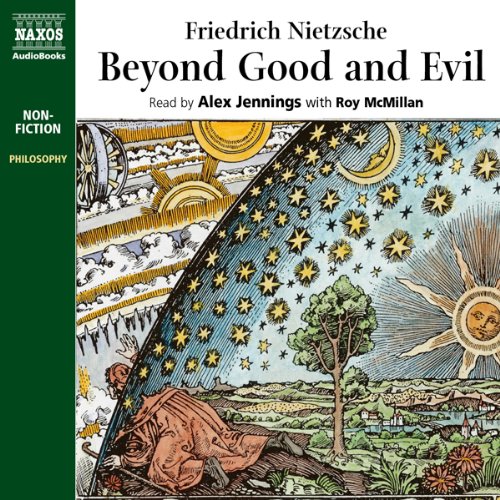
I first read Beyond Good and Evil in a dog-eared paperback during graduate seminars where we argued about Nietzsche the way people argue about difficult relatives, acknowledging the brilliance while being honest about the damage. Returning to it as an audiobook, in Alex Jennings’ reading of Ian Johnston’s translation, was a different experience. Hearing the prose rather than reading it changed something. Nietzsche’s rhythms, the aphoristic jabs, the longer argumentative passages that build to unexpected conclusions, are more apparent when spoken, and Johnston’s translation is fluent enough that the philosophical texture survives the journey into English without becoming a dry academic exercise.
The work continues from Thus Spoke Zarathustra, which the synopsis correctly notes, though it does so in a more analytical register. Where Zarathustra is prophetic and poetic, Beyond Good and Evil is more directly argumentative, Nietzsche is attacking the idea of morality as institutionalized weakness, criticizing his philosophical predecessors for their unexamined moral assumptions, and sketching what he calls the philosophy of the future. The audacity of the project is still startling more than a century later. Nietzsche is not simply being contrarian. He is attempting to diagnose something structural about how European philosophy and Christianity had, in his view, made weakness into a virtue and resentment into a moral system. Whether you agree or not, it is a bracing argument to encounter.
Our Take on Beyond Good and Evil
One reviewer made an observation that has stayed with me: this book reads less like an aberration than like a prophecy of the intellectual and political upheavals that followed in the twentieth century. That is a way of saying that Nietzsche was onto something real, even when his conclusions are troubling and his social applications were disastrous in ways he did not anticipate and would likely have found repugnant. Good Nietzsche reading requires holding both things simultaneously, the genuine philosophical power and the history of what was done with some of these ideas. The audiobook does not resolve that tension because no honest engagement with the text can.
Why Listen to Beyond Good and Evil
Alex Jennings is a seasoned audio performer, and his reading brings a quality that printed philosophy often lacks: the sense of a voice thinking through difficult material rather than simply declaiming it. The aphoristic sections, where Nietzsche condenses a complex position into a single provocative statement, land with more force when read aloud than when encountered on the page, where the surrounding white space can dissipate their impact. Johnston’s translation also tends toward clarity over poetic effect, which is the right call for a general audience engaging with the text for the first time or returning to it after years away. The resulting audio is one of the more accessible ways into a text that has defeated many good-faith readers.
What to Watch For in Beyond Good and Evil
The text is not easy, and the audio format does not change that fundamental fact. Listeners who have not encountered Nietzsche before should be aware that the work assumes familiarity with Kant, Schopenhauer, and the Western philosophical tradition through the late nineteenth century. Without that context, some sections will feel like arriving mid-argument. The Naxos AudioBooks production is otherwise clean and well-paced. The review sample for this specific edition is thin, available responses reference other editions as much as this recording, so listeners should proceed on the strength of Jennings’ general reputation and Johnston’s well-regarded translation.
Who Should Listen to Beyond Good and Evil
Ideal for listeners who have some prior encounter with Nietzsche, perhaps through Zarathustra or secondary sources, and want to hear him at his most analytically direct. Also genuinely useful for anyone working through a survey of modern Western philosophy, since Nietzsche’s influence on twentieth century thought from existentialism to poststructuralism is impossible to understand without this text. Not a starting point for listeners who find philosophical argument in the aphoristic mode frustrating, or who want narrative or biographical framing to orient them. Those listeners might do better to start with a biography of Nietzsche before approaching the primary text.
Frequently Asked Questions
Is Beyond Good and Evil accessible to listeners without a philosophy background?
It is manageable but not easy. Nietzsche assumes familiarity with Kant, Schopenhauer, and the history of European moral philosophy. Listeners without that background will find the aphoristic sections more accessible than the sustained argumentative passages, but will likely miss some of the specific targets of Nietzsche’s critiques. Reading or listening to a secondary introduction first, Walter Kaufmann’s Nietzsche biography remains useful for this purpose, will significantly improve the experience.
How does the Ian Johnston translation used in this audiobook compare to the Kaufmann translation that many readers know?
Johnston’s translation is noted for clarity and fluency in spoken English, which makes it a good fit for audio. Kaufmann’s translation, the standard academic version for decades, is more influential in scholarly contexts and includes extensive notes. For a listening experience, Johnston’s more natural prose rhythm is an advantage; for close study or academic use, Kaufmann’s annotations remain valuable.
Does Alex Jennings’ narration help engagement with the philosophical material?
Jennings is a professional stage actor and experienced audiobook narrator whose reading brings theatrical intelligence to difficult prose. The aphoristic sections particularly benefit from his delivery, he does not flatten them into lecture but gives them the slightly combative energy the text requires. This is one of the better pairings of narrator to philosophical text in the Naxos catalog.
Is this the right version of Beyond Good and Evil for a first-time listener, given multiple translations exist?
Johnston’s translation is a reasonable choice for a first encounter, especially in audio format. The Naxos production with Jennings narrating is professionally produced and widely available. Listeners who want the most critically vetted scholarly translation should look at Kaufmann’s version in print, but for listening purposes this recording represents the material fairly and accessibly.