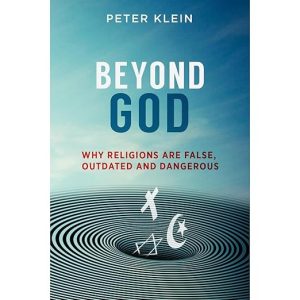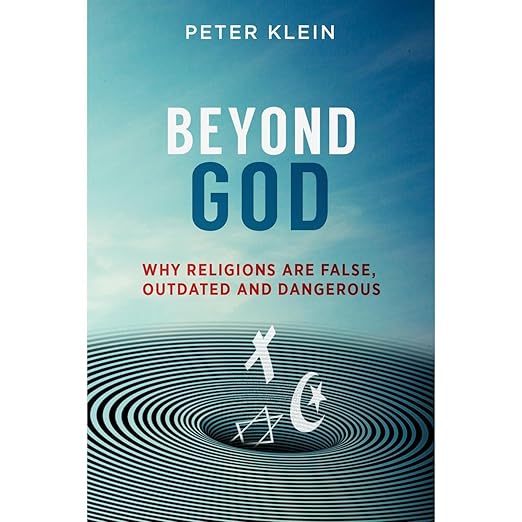
Peter Klein's audiobook Beyond God - Why Religions are False, Outdated and Dangerous arrives at a verdict before the first chapter is even finished: religion has had its run, and the scientific method is now the only defensible framework for understanding the world. That unambiguous stance is either the book's chief virtue or its principal limitation, depending entirely on where you stand when you press play. For listeners already aligned with Klein's skepticism, the nine hours and twenty-one minutes feel like a rigorous vindication. For anyone sitting closer to the middle of the faith-versus-reason debate, the experience is more challenging, though rarely dull.
I've spent a fair amount of time with atheist literature over the years, from the blunt polemics of Christopher Hitchens to the more measured philosophical arguments of Daniel Dennett, and Klein fits comfortably within that tradition. His central organizing idea, the progression of human knowledge through three distinct phases he calls the Magical, the Religious, and the Scientific, gives the audiobook a coherent backbone that many books in this genre lack. It is an accessible framework, and he returns to it often enough that even listeners who drift in and out will find themselves reoriented.
From Magical to Scientific, Klein's Three Phases
The strength Klein brings is breadth. Reviewers who have read widely in this genre consistently flag this as one of the more thorough treatments available, with one noting that after reading dozens of books on atheism and finding many minimalist and unsatisfying, Klein's felt exceptional for the range of topics it covers in sufficient depth while continually making key points. That is not a small claim in a crowded field, and having spent time with the audiobook, I think it is largely earned. Klein does not simply rehash the standard evolutionary biology or cosmology arguments. He examines religious institutions themselves, the structures of doctrine, authority, and social control, as culpable actors in ongoing human harm.
What keeps this from reading as a pure polemic is Klein's insistence on evidence. The religious critique is supported with historical and social research throughout, and while Klein clearly has a prosecutorial rather than a judicial disposition, the case he builds is documented rather than merely asserted. One reviewer compared their experience of listening to building a mental briefing document, which is a useful image: this is a book designed to be argued with and from, not simply absorbed.
One Reader Bought the Audiobook and Paperback
It is also worth noting that one reviewer bought both digital and paperback copies after listening, a response that says something meaningful about how this kind of argument-dense nonfiction works across formats. The audiobook is where the case lands cleanly, continuously, without the temptation to skip ahead; the print version is where you return to underline specific passages. Both instincts, the impulse to absorb and the impulse to annotate, are appropriate responses to what Klein is building here.
Virtual Voice Handles Klein's Analytical Prose Fine
The Virtual Voice narration serves the material adequately. Klein's prose tends toward the argumentative and analytical rather than the lyrical, so the absence of a human narrator's rhetorical warmth does not hurt as much as it might in a memoir or a novel. The pacing is steady, the text is clearly delivered, and at nine-plus hours the runtime gives Klein room to develop his three-phase framework through genuine depth rather than surface-level dismissal of religion.
For listeners who absorb dense nonfiction well through audio, this format actually works in the book's favor. The arguments are structured enough that you can follow them without a page to refer back to, and Klein's chapter organization means the audiobook functions almost like a lecture series on secular humanism. Each section reinforces the last, building toward what Klein frames as an inevitable conclusion: that mythology and superstition are no longer adequate guides for how to live.
No Steelmanning for Augustine or Kierkegaard
The book's most significant limitation is the one inherent to any work with this strong a thesis: it is not a conversation. Klein is not interested in steelmanning religious positions before dismantling them, and readers who find value in the philosophical tradition of faith-informed reason, from Augustine to Kierkegaard to contemporary theologians, will find little acknowledgment of that lineage. The three-phase framework, while rhetorically useful, does risk presenting a teleological arc toward secularism that many historians of science and religion would complicate considerably.
The Virtual Voice narration is also worth a caveat for first-time buyers. In expository passages it is fine; in moments where Klein's prose turns more urgent or rhetorical, the lack of human conviction can create a slight disconnect between the weight of the argument and the flatness of its delivery. This is a consistent issue with AI narration on polemical texts, and it does not break the audiobook, but it is worth knowing before you commit the runtime.
More Interlocutor Than Guide for the Faithful
This audiobook is well suited to secular listeners who want a single, comprehensive volume that challenges religious institutions across history, sociology, and philosophy rather than picking at one thread at a time. It is also genuinely useful for anyone preparing to engage in conversations about faith and reason and wanting a well-sourced, clearly organized set of arguments to draw on. Listeners who are currently religious, or who are agnostic but hold a deep respect for the contemplative traditions within faith, will find the book more useful as an interlocutor than a guide. Klein is not writing for them, and it shows. But for the audience he is writing for, this delivers exactly what it promises.
Common Questions
Does the Virtual Voice narration work for a dense argumentative text like this audiobook?
It functions well enough for the analytical passages that make up most of the book. The narration is clear and paced consistently, which suits Klein's structured, evidence-based arguments. It loses some impact in the more rhetorically charged sections where a human narrator's conviction would add weight, but it does not significantly impede the listening experience.
How does this audiobook compare to other atheist titles like Hitchens or Dawkins?
Reviewers with wide exposure to the genre place it favorably, noting it covers more ground than many books in the field and supports its arguments with more evidence than the more rhetorically driven works. The three-phase historical framework gives it more structural coherence than some comparable titles, though it shares the prosecutorial tone common to the genre.