The Short Version
- Performance: Virtual Voice AI narration handles this list-driven, framework-heavy content reasonably well, a more favorable fit than narrative-dependent material.
- What it covers: generative versus agentic AI, evaluation frameworks over specific tools, career-proofing in a fast-moving field
- Feel: Brisk and reassuring, aimed at replacing anxiety with a usable mental model
- Our call: A clear, well-structured primer on agentic AI for anyone who wants durable frameworks rather than tool-specific tips, best paired with more technical resources for hands-on implementation.
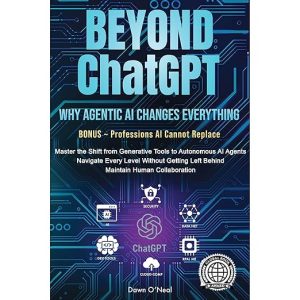
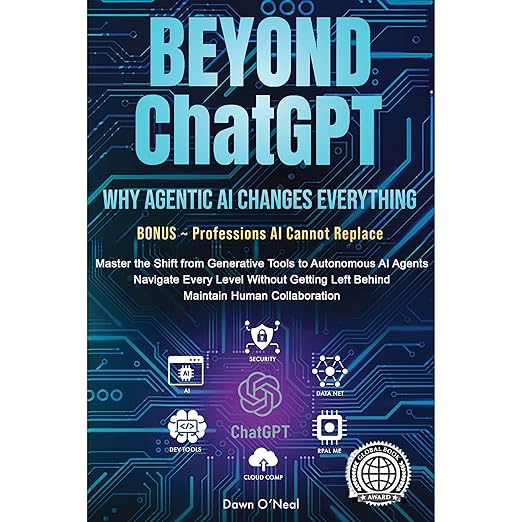
Where does generative AI end and agentic AI begin? That's the exact distinction Dawn O'Neal spends most of this audiobook unpacking, and it's a sharper question than the usual AI-anxiety content tends to ask. BEYOND ChatGPT argues that most people are still mentally stuck evaluating tools that create content, chatbots, image generators, when the real shift already underway is toward systems that make autonomous decisions on their own. O'Neal frames the current moment as roughly equivalent to 1995 in internet terms, meaning the disruption most listeners associate with AI hasn't actually started yet, and understanding the difference now is what separates people who adapt from people who get blindsided later.
Mental Models Built to Outlast Specific Tools
The book is structured around frameworks rather than specific tools, an eight-level AI hierarchy running from basic bots to what O'Neal calls digital CEOs, four questions for evaluating any AI system, and an 80/20 rule for deciding where AI integration actually matters. That's a deliberate choice given how fast specific tools go obsolete; O'Neal says outright that she's teaching mental models rather than instructions for software that may not exist in its current form a year from now.
The 1995 comparison is worth sitting with rather than skimming past, since it implies something sharper than a simple reassurance that adoption is still early. In 1995, most people who used the internet at all were still on dial-up, treating it as a novelty for email and the occasional web page rather than the infrastructure it would become within a decade. O'Neal's argument is that treating today's AI tools the same way, as a novelty layered on top of existing habits rather than a foundational shift in how decisions get made, is the exact mistake that will look obvious in hindsight the way underestimating the internet does now.
Synthetic Narration Fits This Framework-Heavy Content
This audiobook is narrated by Virtual Voice, an AI narration technology, which is worth naming plainly given the subject matter's own focus on where automation genuinely works and where it still falls short. The good news is that expository, framework-heavy business content like this is close to the best-case scenario for synthetic narration: numbered lists, defined terms, and step-by-step evaluation questions translate reasonably cleanly without needing the interpretive warmth or comedic timing that trips up AI narration on more voice-dependent material. Listeners sensitive to synthetic narration should know it going in, but the content itself is structured in a way that minimizes the gap.
Digital CEOs Top an Eight-Level Hierarchy
Reviewer Aubrey Gonzalez calls the book 'perfectly timed for the moment we're living in,' crediting it specifically for breaking down 'the massive shift happening as the world moves toward autonomous AI agents' rather than just rehashing what ChatGPT can already do. Sierra's review frames the audiobook as useful across audiences, describing it as 'a sound guide that helps professionals, students, and leaders alike adapt, collaborate, and thrive' in the current AI moment, which matches the book's own stated goal of teaching transferable evaluation skills rather than tool-specific tricks that expire.
The top of O'Neal's eight-level hierarchy, what she calls digital CEOs, is the single most provocative concept in the book and worth calling out directly rather than leaving buried in a list. It's a deliberately uncomfortable label, positioning certain AI systems as capable of the kind of autonomous, consequential decision-making usually reserved for senior human leadership, and naming it that bluntly is part of what gives the book its edge over more hedged, cautious treatments of the same underlying trend.
Brisk Primer Comes With a Bonus PDF
At three hours and eighteen minutes, this is a brisk, high-level primer rather than a deep technical manual, and listeners wanting to actually build or deploy agentic AI systems will need more specialized, hands-on resources after finishing it. The book is explicit about this scope itself, positioning the frameworks as a starting mental model rather than a complete implementation guide, which is a fair trade for the breadth it covers in a relatively short runtime. Reviewer Shannon Castellano notes the book is aimed at putting an anxious reader's 'mind at ease' about AI generally, which is accurate, but that reassurance-first framing means some listeners hoping for a more technical, skeptical deep-dive may find the tone more accessible than rigorous.
This is part of O'Neal's 'AI For Everyone' series, and while it stands alone content-wise, listeners who find the eight-level hierarchy or the evaluation framework genuinely useful may want to check whether companion titles in the same series dig deeper into specific levels. The included bonus PDF, 'Professions AI Cannot Replace,' is a meaningful add-on for anyone specifically anxious about job security, and skipping it means missing content the book itself flags as a distinct value point beyond the core audio.
An 80/20 Rule Anchors a Newcomer Series
The book's 80/20 rule for AI integration deserves a moment of unpacking, since it's a genuinely useful filter distinct from the eight-level hierarchy. The implication is that a relatively small subset of AI applications will deliver the large majority of practical value for most listeners' actual work, and that chasing every new tool or headline is a worse use of time than identifying which fraction of that 20 percent applies to your specific situation. That kind of prioritization framework is exactly the sort of durable thinking tool that survives longer than any single product recommendation would.
This book's place within O'Neal's broader 'AI For Everyone - Beginners to Tech' series is worth noting for context: a series title that explicit signals the intended audience clearly from the outset, general professionals and curious newcomers rather than engineers or AI researchers, which lines up with how the book itself stays high-level and framework-driven throughout rather than drifting into implementation detail a beginner wouldn't be equipped to use anyway.
Evaluation Criteria That Outlast One Product Cycle
Business leaders, professionals worried about where their role sits on O'Neal's eight-level hierarchy, and anyone who has felt behind on AI conversations without wanting to become a technical expert are the clearest audience here. The framework-first approach is genuinely useful for listeners who want durable mental models rather than a list of specific tools that will need replacing within a year or two, which is a real strength for a topic this fast-moving.
Business leaders weighing concrete AI investment decisions get a distinct kind of value from that same framework-first approach: evaluation criteria durable enough to outlast a single product cycle, which matters more for a real budget decision than for a general reader simply trying to stay current.
Hands-on AI practitioners wanting technical depth on building or deploying agentic tools will need more specialized, practitioner-level resources instead; this audiobook stays intentionally at the conceptual and strategic level. Anyone who has struggled with AI narration on other titles should still preview a sample first, even though the list-driven structure here is a reasonably favorable match for Virtual Voice compared to more narrative-dependent nonfiction.
What's the actual difference between generative AI and agentic AI according to this audiobook?
Generative AI refers to tools that create content, like chatbots and image generators, while agentic AI refers to systems capable of making autonomous decisions on their own; the book argues most people are still evaluating AI through the generative lens even as the agentic shift is already underway.
Is the Virtual Voice narration a problem for this kind of technical audiobook?
Less than it would be for narrative-driven content. The framework-heavy, list-based structure, an eight-level hierarchy, four evaluation questions, an 80/20 integration rule, suits synthetic narration reasonably well since it doesn't lean on interpretive warmth or comedic timing the way memoir or fiction would.
Do I need a technical background in AI to follow this audiobook?
No. The book is explicitly aimed at business leaders, professionals, and general listeners rather than engineers, and teaches evaluation frameworks and mental models rather than assuming prior technical knowledge.
Does this audiobook teach specific AI tools I can start using right away?
Not primarily. Author Dawn O'Neal deliberately focuses on frameworks and mental models over specific tools, reasoning that individual AI products change too quickly for tool-specific instruction to stay useful for long.