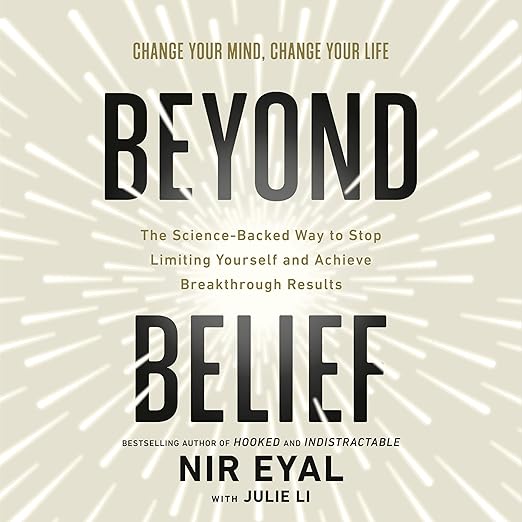
Nir Eyal's Beyond Belief audiobook arrives with a premise that sounds simple until you actually sit with it. The argument is not that you need more willpower, better habits, or a different morning routine. The argument is that the beliefs operating underneath those behaviors are the real variable, and most self-improvement advice never touches them. Eyal, best known for Hooked and Indistractable, has spent his career at the intersection of behavioral science and practical application, and this book extends that project into territory that feels genuinely underexplored in the genre: the question of why intelligent, motivated people keep getting in their own way despite knowing exactly what they should be doing.
The central reframe Eyal offers is that beliefs are not truths, they are tools. That distinction sounds obvious when stated plainly, but the book earns the insight by demonstrating how rarely people actually treat their beliefs that way. Most of us carry assumptions about what we are capable of, what we deserve, how the world responds to effort, and how much change is realistically possible, and we treat these assumptions as reliable reports on reality rather than as hypotheses formed under specific conditions and now operating on autopilot. Eyal's contribution is to show, via neuroscience and psychology research, exactly how those assumptions filter what we notice, what we attempt, and what we give up on before we even begin.
What separates Beyond Belief from adjacent entries in the mindset genre is the specificity of the mechanism. Eyal does not simply assert that your beliefs are holding you back and that you should choose better ones. He builds a model of how belief structures form, how they are reinforced through selective attention, and how they can be systematically examined and revised. Reviewers have noted that the book operates at a level of depth uncommon in this space, with one describing it as one of the most thoughtful books on the role our beliefs play in shaping our behavior, noting how the book goes into the underlying assumptions we carry about ourselves, others, and how the world works, and how those assumptions quietly steer us. That depth is not academic for its own sake; it is in direct service of the practical method Eyal constructs across the book's six-plus hours.
A Proxy Narrator Would Flatten This Distinction
Eyal's self-narration is a significant asset for this audiobook specifically. The book's argument is built from science, but it is illustrated through personal narrative, including Eyal's own experiences with the limiting beliefs that shaped his early career and relationships. A proxy narrator would flatten the distinction between the empirical and the autobiographical; Eyal's own voice keeps the listener oriented between research report and personal testimony. At six hours and forty-seven minutes, the runtime allows for genuine development of the argument rather than the rapid-fire-summary approach that collapses complex psychological models into motivational bullet points.
The audio format also serves the book's practical exercises particularly well. Eyal structures several chapters around reflection prompts that work naturally in a listening context, where a pause in the narration becomes an invitation to sit with a question rather than skim past it. The exercises are not perfunctory; they are designed to surface the specific beliefs operating in your own context, which is where the book's real value lies. One listener described how the book completely changed their thinking about belief after a lifetime of carrying limiting assumptions formed in a conservative upbringing, noting that even when they achieved things they often felt uneasy, as if success did not fully belong to them. That kind of recognition points to real psychological depth in the material.
More Personal in Register Than Kahneman's Book
Listeners who come to this audiobook expecting pure behavioral science writing should know that Eyal integrates the research with memoir and coaching-style narrative. The science is substantive and cited, but it is delivered in service of a practical argument, not as an academic review of the literature. Those who prefer the drier rigor of books like Daniel Kahneman's Thinking, Fast and Slow will find Beyond Belief more personal in register. That is a feature for most listeners and a potential misalignment for a few who want clinical distance from the material throughout.
The rating of 4.9 from 74 reviews reflects an audience that came specifically seeking this kind of change-your-mind-to-change-your-behavior framework, and the reviews suggest strong satisfaction. The response points to real depth in the material, but it also signals that the book rewards listeners who bring their own specific resistance to the table, not those looking for abstract inspiration divorced from personal application. If you do not arrive with a genuine question about where your own beliefs are holding you back, the exercises will feel like homework rather than discovery.
The Gap Between What You Know and Do
This audiobook works best for listeners who have read the standard entries in the mindset and habit literature and felt something was missing. Readers of Mindset by Carol Dweck or Atomic Habits by James Clear who wanted to go further into the foundational layer of why the strategies sometimes fail will find Eyal's framework genuinely additive. It is also valuable for anyone who has noticed a persistent gap between what they know they should do and what they actually do, and wants a model for why that gap exists. Those who want a quick motivational boost rather than a structural investigation of their own belief architecture may find the book more demanding than they are looking for, but that demand is exactly what makes it worth the time invested.