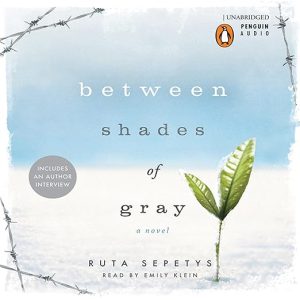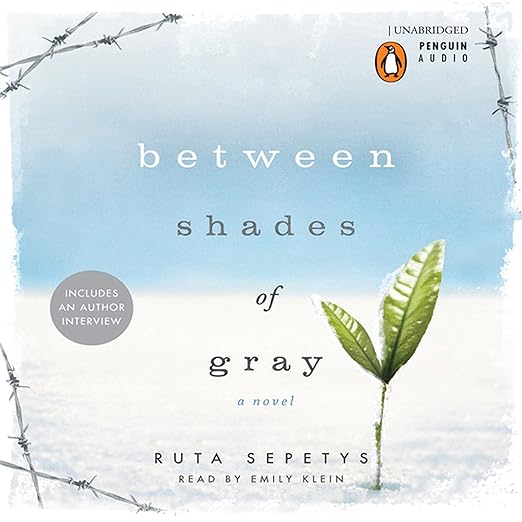
Lina Vilkas is fifteen years old when the Soviet secret police knock on her family's door in Lithuania in 1941. Between Shades of Gray, narrated by Emily Klein, opens at the precise moment that a girl's ordinary life ends and a brutal, unwanted survival story begins. This audiobook is Ruta Sepetys at her most urgent: historical fiction that refuses to be comfortable, written for young adults but carrying weight that no age range can diminish.
The Verdict, Briefly
Sepetys came to this subject with a particular purpose: to bring to light a chapter of history that most Western readers have never encountered. The Soviet deportation of Baltic peoples, hundreds of thousands of Lithuanians, Latvians, and Estonians swept into cattle cars bound for labor camps in Siberia, is not taught in most American or Western European schools. It was deliberately suppressed, and its survivors spent decades in silence. Sepetys, of Lithuanian descent herself, wrote this as an act of remembrance.
Lina is the book's center, but the story she inhabits is larger than any individual. She is an art student, a girl who draws obsessively and uses her skill to leave a trail of clues that might reach her father in his separate prison camp. The drawings function as both plot device and metaphor: the idea that beauty and communication can persist even in conditions designed to obliterate both. KWyly's review captures the historical scale well: 'In 1941, three countries disappeared from local and world maps.' Sepetys never lets readers forget that Lina is one person within a catastrophe of hundreds of thousands.
The book has been praised as belonging with the classics, a designation that reviewer 6stringspider applies without hesitation. That's a significant claim for a young adult novel. What earns it is the combination of emotional authenticity with historical discipline. Sepetys does not sensationalize. She documents, through Lina's eyes, in a register that is precise rather than melodramatic. The horror is not amplified. It is shown clearly, and that clarity is more disturbing than any embellishment would be.
What Makes Between Shades of Gray Worth Hearing
Emily Klein's narration carries the weight of this material with real skill. Lina's voice requires something specific: the determination and occasional despair of a teenager who refuses to stop being herself even as everything around her is stripped away. Klein finds that register and holds it. She does not perform tragedy. She inhabits persistence.
The audio format adds something to the historical sequences. The cattle car passages, the labor camp conditions, the Lithuanian characters speaking to each other in fragments of resistance, all of this benefits from a narrator who can modulate between Lina's interior resilience and the external bleakness without making either feel false. Klein handles the tonal shifts between Lina's memories of her prewar life and her deportation present with a clarity that keeps the timeline clear even when Sepetys moves between them quickly.
At seven hours and forty-seven minutes, Between Shades of Gray is compact for the scope of its subject. Sepetys is an efficient writer, and the audiobook reflects that economy. No padding exists here. Every scene carries either plot or emotional necessity, and Klein's pacing respects that compression.
Points to Consider
The relationship between Lina and Jonas, her younger brother, is one of the book's most quietly powerful threads. He is ten years old at the start of the deportation, and much of Lina's endurance is organized around keeping him alive. Sepetys handles this sibling dynamic with enormous care, never making Jonas a sentimental anchor while also never minimizing what it costs Lina to protect him.
The character of Andrius, the boy Lina meets during the deportation, introduces a different kind of resistance: survival through compromise. His choices are morally complicated in ways that most YA romance avoids. Sepetys does not reduce him to a love interest or a villain. He is a boy making specific, understandable, and sometimes painful decisions in impossible circumstances. This moral complexity is part of what earned the Carnegie Medal nomination and makes the book worth studying as well as feeling.
Reviewer Amazon Customer notes that this history 'was unknown to me before reading this book.' That experience is common and is part of the book's reason for existing. Listeners who come to Between Shades of Gray knowing nothing about the Baltic deportations will leave knowing something that matters. That is a rare achievement for fiction of any category.
The Carnegie Medal nomination and William C. Morris Award finalist designation are not ceremonial. They reflect a consensus among children's literature experts that this book accomplishes something rare: it delivers historical witness in a form young readers can absorb without being either protected from the facts or overwhelmed by them. Sepetys calibrates her prose precisely for that narrow space. Emily Klein's narration understands the same balance. She does not shield the listener from the horror of what Lina experiences, but she also does not perform the suffering in a way that would push listeners out of the story rather than deeper into it.
Should You Listen to Between Shades of Gray?
Young adult readers with an interest in WWII and Soviet-era history will find this essential. Adult readers of historical fiction who haven't encountered it yet are overdue. Emily Klein's narration makes it accessible in audio without softening its edges. If you have teenagers who are studying this period or who need to understand what persecution looks like at ground level and in human terms, this audiobook is one of the most direct paths there. Anyone with a passing familiarity with Sepetys' later work, particularly Salt to the Sea, should know this is where her voice crystallized.
Key Details
- Voice: Emily Klein gives Lina's voice the quiet persistence the role demands; she handles historical bleakness and teenage resilience without collapsing either into the other.
- Big ideas: Soviet deportation, survival and resistance, the cost of bearing witness
- Atmosphere: Harrowing and deeply human; emotionally precise rather than melodramatic
- Worth it?: One of the most important YA historical novels of its era, and Emily Klein's narration serves it well.
A Few Questions About Between Shades of Gray
Is Between Shades of Gray suitable for younger teenagers as an audiobook?
It is written for young adults and does not contain graphic violence, but the subject matter, Soviet deportations, labor camps, and the death of civilians, is genuinely harrowing. Most readers find it appropriate from age 13 or 14 upward, with parental guidance for sensitive younger readers.
Does the audiobook narration keep the historical timeline clear?
Emily Klein handles Sepetys' shifts between Lina's prewar memories and deportation present cleanly. The timeline is not confusing in audio, though the transitions between periods can be sudden.
Is Between Shades of Gray connected to Ruta Sepetys' other audiobooks?
It is a standalone novel. Salt to the Sea covers adjacent history (Baltic refugees at the end of WWII) and is often read alongside it, but neither book requires the other.
What historical event does this audiobook document?
The Soviet deportation of Baltic peoples following Stalin's occupation of Lithuania, Latvia, and Estonia in 1941. This history was suppressed for decades and remains little known outside those countries.