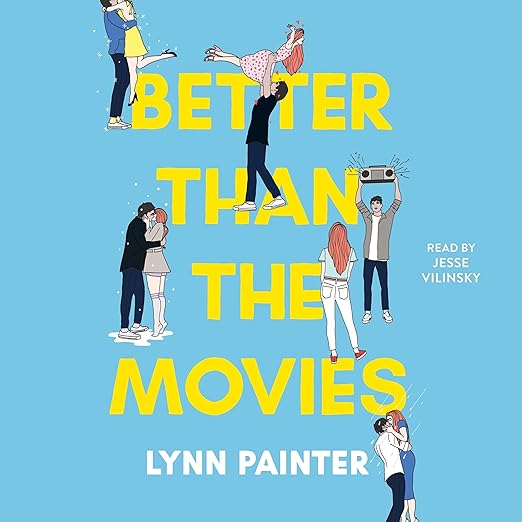
Lynn Painter does something clever with the structure of Better Than the Movies that becomes clear about a third of the way through the audiobook: the story is aware of its own genre. Liz Buxbaum, the protagonist, has spent her adolescence cataloguing rom-coms and building a mental script for how love is supposed to work, and the book keeps cheerfully dismantling that script in favor of something messier, funnier, and more recognizably real. Jesse Vilinsky's narration captures Liz's voice with an energy that suits both the comedy and the genuine feeling underneath it, and the result is one of the more satisfying YA romantic comedies in recent audiobook form.
I listened to this one over a couple of afternoons when I wanted something light but not hollow, and it delivered that balance more reliably than I expected. The enemies-to-lovers dynamic between Liz and her next-door neighbor Wes Bennet is well-worn territory, but Painter earns the trope rather than just invoking it. The relationship between the two builds through the kind of specific, repetitive, minor interaction that actual proximity creates, pranks and borrowed lawn space and showing up at inconvenient moments, and that texture gives the eventual shift in Liz's feelings a genuine emotional logic.
Our Take on Better Than the Movies
The most interesting thing Painter does is make Liz's initial crush on Michael genuinely comprehensible rather than a strawman to be demolished. Michael is described as 'cool, aloof,' an archetypal untouchable crush, and Liz's investment in him is written as something she built over years in his absence. The book treats that kind of romantic idealization not as stupidity but as a particular kind of emotional project, one that becomes harder to maintain when the actual person reappears and turns out to be ordinary. That psychological honesty, about how we fall for the people we imagine rather than the people we know, gives Better Than the Movies more emotional substance than the premise might suggest.
Wes, for his part, is the real accomplishment of the characterization. A reviewer wrote that 'his witty banter was lowkey the best part,' and another quoted the book's own self-aware line: 'Enemies-to-lovers, it's our trope, Buxbaum.' Painter writes the male love interest as someone who is genuinely present in the story rather than simply an emotional destination. His friendship with Michael, which becomes Liz's accidental entry point into the social dynamic she wants, gives him independent agency and makes his evolving relationship with Liz feel like something that happens between two real people rather than a structural inevitability.
Jesse Vilinsky's narration is an asset throughout. Liz is in first-person perspective for the entire book, and Vilinsky maintains the voice with consistency without letting it become monotonous across ten-plus hours. The humor, which is the book's most reliable quality, lands cleanly in audio format. Painter writes comedic timing into her prose at the sentence level, and Vilinsky's delivery respects that timing rather than running roughshod over it. The romantic tension in the later sections also benefits from Vilinsky's ability to modulate between the comedic and the genuinely felt without jarring transitions.
The rom-com movie references that run through the book as Liz's internal compass deserve mention. Painter works in a genuine literacy about the genre, and the way Liz uses movie logic to interpret her own life is both funny and a running commentary on how romantic comedies shape expectations in ways that real relationships can only partially meet. For listeners who share that literacy, the references add texture. For those who do not, the emotional through-line works independently of the specific titles.
The prom setting, which functions as the narrative's organizing destination, is handled with more nuance than the premise implies. Painter is not particularly interested in the prom itself as a romantic milestone; she is more interested in how Liz's investment in that milestone shapes the decisions she makes in the months before it. The book's gentle argument is that the romantic scripts we inherit from movies set us up to miss what is actually in front of us, and Liz's gradual recognition of that gap, played out through specific scenes rather than stated directly, is the emotional work the novel is quietly doing underneath the comedy.
What to Watch For in Better Than the Movies
One reviewer noted that the ending felt 'anticlimactic,' particularly given the buildup. This is a fair observation. Painter was planning sequels, and the first book's resolution reflects that structural decision: the emotional payoff is real but the narrative arc closes more quietly than the preceding momentum suggests it should. Listeners who need a fully cathartic finale may feel slightly underserved. Those who find the gradual accumulation of the relationship more interesting than the final declaration will be satisfied.
The book is also explicitly clean by YA standards, with humor and some language but no explicit content. Listeners who prefer their YA romance with more heat should calibrate expectations accordingly. The emotional intimacy of the relationship between Liz and Wes is the primary draw, not physical heat, and Painter keeps the focus there throughout.
Jesse Vilinsky brings something specific to the audiobook that the prose alone cannot fully convey: the timing of Liz's internal monologue. Painter writes Liz's voice with a rhythm that is faster and more self-interrupting than most YA narrators, and Vilinsky catches that rhythm rather than smoothing it out. The result is a listening experience that feels genuinely like being inside a particular teenager's head rather than a polished literary reconstruction of one. That quality of immediacy is harder to achieve in audio than it might seem, and it is one of the reasons the audiobook is the recommended format for this particular title.
Who Should Listen to Better Than the Movies
This audiobook is for YA romance listeners who enjoy enemies-to-lovers dynamics with genuine comedic energy and some meta-awareness of the genre's conventions. Fans of Kasie West's contemporary YA or Jenn Bennett's work will be comfortable here. Jesse Vilinsky's narration makes the audiobook a particularly good format for this book's humor and first-person voice. Listeners who need a dramatically cathartic ending may find the resolution quieter than expected, but for anyone who wants a warmly funny, emotionally honest teen rom-com, Better Than the Movies reliably delivers.
Key Details
- Narrator: Jesse Vilinsky maintains Liz's first-person voice with energy and comedic timing across ten-plus hours; a strong match for the material.
- Subjects: Enemies-to-lovers, romantic idealization versus reality, rom-com literacy and its discontents.
- Tone: Warmly funny and emotionally genuine, with meta-awareness of its own genre conventions.
- Bottom line: Painter earns her tropes through specific, funny characterization, and Vilinsky's narration makes the audiobook the best format for Liz's voice.
Common Questions
Is this audiobook appropriate for listeners in their early teens, or is it more suited to older YA readers?
Better Than the Movies is clean by YA standards with humor and some language but no explicit content. It is appropriate for most teen readers and adults who enjoy YA romance. The emotional themes, idealization versus reality, and social dynamics, are accessible across a broad YA age range.
How does Jesse Vilinsky's narration handle the humor in this audiobook?
Very well. Painter writes comedic timing into her prose at the sentence level, and Vilinsky respects that timing rather than overplaying it. The humor is one of the book's strongest qualities in audio format, and Vilinsky's delivery is a significant part of why it lands cleanly.
How explicit is the content in this audiobook?
The book is clean. The romantic content is emotional rather than physical, and Painter keeps the focus on the relationship dynamic and character development throughout. Listeners looking for heat in their YA romance should look elsewhere; this book's appeal is its humor and emotional honesty.