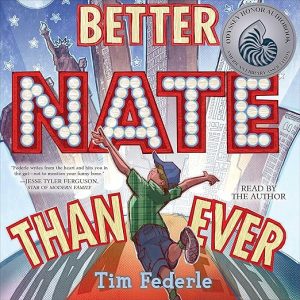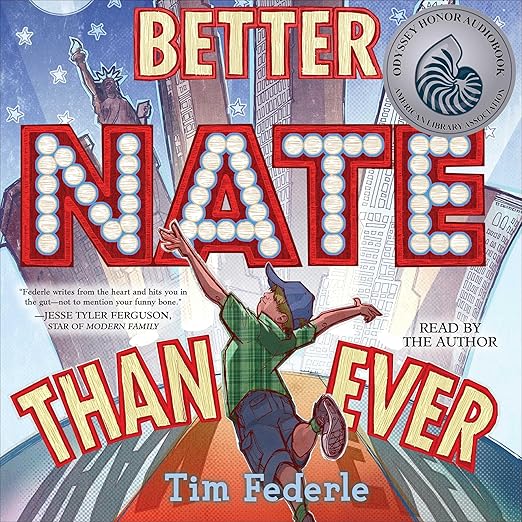
Nate Foster's escape from Jankburg, Pennsylvania, happens on a single overnight bus ride to New York City, and Tim Federle narrates that journey with the barely controlled exhilaration of someone who has made the same trip in his imagination more times than he can count. Better Nate Than Ever opens the audiobook not with careful scene-setting but with the slightly terrified momentum of a plan already in motion. The audiobook catches you mid-stride, which is exactly where the best middle grade fiction begins.
Federle's debut novel spent years earning the kind of endorsement that few children's books receive: Lin-Manuel Miranda called the Nate series "a wonderful evocation of what it's like to be a theater kid," which says something about the specificity of the world Federle constructs. This is not a generic coming-of-age story with a performing arts backdrop; it is a book that knows the difference between ensemble and principals, between a callbacks list and an open casting call, between the kid who wants Broadway and the kid who merely wants to be seen. Nate is the latter, which makes him considerably more interesting than the former would be.
Nate Carries a Difference Never Fully Named
The premise, a thirteen-year-old sneaking away from home to crash an open audition for "E.T.: The Musical," operates as both a comic engine and a serious emotional project. Federle uses the absurdity of the fictional show-within-the-book to create distance from the sincerity of Nate's longing, which is a structurally elegant choice. The New York Times described it as "inspired and inspiring," and the balance that characterizes the book is precisely there: it earns the emotion because it never lets the emotion announce itself too loudly or too soon.
Federle is also doing something relatively rare in middle grade fiction: writing a protagonist who is navigating a sense of difference that is never fully named but always present. Reviewers have noted the book's resonance with LGBTQ+ readers, and the opening in this series does important work by showing a kid whose sense of not belonging in his hometown extends beyond the performing arts question. The audiobook communicates this with even more precision than the text, because Federle's narration of Nate's internal voice carries exactly the right mixture of bravado and anxiety.
The New York Times Notable Book of the Year designation and the Publishers Weekly Best Book of the Year recognition confirm that the book's reception extended well beyond a niche theater-kid audience. A Publishers Weekly reviewer described it as a "hilarious and heartwarming debut novel," which maps accurately to what the audiobook delivers across its nearly six hours. It has the warmth without the sentimentality and the humor without the distance.
Federle Narrates the Lines He Knows Are Funny
Federle performing his own work is an argument for self-narration in the same category as other authors who are also performers. He knows which lines are funny, how long to let a pause breathe, and when to undercut sentiment with timing. One reviewer described the experience as reading "history being made," which is an extravagant claim but not entirely without foundation: the theater-kid novel has existed as a category before this book, but Nate occupied a gap in it that readers recognized immediately upon publication.
The audiobook runs five hours and fifty-four minutes, which is a long Saturday afternoon or a short week of commutes. It plays well in a single sitting for invested listeners, and the momentum of Nate's New York adventure sustains that extended engagement without flagging. Federle's pace never drags because Nate's internal monologue is never idle; even the anxious waiting produces comedy. The narration gives the book a forward propulsion that would serve any young listener who has trouble finishing longer reads.
An Open Ending Leads Straight to the Sequel
This is the first book in a series, and it ends with Nate's immediate adventure resolved while larger questions about his life in Jankburg and what he's discovered about himself remain productively open. Listeners expecting a tidy wrap-up may find the ending more of a beginning than a conclusion. The sequel, Five, Six, Seven, Nate!, picks up those threads and has earned equally warm reception, so the open ending is a feature rather than a flaw for readers planning to continue.
The book is squarely targeted at middle grade readers, roughly eight to twelve, though the theatrical specificity means it has genuine appeal for adults who were theater kids and for anyone interested in middle grade fiction that handles identity with care. Some of the Broadway references and showbiz humor may land differently for readers without a performing arts background, though Federle is careful enough that the emotional stakes are legible regardless of familiarity with the industry specifically.
For Theater Kids Who Felt Too Big for Home
This audiobook belongs in the hands of every theater-obsessed middle schooler who has ever felt too big for where they grew up. It also belongs with the adults who used to be those kids, whether or not they ever made it to New York. Listeners who enjoyed Absolutely Normal Chaos by Sharon Creech or the Harriet the Spy tradition of kids navigating a world slightly too large for them will find Nate a companion in that lineage. The Disney+ adaptation has introduced the story to a new generation of younger viewers, making the audiobook a natural follow-up for families who want to extend that experience.
The Federle self-narration is the clinching reason to choose the audiobook over the print edition, and for any listener who has spent time as a theater kid, or who has ever watched a kid audition for something far bigger than anything in their hometown, this audiobook will land with particular force. It does not require a performing arts background to move you. It requires only that you remember wanting something very badly and not knowing if you were allowed to.
- Read by: Tim Federle narrating his own debut novel brings an insider's theater-kid energy that elevates already funny material; his feel for comic timing is essential to why the audiobook works as well as it does.
- At its heart: Dreams bigger than your hometown, outsider identity and belonging, the particular loneliness of being a performing arts kid in a non-performing arts place
- Vibe: Funny and genuinely warm, with a forward momentum that makes five hours feel like two
- Short version: A middle grade audiobook that works for theater kids of every age, and for anyone who ever wanted something larger than the world they were handed.