The Short Version
- Narrator: Tom Parks suits the memoir-and-business-manual hybrid format, maintaining the direct, personal quality that makes Bob Stiller's voice feel authentic rather than promotional.
- Subjects: Employee engagement as competitive advantage, mission-driven capitalism, authentic leadership over decades
- Tone: Warm and purposeful, with genuine pride in an unusual corporate culture
- Bottom line: Bob Stiller's Green Mountain Coffee story is a rare case where culture-building claims are backed by decades of documented outcomes, making this considerably more credible than most leadership titles.
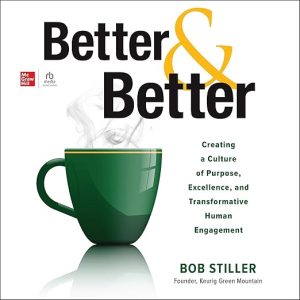
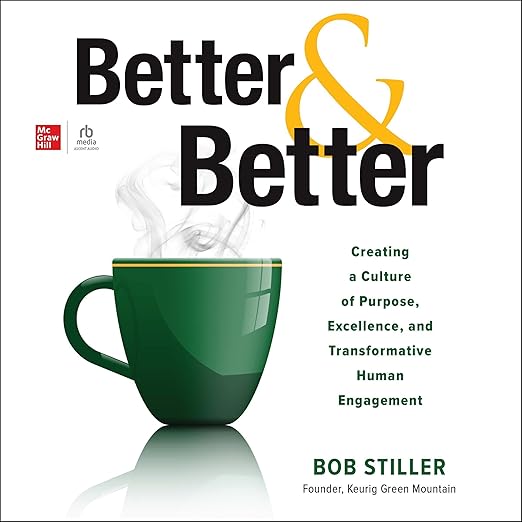
Green Mountain Coffee Roasters was, by the numbers, one of the best-performing stocks of the 1990s on the Nasdaq exchange. But Robert Stiller's Better and Better audiobook isn't primarily interested in the stock price. It's interested in explaining how a company that donated five percent of its pretax net income to social and environmental causes, paid employees to volunteer in their communities, and let staff decide how charitable donations would be allocated managed to become one of the few coffee companies ever to reach one billion dollars in sales. That combination is unusual enough to deserve serious examination, and Stiller provides exactly that.
Parks Narrates a Hybrid of Memoir and Case Study
The central argument is simple: genuine staff engagement - not the performed version that became a corporate buzzword, but the actual organizational belief that employees' input mattered and would be acted upon - produced better business outcomes than the conventional alternative. Stiller traces this through decades of decisions at Green Mountain, from the company's Vermont origins to the Keurig investment that transformed its scale and market position. The framework isn't complicated, but the consistency of its application across thirty-plus years is what makes it credible. Reviewer Greg M notes that "what resonates throughout the book was the relationship he cultivated with those that worked for/with him," and that relationship is documented in enough operational specificity that it doesn't feel like retrospective mythology.
Tom Parks narrates in a manner that suits the hybrid structure of the book, which moves between personal memoir and business case study without losing the distinctive quality of Stiller's voice. The founder's perspective is what makes this format work: Stiller isn't describing a culture he designed for others to implement, but the culture he spent years building with specific people and specific decisions. Parks keeps that personal register intact, which is the right call for a book whose argument depends on authenticity rather than abstraction.
From 280 Employees to Over 7,000
What distinguishes this from the broader business leadership genre is the specificity of the outcomes. Stiller doesn't claim to have discovered universal principles; he documents what actually happened over decades at a specific company. From 1995 to 2015, Green Mountain's stock had a 70 percent compounded annual rate of growth. The company moved to wholesale exclusively, made the Keurig investment at the right moment, invested in small farms and community lending, and sustained an unusually inclusive culture through those transitions. Reviewer Wade Houston notes that "Bob does an amazing job outlining the principles that created his massive success" while maintaining focus on making others' lives better - and the alignment of those two objectives is the real claim the book is making: that the social mission and the financial success were mutually reinforcing rather than in tension.
Reviewer Elizabeth Stanford, who worked at Green Mountain when it had 280 employees and remained through its expansion to over 7,000, adds valuable grounding. She confirms the culture worked at the smaller scale and describes how it had to adapt as the company grew - not as a failure of the model but as a natural evolution that required continuous reinvention. That honest account is consistent with Stiller's own narrative, which doesn't shy away from the challenges of sustaining a particular organizational culture through rapid growth. The book is stronger for including that complexity rather than presenting an unqualified success story.
EZ Wider, the Business Before This One
With fourteen reviews and a 4.7 rating, this is a relatively lightly reviewed title. The audience is narrower than the broader business self-help category - this is specifically for people interested in organizational culture, social responsibility as a business practice, and the particular history of Green Mountain and Keurig. Listeners looking for a universal framework book in the style of Jim Collins or Patrick Lencioni will find this more personal and more particular than that genre implies. That's a feature for the right reader and a limitation for the wrong one.
The book also covers the backstory of EZ Wider, Stiller's earlier business venture, which Greg M finds "great reading and extremely educational." That early history helps explain how Stiller developed his management philosophy before Green Mountain, but listeners primarily interested in the coffee company and the Keurig story may find the opening chapters more biographical than immediately relevant to their interest. The payoff comes as Stiller carries the values established early in his career through to the larger organizational challenges of Green Mountain's growth.
Making the Lives of Others Better
Business leaders and entrepreneurs interested in building inclusive organizational cultures with documented financial outcomes will find this a substantive case study rather than abstract principle. The Green Mountain story is specific enough that readers familiar with the company, the Vermont business community, or the single-serve coffee market's development will find additional texture beyond the leadership framework. Listeners looking for a quick-framework leadership book may find the narrative approach slower than expected; those willing to sit with a founder's full account of how a culture was built and sustained over decades will get considerably more from the seven-plus hour listen. Wade Houston's description - a book about "building wealth while at the same time focusing on making the lives of others better" - is accurate and the right signal for who this rewards. The seven-hour runtime provides enough depth to make the Green Mountain story feel genuinely illuminating rather than summarized.