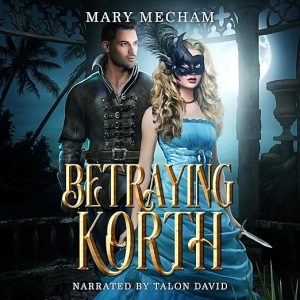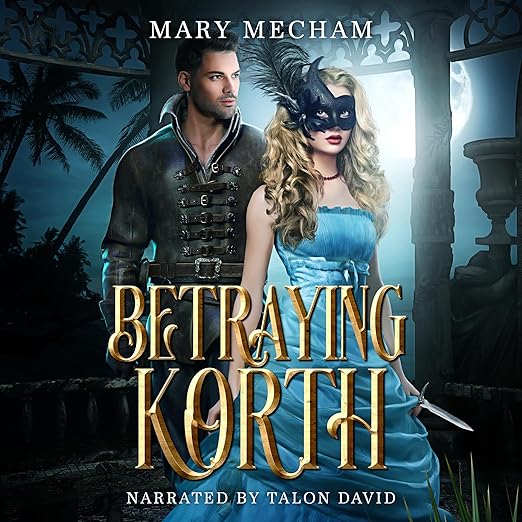
Dahlia knows her life is likely to end at the end of a hangman's rope, and this audiobook opens with her having already accepted that fact. The calculus that drives Betraying Korth from its first pages is not whether Dahlia will survive but whether the survival of her people can justify the price she is paying in deception. Spy narratives built on assumed identities are common across genres; what Mary Mecham adds to the structure is the specific moral weight of a woman who chose her betrayals deliberately, not out of weakness or confusion, and who then falls in love with the person she is betraying. Talon David's narration makes that distinction audible from the opening scenes, keeping Dahlia's self-awareness sharp even as her emotional situation grows increasingly untenable.
The plot arrives fully assembled: Dahlia is a handmaiden and a rebel spy. She stages a shipboard mutiny, forces Princess Odette to switch places with her, and arrives at Haven Harbor masquerading as the woman Korth expects to marry. Her objective is to secure Haven Harbor's loyalty for the rebellion against a tyrannical king. The problem, which is the entire book, is that Korth is not the convenient villain she anticipated. He is something more inconvenient: a decent man. Dahlia falling for him is not a weakness of the narrative but the narrative's actual engine, because it forces the question of whether her original moral calculus, treason for a just cause, holds up when the person she is betraying has done nothing to deserve it.
The Verdict, Briefly
Mecham's retelling of The Goose Girl, a lesser-known fairy tale that involves a princess forced to trade places with a servant, is thoughtful in how it inverts the moral valences of the original. In the source story, the deception is a wrong done to the princess. Here, the deception is a moral choice made by the rebel handmaiden, and the sympathies are firmly with her even as the narrative holds her accountable for what that choice costs everyone involved. One reviewer described Dahlia as a character who does the wrong thing for the right reasons, which is accurate and also explains why the audiobook's moral tension stays alive rather than resolving into simple adventure. Talon David keeps that ambiguity in Dahlia's voice throughout, resisting the temptation to signal whether she is hero or villain with vocal choices that would prejudge the question the novel is actually asking.
The romance between Dahlia and Korth is the central emotional relationship, and it works because Mecham gives Korth enough specificity to make the betrayal feel like a genuine loss rather than a narrative device. He is not simply the handsome obstacle; he has opinions, a code, a set of assumptions about the woman he thinks he is marrying that Dahlia must constantly navigate. David handles the Dahlia-Korth scenes with appropriate tension, making audible both Dahlia's growing emotional entanglement and her sustained awareness that everything she allows herself to feel is built on a lie he does not know she is telling.
Why Listen to Betraying Korth
This audiobook rewards listeners who want moral complexity in their YA fantasy rather than clean alignments. The rebellion is just, but Dahlia's methods are compromised by personal entanglement. The tyrannical king is clearly a villain, but the political consequences of succeeding or failing in Haven Harbor are not fully predictable from within Dahlia's limited vantage point. Mecham does not simplify the stakes, and David's narration does not simplify the emotional register. The mutiny sequence early in the audiobook, which one reviewer praised for achieving its goal without anyone getting hurt, is representative of how Mecham handles action: with the kind of problem-solving that reveals character rather than simply providing spectacle for its own sake.
The fact that Betraying Korth is the third book in the Legends of Neverland series while also being designed as a standalone is a meaningful feature for listeners approaching it without prior series knowledge. Mecham has built sufficient world context into the novel that newcomers can follow without confusion, while readers of the series will pick up on layers that deepen the experience. At over eight hours, the audiobook has room to develop its world without rushing the romance or the political plot, and David's pacing manages the two strands without letting either overshadow the other across the full runtime.
Points to Consider
Listeners who want swift action-forward narratives may find the emotional interiority of Dahlia's situation requires patience. Mecham is interested in what it feels like to live inside a lie you cannot abandon, and a significant portion of the audiobook's runtime is Dahlia navigating social and emotional situations that require her to maintain her false identity under pressure. If that psychological dimension is part of what drew you to the premise, the audiobook delivers it fully and consistently. If you came primarily for the rebellion plot, the romance may occasionally feel like it slows the political narrative in the middle section.
The ending resolves the central dilemma of Dahlia's identity, but listeners who finish this audiobook and want more of the Legends of Neverland world have additional books in the series available. Mecham's pattern across the series is consistent: fairy-tale structures used as scaffolding for narratives that care about moral agency and the consequences of deception as much as they care about romance. David's narration across the full eight hours sustains investment in both dimensions without letting the listener forget that this is, at its core, a story about what it costs to make an impossible choice.
The Right Listener for Betraying Korth
YA fantasy listeners who want their romance tangled in genuine moral stakes, and who enjoy fairy-tale retellings that do more than update costumes, will find Betraying Korth among the stronger entries in that crowded subgenre. Listeners who have encountered The Goose Girl in other versions will find Mecham's inversion of its sympathy structure particularly satisfying and inventive.
Listeners who prefer action-first YA fantasy with clean moral alignments may find Dahlia's sustained moral ambiguity frustrating rather than compelling. The audiobook is fundamentally a character study built around an impossible situation, and Talon David's performance requires you to sit with Dahlia's discomfort rather than moving past it. If that kind of sustained psychological tension sounds like a feature rather than a flaw, this audiobook is worth every minute of its eight hours.
Can I listen to Betraying Korth as a standalone audiobook without reading the first two Legends of Neverland books?
Yes. Mecham designed this as an entry point as well as a series continuation. The audiobook provides enough world context that listeners without prior series knowledge can follow the plot and characters without confusion, though series readers will find additional resonance in certain references.
Does Talon David's narration work for Dahlia's first-person perspective, given the sustained deception she is maintaining?
Yes. David keeps Dahlia's dual awareness legible throughout: you hear both the performance she is giving to those around her and the private reckoning she is conducting with herself. That distinction is load-bearing for the audiobook's emotional effect, and David handles it consistently.
How does the romance between Dahlia and Korth develop in this audiobook, and does it overshadow the political plot?
The romance and the rebellion plot are intertwined rather than competing. Dahlia's growing feelings for Korth directly complicate her mission, so the romantic development is also political development. Mecham keeps both strands active across the eight-hour runtime without sacrificing one for the other.