Rudi takes photographs and Peter acts, and for most of their lives that has been an unequal arrangement, with Peter getting the light. Their parents divorce, the twins end up in different sectors of the city, and then one night in 1961, while Berlin sleeps, a wall goes up through the middle of everything. Vesper Stamper's audiobook runs thirteen hours and twenty-three minutes, which is long for a title shelved under teen fiction and about right for what it is actually carrying.
Twins are a blunt device for a partitioned city and Stamper appears to know it, which is why the book keeps refusing the neat version. Rudi is the one who toes the line and does what is best for the party, and he is sick of living in his brother's shadow. Peter is the golden child with things landing in his lap, an aspiring actor who falls in with an underground cabaret and starts to understand what is really going on around him. That reversal, the obedient brother turning inward while the favored one gets radicalized by a nightclub, is the engine, and a four-star entry filed in the release week lays it out in exactly those terms.
What the copy calls a stark look at how resentment and denial can strain the bonds of brotherhood is not marketing overstatement. The Berlin material is researched hard enough that the family plot never floats free of it, and the divorce arrives before the wall does, so the political partition lands on a household that has already split along the same seam. Sequencing it that way is the choice that makes the novel work rather than merely resonate, and it is why the book can spend thirteen hours on two brothers without the history turning into backdrop.
Clifton Duncan reads it. Nothing in the written column addresses how the recording sounds, so the honest thing to describe is the load rather than the delivery: two brothers who have to be audibly separable while still sounding related, a family name the publisher's copy prints as Möser-Fleischmann and one written response renders as Moeser-Fleischmann, and a steady supply of East German institutional acronyms recurring across a very long file. One voice covers all of it, with no cast behind the microphone.
Why It Works in Audio
Prior knowledge is the variable that decides how this lands, and a five-star from March 2024 is unusually precise about why. That entry describes handing the book to a twelve year old who reads constantly and watching it go wrong: the story assumes a working understanding of East and West Germany, of communism and of the cold war, and it stacks up abbreviations for party bodies without stopping to gloss them. The adult in the same household read it afterward and loved it. One book, two readers, and the gap between them was background rather than reading ability.
Audio sharpens that problem, and the publisher has partly answered it. The record includes a downloadable PDF of a glossary and resources drawn from the book, which is the right fix for a text whose difficulty is vocabulary rather than syntax. Acronyms are the specific hazard here. Heard rather than seen, a string of initials arrives as noise, and no page is available to glance back at. Anyone starting this without German history already in the tank should open that PDF first rather than third.
Across those thirteen hours the payoff is a period the medium handles unusually well. Cabaret, radio, rehearsal, whispered arguments in stairwells, official language against what people say once the door is shut: this is a story built out of talk and performance. Stamper's twins are a photographer and an actor, so one of them is always watching and the other is always projecting, and both of those jobs come through cleanly in sound. Listening Library issued the file in October 2022, and it has aged into the sort of backlist a history teacher recommends.
Before You Commit to Berliners
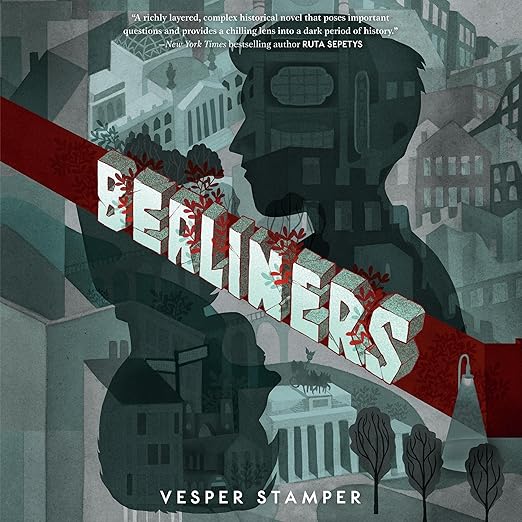
Illustration is the loss, and the page never mentions it. A five-star filed in December 2022 counts twelve illustrations, calls them beautiful and moving, and credits them with a real share of the imaginative work the book does. Stamper is described in the copy as an author-illustrator, so those images are part of the design rather than decoration. The companion PDF is advertised as a glossary and resources, not as an art file, which means a listener should assume the pictures are not coming along.
A February 2023 response makes the same point from the other side, recommending the novel warmly and then noting the effect is stronger still if you own a physical copy with the artwork in it. That same entry refers to the book as The Berliners throughout, which is not the title on this file, and a definite article is enough to send a search somewhere else. Two of the five written responses are therefore partly assessing an object this format does not deliver.
The badge reads 4.8 across forty-one ratings, with five written entries attached, four at five stars and one at four. Nothing in those numbers is out of line, and a column that small on a title three years old is normal for a literary young adult release. The shelving is the thing to weigh instead. Category says teen and young adult, tag says history and culture, and the copy cites National Book Award recognition for the author without hinting that the reading level runs well above the age band the record files it under.
Who Will Get the Most From It
Two audiences split cleanly here. Listeners who already carry the cold war around with them, or adults who read young adult fiction without apology, get a dense and unusually well-built historical novel, and they should treat the age category as a filing accident rather than a warning. A January 2025 entry sums that reading up as a good walk back through time. At thirteen hours and twenty-three minutes it is a long walk rather than a sampler, and it rewards the commitment.
For a younger listener the honest answer is that everything depends on preparation. A teenager who has studied the period will be fine; a teenager who has not will be lost inside an hour, and no reading, however good, changes that arithmetic. Buyers who want the illustrated Stamper experience should choose the printed edition instead, since the artwork is a real part of what the enthusiasm on this page is responding to and it does not travel into a file. Everyone else can start with the glossary open and enjoy one of the better wall novels written for any age.
- Narrator: One voice, thirteen hours, and a glossary PDF supplied precisely because the text never stops to explain its own vocabulary.
- Subjects: divided Berlin, sibling rivalry, complicity and denial, art under surveillance
- Tone: Somber and tightly wound
- Bottom line: Excellent historical fiction filed on the wrong shelf, best bought for a listener who already knows what the wall was for.
Does the Berliners audiobook include the artwork?
No, and nothing on the listing suggests otherwise. The only supplementary file named is a PDF carrying glossary and resource material. Buyers who want the drawings will need the printed edition, where those images were designed to sit against the text rather than to be described in it.
Who narrates it, and what is the runtime?
Clifton Duncan does the reading, across thirteen hours and twenty-three minutes. Listening Library published it on October 25, 2022. That length sits well above the average for the teen and young adult category, which is a fair early signal of how much this book expects from a listener.
What age is this audiobook actually pitched at?
The record states no age band beyond its teen and young adult category. The setting is Berlin in 1961, the vocabulary includes East German institutional acronyms, and the glossary PDF exists precisely because the text does not stop to explain itself. Treat it as upper-teen and adult crossover material.