In Brief
- Voice: Mae Martin and Sabrina Jalees performing their own friendship conversations brings a quality of genuinely unscripted chemistry that no studio casting could replicate.
- Big ideas: Friendship intimacy and hard conversations, money, gender and kink, shame and honesty
- Atmosphere: Candid, funny, and surprisingly vulnerable
- Worth it?: A comedy duo audiobook that uses humor as an entry point to conversations about friendship depth that most people are having with no one.
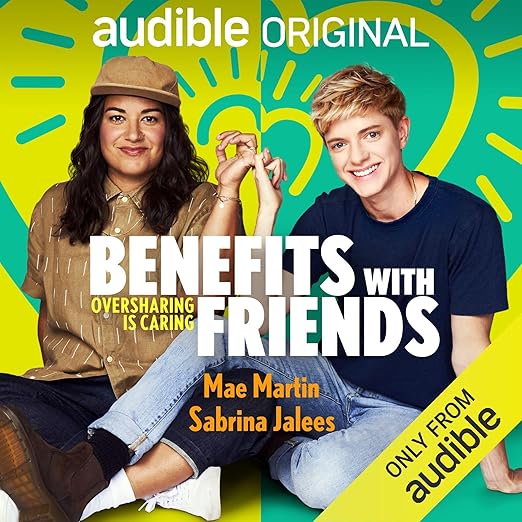
The context for Benefits with Friends is a cultural observation that Mae Martin and Sabrina Jalees make directly and without apology: we have extensive guidance for the conversations romantic partners should have before committing to each other, but virtually none for the conversations best friends should be having to truly understand one another. The audiobook, which runs just under five hours and features both Martin and Jalees performing what are essentially their actual friendship conversations, is built around that gap. The result functions partly as comedy and partly as a genuine exploration of why the topics we avoid in polite company are exactly the ones that determine whether a friendship has real depth or simply comfortable familiarity.
Martin, who is known internationally for the semi-autobiographical series Feel Good, and Jalees, known for Roast Battle and over two decades of stand-up, have been close friends for more than twenty years. That longevity matters for how this audiobook works. The conversations here are not performed intimacy between collaborators who are professionally comfortable together. They are the real thing, and the audio format lets the listener into a friendship dynamic that has actual history and friction and affection behind it. The candor that results from that history is the audiobook's primary resource, and it is the thing that distinguishes Benefits with Friends from the large and growing category of comedy conversation content.
The subject matter coverage is worth noting specifically: money, gender, parenting, kink, and shame are the headline topics, and each is handled with the combination of humor and genuine curiosity that distinguishes a good comedy discussion format from simple entertainment. Martin's public persona is built on a willingness to examine her own experience without defensiveness, and that quality is fully present here. Jalees brings a counterpoint sensibility that keeps the conversations from being simple agreement sessions between two people who already think the same way. There is real pushback, real surprise, and real discovery in how each host responds to the other's framing of a given subject, which is what separates this audiobook from scripted comedy content regardless of how naturalistic the scripting might be.
The explicit content advisory is worth taking seriously. Benefits with Friends discusses sex, kink, and adult content with the frankness you would expect from two comedians who have built careers on not flinching from difficult material. The humor is not there to defuse the content but to enable more direct engagement with it. Martin's particular skill is finding the joke that opens a subject rather than closes it, and that skill is applied consistently throughout the nearly five-hour runtime. The result is an audiobook that covers genuinely taboo territory while remaining approachable for listeners who might not otherwise engage with it.
Five Hours That Only Work as Audio
The audio format is essential to this material in a way that is worth being clear about. Benefits with Friends is not a book that would translate to print without significant loss, because the friendship dynamic, the timing, the moments where one host surprises the other, and the quality of actual laughter in the room are all load-bearing elements of the experience. This is a conversation captured in audio, and the medium is native rather than adapted. The nearly five-hour runtime reflects the extended, exploratory quality of conversations that take their subjects seriously rather than rushing through them to hit a word count.
The value proposition for the listener is both entertainment and a kind of permission structure. Hearing two people who have been close friends for twenty years wrestle openly with money anxiety, gender identity, shame around sex, and the complications of thinking about parenting normalizes conversations that most people feel they are the only ones not having. Martin and Jalees are funny, but the comedy is doing something useful: it is making it easier to sit with discomfort rather than explaining the discomfort away or rushing past it toward a resolution that would be tidier but less honest.
Shame Becomes Audible in Jalees's Responses
The chapter on shame is where the audiobook reaches its most substantive territory. Martin's willingness to discuss shame around desire and identity directly, without turning it into either a confessional or a comedy bit, is a difficult tonal achievement and one that benefits significantly from the audio format. You can hear when the conversation shifts register, and Jalees's responses in those moments are some of the most genuinely interesting listening in the whole audiobook. The dynamic between their two voices becomes most itself when the material is hardest.
Listeners expecting a traditional comedy performance recording will need to recalibrate. This is a conversation audiobook, not a stand-up set or a scripted comedy narrative. The humor emerges from honesty rather than being constructed around it. The distinction is subtle but real, and understanding it going in will help listeners get the most from the format. The money chapter is an excellent illustration: the jokes about financial anxiety are funnier because they are coming from an actual conversation about what Martin and Jalees actually worry about, not because they were written to maximize laughs at a preselected target.
Close Friendships Having Their Hardest Conversations
This audiobook is for listeners who have a close friendship that has lasted long enough to carry the weight of difficult conversations but who have somehow never gotten around to having them, and who want both the model and the permission to start. It is also genuinely entertaining for anyone who enjoys Mae Martin's comedy sensibility, Sabrina Jalees's sharp intelligence, or the specific genre of best-friend-conversation content that creates intimacy through honesty rather than through performance of closeness. The explicit content advisory should be taken seriously: this is not appropriate for children or for listeners who prefer comedy that stays away from frank discussion of sexuality and adult relationships. For everyone else, this is nearly five hours of conversation that is simultaneously funnier and more substantial than its premise suggests.