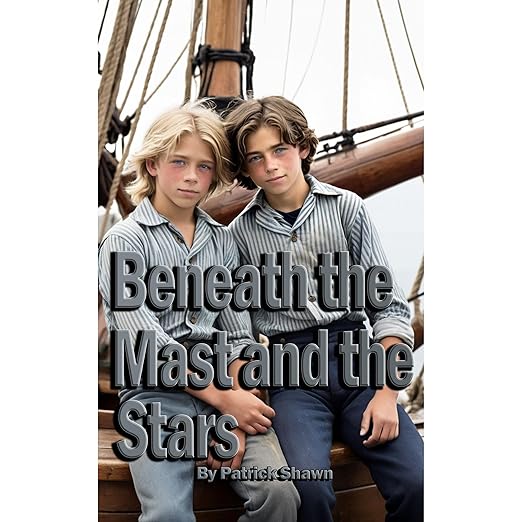
- Themes: forced naval service, first love under pressure, class distance between two boys, survival at sea
- Mood: Earnest and steady, a plain historical adventure with a quiet romance inside it
- Verdict: The premise is genuinely uncommon, and a synthetic reader across all seven hours and thirty-six minutes is the price of admission.
Virtual Voice is the credited reader, and that one line in the credits tells you more about this audiobook than the rest of the page combined. Not an actor. Not the author. A synthetic voice working through seven hours and thirty-six minutes of a story about a twelve-year-old and a thirteen-year-old pressed into naval service aboard a British ship in the late 1800s. Knowing that before you start is the difference between a fair expectation and a disappointment, because nothing else on the listing prepares you for it.
Seven hours and thirty-six minutes is a long stretch of machine reading. Synthetic delivery handles plain declarative narrative reasonably well, and much of this story is plain declarative narrative: a ship, a routine, a war. Where the format has its hardest job is precisely where the book lives, in two young voices separating themselves inside a cramped bunk, in the pitch of fear during a battle, in the hesitation before a first admission. None of that is a prediction about this particular file, which nobody has described. It is what the credit asks a buyer to weigh.
Two ratings support the 4.0 badge, and neither voter wrote anything at all. The arithmetic is at least clean: two votes carrying eight stars between them out of a possible ten, so either a pair of fours or a five beside a three. Two stars short of a clean sweep, in other words, with no explanation attached to the shortfall. What those two listeners responded to, whether the writing, the premise, or the reading itself, went unrecorded, and the page offers no other listener testimony to set beside them.
The Best Parts of Beneath the Mast and the Stars
Patrick Shawn has picked a setting the LGBTQ+ young-adult shelf does not often reach for. The lower deck of a British warship in the late 1800s puts two boys in forced proximity, in constant physical danger, inside a hierarchy that grants them no privacy and no way out. Wyatt arrives from a struggling tenant farm and Jack from the streets of a seaport, and the description is explicit that both are pressed into service rather than volunteering. That premise generates tension without needing a villain, and it hands a first-love story stakes no school corridor can supply.
Independently Published fills the publisher line, which means no editorial house sat between the manuscript and the recording. The description carries the evidence in plain view: Jack, 13, is a orphan. A dropped article in the copy meant to sell the book is small, and exactly the sort of small thing a desk catches. Adjust expectations accordingly, not because self-published historical fiction is weak by default, but because every decision here, from line editing to the choice of a synthetic reader, sits on the author's side of the desk.
Wyatt and Jack start as strangers sharing a bunk neither chose, and the description has them bonding over harsh training and the demanding sea before anything romantic surfaces. Ordering matters in a book like this. Friendship first, formed under pressure, with the romance arriving as a discovery rather than a premise, is the structure that lets a story of this kind work for younger listeners as well as older ones. Seven and a half hours leaves room for that development, and the copy promises warfare alongside the romance rather than in place of it.
Before You Commit to Beneath the Mast and the Stars
Ages are the first thing to check. Wyatt is twelve and Jack is thirteen, which puts both protagonists in middle-grade territory while the listing files the recording under teen and young adult. A first romance between a twelve-year-old and a thirteen-year-old is a different proposition from one between sixteen-year-olds, and the horrors of warfare are promised in the same paragraph. Adults choosing for a younger listener should read the whole description rather than trusting the shelf label, because label and character ages point in slightly different directions.
Historical texture is the second open question. The copy commits to the late 1800s, a British naval ship, harsh training, and two boys pressed into service, and it commits to nothing further: no named conflict, no named port, no named vessel. Whether the book fills that in convincingly or settles for generic sea-story furniture, nobody who has listened has said. With two ratings and zero written responses, a buyer is working entirely from promotional copy composed by the same person who wrote the novel.
February 20, 2026 is the release date, so this is a recent listing rather than a neglected one, and two ratings across that span says more about discoverability than about quality. A book with no house behind it has no review push behind it either, which makes the empty column close to what anyone would expect. Read it as an absence of evidence rather than as evidence of a problem, and give the description more weight than you normally would, since it remains the only account of this book that anybody has written down.
Machine narration will decide this one for most people, and the trade deserves blunt statement. A synthetic reader never fumbles a name, never runs out of breath, and will carry you through the plot without incident. It also does not act. In a book whose emotional core is two boys working out what they feel, in a setting where the surrounding adults are meant to register as a threat, that levelling is not cosmetic. Anyone who buys audiobooks primarily for performance should treat the credit as the deciding fact and stop there.
Should You Listen to Beneath the Mast and the Stars?
Queer coming-of-age fiction set below decks in the 1800s, told without a school, a phone, or a coming-out scene, is genuinely hard to find. Readers who have been hunting for exactly that will care far more about the premise than about who reads it, and they are the ones this rewards. One straightforward narrative line and two protagonists also make for an easy listen to follow while your hands are busy, which suits synthetic delivery considerably better than a densely voiced novel with a large cast would.
Hold off if performance is what you buy audiobooks for, or if you want a review column to lean on before committing seven and a half hours. Listeners who need a human reader have nothing to weigh here, because the credit settles the question before chapter one. Two ratings and a machine reader are what this listing actually offers, and going in knowing that is worth more than anything in the description.
Before You Listen
Who reads the Beneath the Mast and the Stars audiobook?
The credit reads Virtual Voice, which is a synthetic reader rather than a person. Across seven hours and thirty-six minutes that means consistent pronunciation and no acting whatsoever: character distinction, emotional shading, and the gap between Wyatt and Jack in dialogue all arrive in a single register. Weigh that before buying.
Does this audiobook finish on its own or continue into a sequel?
No series name and no volume number appear anywhere on the listing, and the description closes on the two boys fighting to protect what they have found rather than on an unresolved hook. Everything visible points to a self-contained story, though only Patrick Shawn can confirm whether more is planned.