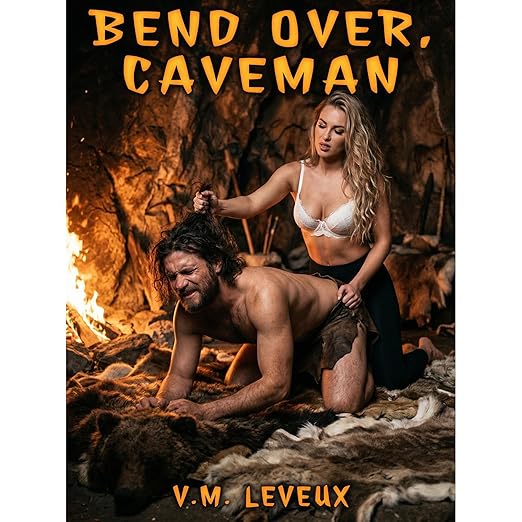
Dr. Valerie Paris studies time travel for a living, which is how a frustrated physicist ends up stranded in the Palaeolithic era and, improbably, exactly where she needs to be. Bend Over, Caveman is a short, explicit audiobook, just over an hour long, built around a single premise: a caveman skilled at carving stone 'tools' who turns out to have an equally specific talent for submission.
Stone Tools Are Only Half the Pun
The synopsis is refreshingly direct about what's on offer, an eleven-thousand-plus-word short story pitched as 'an erotic adventure into prehistoric pegging and female empowerment,' with an explicit content warning attached rather than left for the listener to guess at. It's the opening entry in The Valerie Paris Adventures, and the listing itself flags it as a new and improved edition.
The one available review captures both the appeal and the limitation in a single line: 'Great plot and was well written with just a few minor errors and need a bit more editing,' the reviewer writes, before adding, 'Starts with a very obnoxious DR and no action just a lot of lusting.' That's a fair, specific assessment of a short-form premise that spends real time on setup before delivering its central scenario.
Short, high-concept erotica built around a single vivid premise is its own small, established corner of independent publishing, where the appeal rests entirely on how specific and well-executed the central scenario is rather than on plot complexity or a sprawling cast. The title itself does real work here too: 'tools' in quotation marks in the synopsis is a clear, playful signal of the pun running through the whole premise, a caveman literally skilled with stone tools whose other talents turn out to be considerably more contemporary.
A genuine comic tension is built into the premise itself: Dr. Paris is a physicist, someone whose entire professional identity rests on rigor and control, and the synopsis frames her Palaeolithic detour explicitly as a discovery of her 'wild side,' the loss of that same control turning out to be exactly what she's been missing. That contrast between scientific precision and primal chaos is a genuinely clever hook for a female-empowerment framing, even within a short, explicit format.
Take the 'female empowerment' framing seriously rather than reading it as marketing boilerplate; Dr. Paris isn't rescued or seduced into the encounter, she initiates and directs it, and the caveman's eagerness to submit is presented as his own specific desire rather than something she has to coax or overcome. That structural choice, agency flowing outward from the female lead rather than toward her, is the actual mechanism behind the empowerment claim.
The Palaeolithic setting is a deliberate choice rather than a random one for a physicist protagonist; it's about as far from her own precise, controlled discipline as human history offers, which makes the era itself part of the fantasy, not just scenery for the encounter to happen in front of.
Narration Struggles With Vocal Warmth and Rhythm
The narrator credited here is Virtual Voice, meaning this is synthetic, AI-generated narration rather than a human performer. That's a genuine limitation for erotica specifically; the genre depends heavily on vocal warmth, timing, and interpretive nuance to sell tension and intimacy, and synthetic delivery has consistently struggled to replicate that across similar titles. Expect competent, intelligible narration without the vocal color a skilled human narrator would bring to a premise this specific.
What the format does offer is convenience for a genuinely short, single-sitting listen. This kind of novella is built around a premise clear enough to fit in a title and delivered fast, and this book fits that convention exactly: one hour and four minutes, one central scenario, no padding toward a longer arc.
This fits a well-established pattern across similarly formatted titles: synthetic narration tends to handle plot mechanics and dialogue intelligibly enough, but struggles specifically with the vocal warmth, teasing rhythm, and interpretive timing that make explicit content land as playful rather than clinical. Listeners who've found Virtual Voice narration workable for other genres should expect a more noticeable gap here.
At just over an hour, the narration doesn't have much room to build the kind of slow tension a longer synthetic-narrated title might struggle to sustain across many hours; the format's limitations are less exposed here simply because the listen itself is so brief.
Labeled New and Improved After Feedback
The one review on record specifically flags pacing problems: the ending feels hurried, and the opening spends real time establishing Dr. Paris as, in the reviewer's words, 'obnoxious,' before the actual premise kicks in. If you're coming for the central scenario specifically, expect some setup before you get there.
The content warning in the synopsis is worth taking at face value rather than skimming past: spanking, anal play, strap-ons, and primitive sex toys are all named directly, alongside female dominance as the organizing dynamic. This is explicit content by design, not implied or fade-to-black.
The 'new and improved edition' label in the synopsis suggests the author revisited the story after its initial release, likely in response to feedback similar to what's captured in the one review on file, pacing and editing concerns rather than anything about the core premise itself. That's worth knowing if you're deciding between editions or wondering whether critical feedback has already been addressed.
Short-form erotica revisions like this one typically respond to exactly the kind of feedback captured here, pacing complaints and requests for a fuller emotional arc, since a single-scenario novella has very little room to fix structural problems without a genuine rewrite rather than a light copyedit.
Pegging and Female Dominance in a Novelty Setting
Readers specifically seeking pegging and female-dominance content wrapped in a novelty prehistoric setting, and anyone who wants a fast, single-sitting listen without a longer plot commitment, are the clear audience for this one.
Readers newer to pegging-focused erotica specifically, curious but not yet committed to the kink, may find the short runtime a genuinely low-risk way to sample the dynamic before investing in a longer title.
For readers already fluent in the pegging and femdom subgenres specifically, the novelty prehistoric setting offers a fresh backdrop for familiar dynamics without requiring investment in an unfamiliar world beyond the premise itself.
It's a reasonable pick, too, for anyone specifically curious how a premise this narrow, one setting, one central act, sustains reader interest across even a short runtime, since the mechanics of that sustained tension are really the whole craft question the one review is responding to.
A story with real plot development and slower-building tension is not what's on offer here; anyone wanting more than a fast, single-scene premise, per the one review available, should look toward a longer entry in the same subgenre instead.