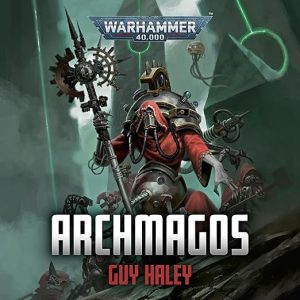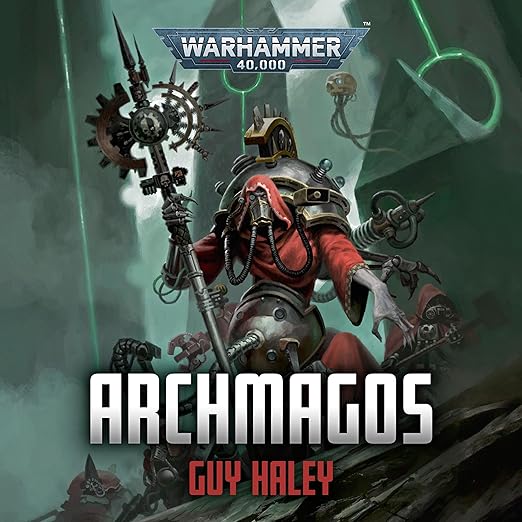
Belisarius Cawl stands as one of the most compelling figures in the current Warhammer 40,000 narrative, and Guy Haley's Belisarius Cawl: Archmagos gives him the extended treatment his character demands. This audiobook enters at a specific, high-stakes moment in the 41st Millennium: Cawl, the self-described greatest mind of his age, has developed a plan to stabilize the Attilan Gap and allow safe passage through the Cicatrix Maledictum - the great rift that split reality and isolated Roboute Guilliman on the far side. John Banks narrates across ten hours and fifty-one minutes, which is as close to ideal casting as this universe permits for a character of this complexity.
The mission driving the novel is characteristically audacious: to retrieve control codes preserved on a necron tomb world trapped at the event horizon of a black hole. The physics alone would stop most Adeptus Mechanicus operatives in their tracks. Cawl recruits help from across his organization and proceeds anyway, because in Haley's characterization, Cawl's genius is inseparable from his willingness to attempt what others deem impossible - and equally inseparable from his blindness to the attention that audacity attracts from malign forces watching for exactly this kind of overreach.
The Vashtorr the Arkifane thread introduces a threat operating at a different register from the necrons. Where the ancient xenos are cold and implacable, Vashtorr is actively interested in Cawl's work, and that interest is not flattering. Haley structures the novel so that Cawl's greatest success becomes the moment of his greatest exposure - the kind of narrative irony that suits a character whose confidence in his own judgment has historically been both his greatest asset and his most significant vulnerability. The setup for what follows in the broader Warhammer 40,000 narrative is handled with economy, without sacrificing the present story's completeness.
What Makes Belisarius Cawl: Archmagos Worth Hearing
John Banks's narration is a significant factor in how well this audiobook functions. Banks has narrated extensively within the Warhammer fiction catalog and brings to Cawl the specific combination of layered complexity, slightly inhuman precision, and suppressed magnitude that the character requires. Cawl is not a straightforward narrator subject: he is ancient, multiply-backed-up, simultaneously arrogant and genuinely capable, and his internal voice reflects all of that. Banks does not simplify the character into an accent or a vocal tic; he conveys the sense of a mind operating on multiple simultaneous tracks, which is exactly what the character demands.
The necron sections are handled with the kind of measured, otherworldly delivery that distinguishes strong 40k audio from adequate work in the genre. The necrons are not simply antagonists; they are ancient intelligences with their own logic and history, and Haley's treatment of their perspective gives Banks something to work with beyond generic menace. The one available review describes the novel as an okay story without major surprises - a minority view given the 4.5 rating - and likely reflects a listener expecting escalating revelation rather than the character-driven mission narrative Haley and Banks actually deliver.
Things to Know Before Starting Belisarius Cawl: Archmagos
Listeners new to Warhammer 40,000 fiction should know that Belisarius Cawl: Archmagos is not a starting point for the universe. The novel assumes familiarity with the Great Rift, the Adeptus Mechanicus, necron factions, the primarchs, and the political situation of the Imperium in the post-Gathering Storm period. Readers who have engaged with Haley's earlier standalone Cawl novel, or with the Gathering Storm narrative material, will be well-positioned. Those entering the 40k universe for the first time should find an earlier and more accessible entry point before committing to this volume's specific lore density.
Haley's approach to Cawl involves letting the archmagos be genuinely wrong about things while still being genuinely brilliant, which is harder to write than it sounds. The novel does not tip into either hagiography or deflation. Cawl's plan is audacious and largely succeeds, but the attention he attracts from Vashtorr is a cost he did not fully account for, and Haley makes clear that even the greatest mind in the Imperium operates within limits he cannot always see. That character honesty gives the novel weight beyond its function as a lore-building exercise in the ongoing 40k narrative.
Who Guy Haley Is Writing For
Warhammer 40,000 readers following the current lore arc - particularly those invested in the aftermath of Gathering Storm, Guilliman's return, and the Cicatrix Maledictum narrative - will find Belisarius Cawl: Archmagos a detailed and satisfying expansion of Cawl's role in events. Fans of Haley's other work in the 40k universe will recognize his character-focused approach and find it applied here with particular care for the specific strangeness of Cawl as a protagonist. Listeners new to 40k should begin elsewhere. Those deterred by the single available review's note about lack of major surprises should know that Haley's priorities are character depth and lore coherence rather than shocking reversals, and the audiobook delivers exactly what it sets out to achieve.
The ten hours and fifty-one minutes runtime is appropriate for the scope Haley is working with: Cawl's mission to the necron tomb world, the assembly of his team from across the Adeptus Mechanicus, the necron resistance, and the emergence of Vashtorr's interest all require room to develop without compression. Haley does not write 40k fiction that can be rushed. His attention to the specificity of the universe - the particular texture of Mechanicus ritual, the precise character of necron intelligence, the distinct quality of Chaos-adjacent threat - makes each scene register as belonging to the 41st Millennium rather than generic science fiction with 40k terminology overlaid. Banks's narration honors that specificity, and the combination is why this entry in the expanding Cawl narrative works as well as it does.
At a Glance
- Voice: John Banks is one of the most experienced narrators in the Warhammer 40,000 audio catalog, and his voice suits Cawl's fractured, ancient intellect in ways that characterize rather than merely deliver the prose.
- Big ideas: Singular genius against impossible odds, ancient machine intelligence versus the forces of Chaos, the cost of audacity in a dying universe
- Atmosphere: Dense and atmospheric, with the cold grandeur of 40k lore balanced against the tight urgency of a single high-stakes mission
- Worth it?: Belisarius Cawl: Archmagos is a rich Warhammer 40,000 audiobook that rewards listeners already invested in the setting, with Banks's narration elevating Haley's complex protagonist throughout.