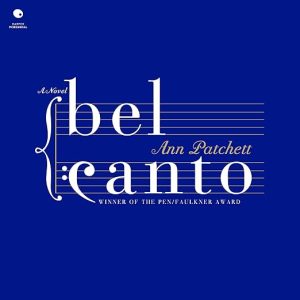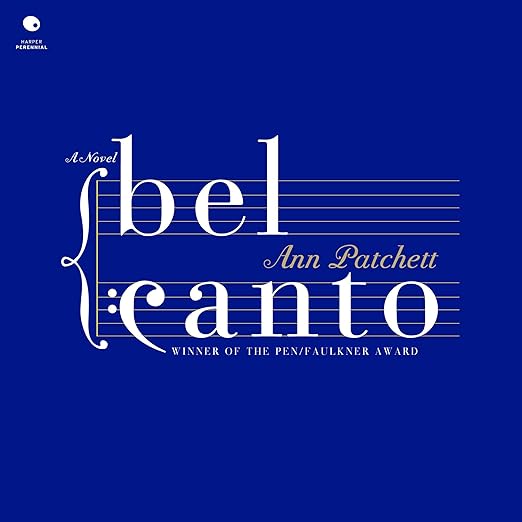
A novel built around a soprano's voice ought to be the easiest case in the world for an audiobook, and this is exactly that novel: a hostage crisis in which the singing keeps everybody alive. Anna Fields reads eleven hours and twenty minutes of it. Whether the recording delivers on that premise is the one question this listing cannot answer, because none of the seventeen people who voted, and none of the five who wrote, addresses the reading at all.
Opera is not decoration here. The description places Roxanne Coss, called opera's most revered soprano, at a birthday party for the businessman Mr. Hosokawa somewhere in South America, and the party is taken hostage by gun-wielding terrorists. What follows turns from panic into something else entirely: captors and captives forming bonds, people from different continents becoming compatriots, intimate friends and lovers. Singing is the mechanism by which that shift happens, which puts unusual weight on how a recording handles the passages describing it. Print leaves that music to the imagination; audio invites a comparison the text never asked for.
Patchett collected the PEN/Faulkner Award and the Orange Prize for this one, was a National Book Critics Circle Award finalist, and the listing adds a New York Times readers' pick for the top hundred books of the twenty-first century. That is a heavy load of decoration for a page filed under romance. The awards line also dates the copy: a top-hundred-of-the-century list is a recent addition, while the recording itself went out in August 2004, so the description has been revised around a book that has not changed.
Harper appears as the publisher on an audio listing, which is a print imprint's name rather than an audio label's, and the description carries the marks of the same origin. A Washington Post Book World pull-quote arrives wrapped in doubled quotation marks. Two words are fused together where the formatting collapsed, so a sentence about lyrical prose and lucid imagination runs straight into the title without a space. None of that affects the recording, but it does tell you the page was assembled from print material rather than written for this edition.
Why Listen to Bel Canto
Rebel gurillas is how one response spells the antagonists. Another calls them a band of gorillas in a foreign country. Two readers, both posting in early 2026, turned guerrillas into a word meaning something else entirely, and both entries otherwise describe the book accurately. Small, and revealing: this is a novel of atmosphere and feeling far more than of incident, and the people responding to it are recalling how it felt rather than what precisely happened in it.
Anna Fields is the credited reader, alone, for the whole eleven hours and twenty minutes. One voice has to carry an international cast: a Japanese businessman, a revered soprano, and a house full of guests from several continents along with the people holding them. Solo narration of a book whose subject is strangers failing and then managing to understand one another across languages is a genuine test of a reader. Beyond that one name the page offers nothing at all, which leaves a single credit doing every bit of the persuading.
Romance is the genre this page assigns, with Multicultural as its only tag. Both are defensible and both mislead. A romance does develop, and the copy closes on transcendent romance, but a browser filtering by that genre will arrive expecting a courtship and find a siege that runs for months. The five responses call it a hostage situation, a story about bonds formed under strain, and a novel with a huge twist at the end. The word romance appears nowhere in the column.
What to Watch For in Bel Canto
Seventeen votes sit behind the 4.3 this page displays, and five of them came with text. That is a modest average for a novel carrying this many prizes, and the written responses show where it comes from. Three are unreserved. One awards four stars while objecting that the endings are always strange with this author. One awards three, says the plot drags while the relationships form, and then reports a huge twist. The reservations cluster on the same place: how it finishes.
Chappy's four-star entry is barely about this book at all. It says the endings are always weird with Patchett, that the reader goes on reading her books regardless, that the nonfiction is better, and that Tom Lake was the exception. That is a verdict on a career, filed under one title, and it is the most useful line in the column for anyone who has read Patchett before. For anyone who has not, it says nothing about whether this novel works, only that a returning reader keeps returning with reservations.
Nobody has written about how this one sounds, and on this particular novel the gap is loud. Five people describe the plot, the characters, the ending and the author's other work; the soprano at the center of the story reaches every one of them as description on a page rather than as sound. A book about what a voice does to a room full of frightened people is being judged here purely as text. Choosing the audio edition means making a bet the column has never tested.
Recommended For
Newcomers to Patchett get an entry point three five-star responses endorse without reservation, one of them calling it a lovely, warm and intimate tale full of marvelous, complex characters, in a format that suits long conversations and slow accumulation. Opera knowledge is not required, and one response, from a self-declared opera fan, makes a point of saying so. A closed setting, a large multilingual cast and months of enforced proximity is the specific combination that rewards listening over reading, because the voices stay in the room with you. Long stretches of dialogue with few scene changes are exactly what a solo reader handles best.
Whoever needs a plot that moves should heed the three-star entry, which found the middle slow while the relationships take shape. So should anyone who wants an ending resolved, since two separate responses flag the finish as weird or as a huge twist. Filed under romance, awarded the PEN/Faulkner, issued on audio by a print imprint in 2004: this page contradicts itself at almost every field. Anna Fields carries all eleven hours and twenty minutes of it, and no listener here has said a word about how.
- Performance: Anna Fields reads the full eleven hours and twenty minutes solo, one voice for a house of guests from several continents and the people holding them.
- What it covers: Hostage siege, opera and communication across languages, unlikely intimacy under pressure.
- Feel: Hushed, warm, slow-burning.
- Our call: A prize-winning novel filed under the wrong genre, with the recording itself untested by anyone on the page.
Questions Listeners Ask
Is the Bel Canto audiobook really a romance?
The listing files it that way, and the copy closes on transcendent romance, but the story is a months-long hostage siege in which bonds form between captors and captives. Not one reader in the column reaches for that word. Expect a siege novel with love inside it rather than a courtship.
Does one narrator handle the whole international cast?
Eleven hours and twenty minutes, read by Anna Fields alone. Harper is named as publisher and the release date is August 2004. A single voice covers a Japanese businessman, a revered soprano and a house of guests from several countries, which is a substantial demand on one reader.
Do you need to like opera to enjoy this audiobook?
No. One response, written by a self-declared opera fan, makes exactly that point: a singer sits at the center of the plot and the effect of her singing matters, but no further knowledge is required. The music works as the reason strangers begin trusting each other.