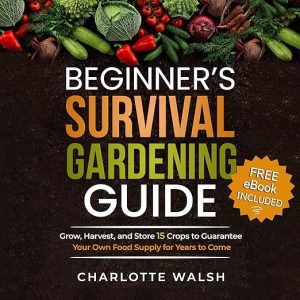
I grew up with a grandmother who kept a kitchen garden that I largely ignored as a child and have spent decades quietly regretting. There's something about the current moment, the supply chain disruptions, the economic pressures on food costs, the general sense that depending entirely on grocery stores is a fragile strategy, that has made books like Charlotte Walsh's Beginner's Survival Gardening Guide relevant to a much broader audience than traditional gardening titles. I listened to this on a weekday morning when I was supposed to be doing something else, and I kept thinking about the small raised bed I could realistically manage in my backyard.
Walsh's framing is explicit from the first chapter: this is not a hobby gardening book. It's structured around the premise that growing your own food is a practical response to real-world uncertainty, whether that's climate disruption, economic instability, or simple grocery store unreliability. That framing makes the book feel timely in a way that a purely aspirational garden guide doesn't. You're not growing tomatoes because they're pleasant. You're growing them because having a food backup plan is sensible.
Walsh covers the full cycle: setting up garden beds for whatever space you have available, the mechanics of sowing, propagating, and transplanting, pest management, and importantly, post-harvest storage and preservation. That last section is where survival gardening diverges from conventional beginner guides. Growing the food is only half the equation; knowing how to keep it through seasons you're not harvesting is what makes the difference between a nice summer project and actual food security.
The fifteen crops Walsh focuses on are chosen for ease and productivity rather than novelty, which is exactly the right call for a beginner-level guide. One reviewer highlights the seed-saving and root-stock storage section as a particular strength: the ability to regenerate your garden from its own produce rather than purchasing new seeds annually is a genuine self-sufficiency skill that's often missing from introductory gardening books.
Tamrix Reads Clearly, the PDF Shows Spacing
Tamrix narrates this with clean, unhurried delivery that suits the instructional format. This is a practical guide, not a lyrical meditation on soil and seasons, and the narration reflects that. Clear and accessible is what works here, and that's what you get. There's a companion PDF available in your Audible library alongside the audio, which addresses one of the inherent challenges of listening to a how-to book: some content, particularly bed layout planning and spacing charts, is simply easier to process visually. The inclusion of that PDF makes the audio version a more complete experience.
At just over four and a half hours, this is a short listen by audiobook standards, which means it's realistically completable in a single day of casual listening. For a reference guide that you'll likely want to return to by section, that brevity is appropriate. You don't need a 12-hour garden encyclopedia when you're planning your first raised bed.
Fifteen Crops for Preppers and Hobbyists Alike
The scope here is intentionally narrow. Fifteen crops, beginner-accessible methods, practical space management. One reviewer notes the absence of photos as a mild limitation in the print version; in audio, that absence is built into the format, and the companion PDF does some work to compensate. Experienced gardeners will find this too introductory to be useful, and readers looking for guidance on specific regional climates or advanced techniques like permaculture design will need to look elsewhere.
The "survival" framing skews the content toward a specific kind of self-reliance mindset. If you're a purely hobbyist gardener not particularly motivated by prepper concerns, the tone may feel slightly mismatched to your purpose, though the actual gardening information is universally applicable. The practical advice on growing, harvesting, and storing food doesn't require any particular ideological motivation to be useful.
Urban Growers Get the Gardening Slice
This is an ideal entry point for listeners who have never grown food before and want practical, step-by-step guidance without being overwhelmed by horticultural complexity. It's well-suited for people in urban and suburban settings with limited space, as Walsh explicitly addresses container gardening and vertical growing alongside traditional beds. It's also a solid choice for anyone whose gardening interest is specifically motivated by food security concerns rather than aesthetic pleasure.
Skip it if you already garden with confidence. The content will cover familiar ground quickly. Similarly, if you're looking for a comprehensive food production system including livestock, foraging, or large-scale food storage, this book covers the gardening slice of that picture and not the broader self-sufficiency ecosystem. But for where it positions itself, as a beginner's practical starting point, it delivers exactly what's promised.
In Brief
- Voice: Tamrix delivers a clear, competent read that suits a practical how-to format without being particularly memorable.
- Big ideas: Food self-sufficiency, prepper preparedness, accessible beginner horticulture
- Atmosphere: Practical and reassuring, with a mild undercurrent of self-reliance urgency
- Worth it?: A genuinely useful starting point for anyone wanting to grow food at home with limited space and limited prior knowledge, though experienced gardeners will find the scope narrow.
Before You Listen
Is this audiobook useful without the companion PDF, or is the PDF essential?
The audio content stands on its own as instructional material. Walsh explains concepts verbally in a way that doesn't require visual aids to follow. That said, the companion PDF adds real value for sections involving spacing, layout planning, and the specific crop reference guides, where a visual scan is more efficient than listening for particular details. Downloading it before you begin is worth the extra step.
Does Walsh's book cover gardening in small spaces like balconies and apartments, or only traditional outdoor garden beds?
Small-space gardening is explicitly covered, including container gardening and vertical growing methods. Walsh frames the book around whatever space you have available, which makes it applicable to urban apartment dwellers with a sunny balcony as well as suburban households with a small yard.
How does the survival gardening focus differ from a conventional beginner gardening book?
The main differences are in emphasis rather than technique. Conventional beginner guides focus on growing successfully. This one extends that focus to include post-harvest storage, seed saving, and the goal of year-round food security rather than seasonal enjoyment. The actual gardening instruction is broadly applicable either way.