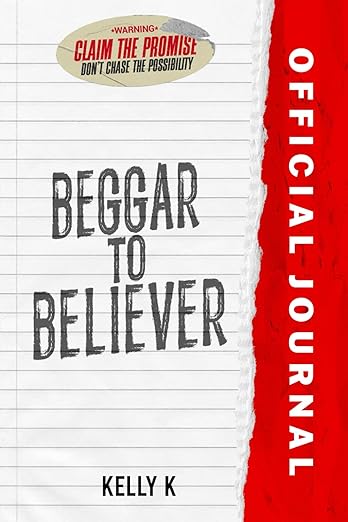
Journaling is what the description on this listing sells, and journaling is the one thing an audiobook cannot do. Read the copy attached to Beggar to Believer and you find yourself looking at The Beggar to Believer Journal, a reflection and prayer journal created to walk alongside the book, offering space for Bible study notes, prayer journaling and honest questions. That is a different product from the one on sale, and it is the only product this page describes. What the listing actually delivers is six hours and one minute of teaching read by Seth Andrews.
The Page Count Belongs to a Print Journal
Blank space is the entire proposition of the thing described. The copy asks you to record Scripture insights, journal prayers and personal breakthroughs, process conviction and clarity, and track your journey from doubt to confidence in Christ. It promises that one day you will flip back through these pages and see more than ink on them. Every one of those instructions requires a physical object with room to write in, and none of them survives a reading, because no listener can flip back through anything. The description is not badly written. It is simply written about something else, and nobody caught it before the file went on sale.
Arithmetic closes the case. This record lists a page count of 107 beside a runtime of six hours and one minute, and a hundred and seven pages is roughly half of what a recording this long normally consumes, which is another way of saying the page count belongs to the journal rather than to the file. The price sits where a paperback sits rather than where a download sits. The publisher and language fields both open with an invisible character left behind by whatever fed this listing, and the publisher value itself is simply Independently published. None of that is dishonest. It is a page assembled out of at least two products with nobody checking the joins.
Beggar Thinking Means Receiving What's Already Given
Beggar thinking is the idea underneath all of it, and the idea is a real one. The copy describes moving away from begging for God's attention and toward living from what has already been received, rooted in what Jesus has already finished. That is an old and specific claim about grace, the sort of thing that changes how a person prays rather than how they argue, and it is the difference between a devotional that scolds and one that reassures. If the recording delivers the teaching the journal was built to accompany, the shape is clear enough: doubt to confidence, earning to receiving, and a set of questions to sit with rather than a program to complete.
Discipleship settings are where the copy places the material, naming personal devotion time, small groups and individual Bible study by name. That tells you the register immediately. This is not apologetics and not systematic theology, but the kind of teaching that expects a response from the person receiving it. The instruction to write what challenges you, what shifts in you and the prayers you have been afraid to say out loud is unusually direct for a devotional product, and it implies the book behind it asks for the same honesty. Six hours is a manageable length for a group working through a section each week.
Buyers Get No Table of Contents Here
Buyers deserve to know precisely what they are risking, and this record makes that difficult. The listing's title belongs to the book. The description belongs to the companion journal. Seth Andrews holds the reader credit, and the page connects that name to neither product beyond the credit line itself. Kelly K is the byline, which reads like a truncated entry rather than a chosen name. A prospective listener gets no table of contents, no chapter list, no described sample and no account of what those six hours contain, which is a great deal to take on trust.
Doctrine is the other unknown, and it matters in this corner of the shelf more than in most. The copy is confident and evangelical in its vocabulary, talking about conviction, breakthrough and what God is revealing to you, and it assumes a listener who already accepts that frame rather than one being argued into it. Anyone shopping for a book that reasons its way toward faith is in the wrong place. So is anyone allergic to the word breakthrough. What the copy never does is name a tradition, a church or a single passage of Scripture the teaching rests on, which is a lot to leave unsaid on a page selling this much Bible teaching.
Seth Andrews Reads for the Small-Group Crowd
Small groups are the best fit if the recording matches its stated purpose, since the material is designed to be worked through rather than consumed in one pass. Listeners who already know the beggar-to-believer framing from preaching or from a study will find a long-form version of it here, and the format suits a drive followed by ten minutes of writing far better than a single evening. Christian listeners who like their devotional material practical and directive, with homework attached to it, are the audience the copy is openly courting.
Wait for the record to be corrected if you can afford to. Until the listing describes the audio edition rather than the paper journal built to accompany it, every buyer is working from a description of a different object, and that is more uncertainty than an unheard purchase at this price should carry. If the framing is what you want and you already trust the source, the risk is small and the subject is a good one. If you prefer to know what you are buying before you buy it, this page will not tell you.
Does this audiobook contain the journal the description advertises?
It cannot. The copy describes The Beggar to Believer Journal, a reflection and prayer journal with space for Scripture notes and written prayers, which only works as a physical object. What is on sale here is a spoken reading, so the writing prompts arrive as instructions you cannot follow.
When was the Beggar to Believer audiobook released and how long does it run?
The record dates it to March 2, 2026 and gives a runtime of six hours and one minute, published independently rather than through a religious imprint. Seth Andrews is the credited reader, and the page names no other contributor at all.