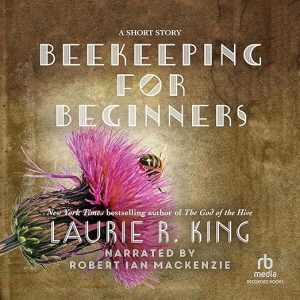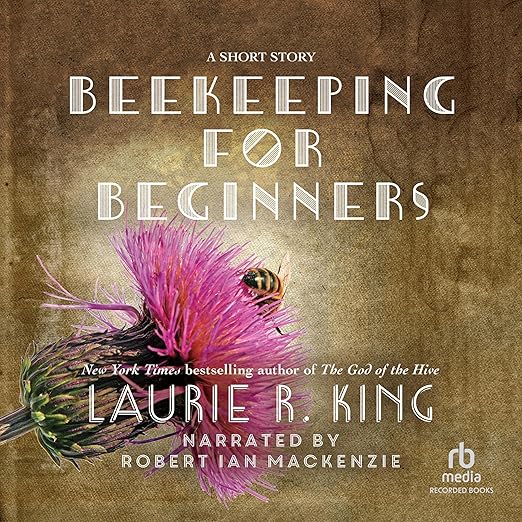
Come for the detective, not for the bees. The title on this audiobook reads Beekeeping for Beginners, the categories file it under Gardening and Horticulture, and the description underneath describes Sherlock Holmes walking the countryside in a dark temper looking for wild bees, until he runs into the headstrong young woman who becomes his apprentice. That mismatch is not a slip in one field. It runs through the entire record.
The Right Length for a First Meeting
What the description actually promises is a first meeting. Laurie R. King, whose Holmes and Mary Russell books the copy calls among the most popular mysteries being published, uses this piece to stage the encounter that starts everything: the great detective at his least sociable, out in the countryside on an errand about bees, colliding with somebody who declines to be intimidated. An hour and forty minutes is exactly the right size for that scene and no larger. Recorded Books put it out in April 2012, in the short-form slot where a publisher tests whether an established readership will follow a series sideways into something smaller.
The single written response, four stars in August 2018, calls it a decent story on the understanding that it continues Conan Doyle's original series, and reports that it was also quite short. That sentence arrives on the page with a word or two missing from the middle, which would be trivial anywhere else. Here it joins a longer list of things on this record that nobody checked.
Origin scenes are difficult because the reader already knows the outcome, and this description compounds the problem by announcing that the young woman becomes the detective's apprentice and eventual bride within the same sentence that introduces her. Whether that reads as a spoiler or as a reassurance depends entirely on how much of the series you have already met. For a returning reader it is the pleasure of watching two people fail to notice what is starting; for a newcomer it removes most of the suspense from an encounter built out of suspicion.
Mackenzie Keeps Two Voices Apart
Bees are the best thing in the setup, because they are not decoration. Holmes is out in the countryside hunting wild colonies, in a decidedly dark temper, which gives the encounter a reason to happen and gives the story its unlikely title. A detective famous for reading a room gets caught doing something obsessive and slightly ridiculous, and gets read himself by a stranger. That reversal is the whole appeal, and it is the reason the countryside matters: away from clients, cases and the city, the character has no professional armor to hide behind.
For anyone curious about the Russell books without wanting to commit to a full novel, a short recording covering the first meeting is the cheapest possible sample. The description supplies everything a newcomer needs, and the piece asks no prior reading, which is unusual for a series entry and makes this a rare no-risk introduction to a long-running sequence. Short-form audio is at its most useful in exactly this role, letting a reader audition a voice and a pairing for the price of one afternoon rather than committing to a full novel on the strength of a cover.
Recorded Books produced it and Robert Ian Mackenzie reads it, and the shape of the material puts real weight on that casting. Two people talking in a field, one of them irritable and famous, the other young, headstrong and unimpressed, needs the two voices to stay clearly apart, and a short piece has no time to establish them gradually the way a novel would.
Byline, Author and Reader All Disagree
Whoever assembled this record left three names on it and no way to reconcile them. The author field reads Michael York, the description states plainly that King wrote the story, and the reading credit goes to Robert Ian Mackenzie. At most one of those three can be the author, and the page declines to say which, so anybody searching by byline is looking for a book attributed to somebody the copy never mentions.
Category placement compounds it. Filing a Sherlock Holmes story under Home and Garden with a Gardening and Horticulture tag means gardeners hunting for a beekeeping manual land on a mystery, and mystery readers hunting for King's series never see it at all. The series fields are empty as well, despite a description that positions the piece squarely inside an ongoing sequence of novels, so nothing on the record tells a curious listener what to read next or where this sits in the order. Misfiling of this kind is usually harmless. Here it hides the book from the only people likely to want it.
Then the evidence base, which is close to nothing. Six ratings produce the 4.3 average, one written response accounts for all the commentary on the page, and its substantive observation is that the story ends quickly. For a 2012 release from an established audio publisher, that is a remarkably quiet record, and it leaves a buyer relying entirely on the description of a book the description does not agree with the byline about.
Holmes Fans Yes, Working Beekeepers No
Holmes readers with completist instincts are the obvious audience, along with anyone who has heard about the Russell books and wants to test the premise before starting a novel. It suits listeners who prefer the sideways, character-first angle on the detective to the case-driven stories, and it fits a single sitting on an afternoon when a full mystery would be too much.
Anyone who genuinely wants to keep bees should close the page. Nothing here explains a hive, a season or a colony, and the category placement is doing real harm to somebody's afternoon. Listeners who want a proper investigation should also adjust: this is a meeting, not a case, and the mystery machinery stays in its box.
Any story about the moment two people recognize each other deserves a page that knows whose story it is. This one gets the encounter right and everything around it wrong.
Questions Listeners Ask
Is this audiobook actually about beekeeping?
No. Despite the title and the Gardening and Horticulture tag, the description is about Sherlock Holmes searching the countryside for wild bees and meeting Mary Russell. The insects explain why the detective is out there at all, and they supply the title. Nothing further.
Is this a full novel or something shorter?
A short story or novella, comfortably. Expect one encounter developed properly rather than a case with clues and a solution, and set your expectations for scale before you press play. The brevity is appropriate to the material rather than a sign of anything missing.
Does the audiobook work as an entry point to the Mary Russell novels?
Not at all. The description presents this as the detective's initial meeting with Russell, which makes it a starting point by definition. It does name where their relationship ends up in the same breath, so series readers get a familiar scene and newcomers get a small spoiler alongside their introduction.