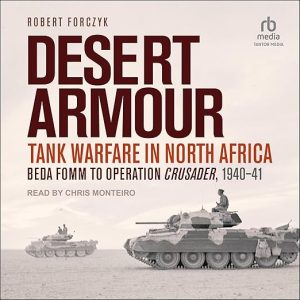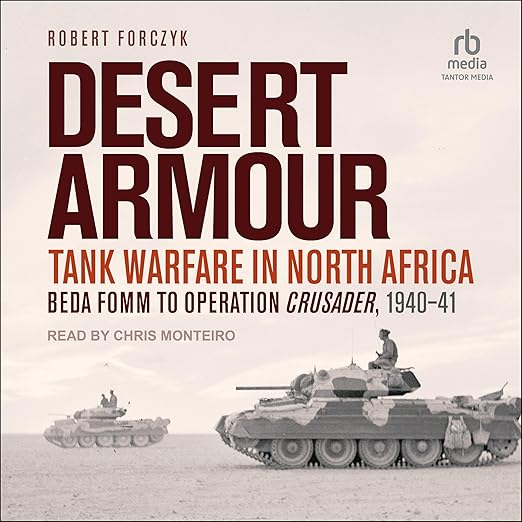
Robert Forczyk has built a reputation among World War II military historians as the author you read when you've exhausted the popular accounts and want someone who has actually gone back to the primary sources. Beda Fomm to Operation Crusader, 1940-41 is the first half of his Desert Armour project, covering North African mechanized warfare from the opening Anglo-Italian engagements in 1940 through the British relief of Tobruk during Operation Crusader in late 1941. The audiobook is exactly the kind of production that validates choosing audio for serious military history: Chris Monteiro's narration keeps thirteen hours of operational detail comprehensible across the full runtime without losing the listener in the density of the material.
Disproving the Rommel Myth Through Documentation Alone
Forczyk's scope is more granular than most popular accounts of the North Africa campaign. He focuses on armored forces at the brigade and regimental level rather than at the strategic command level that most narrative histories prefer, which means readers get detailed analysis of the equipment, doctrine, training, and logistics on both Allied and Axis sides rather than dramatized accounts of command decisions and personality clashes. The Rommel mythology, which has been central to popular accounts of the desert war for eighty years, gets particular attention. Reviewers consistently note that Forczyk presents a different take on Rommel that challenges the received Rommel legend, and that reassessment is built on documentation rather than contrarianism. One experienced reviewer noted that Forczyk disproves many long-held myths about this theatre, and that debunking work is the book's most distinctive scholarly contribution.
The German Panzergruppe Afrika is examined with the same critical rigor applied to British and Commonwealth forces, making this a genuinely comparative study rather than an account from one national perspective. The arrival of Rommel's forces in early 1941 and the subsequent oscillating campaign through Tobruk and Operation Crusader's final phase is covered in operational depth that most popular accounts skim over in favor of narrative momentum. Forczyk sacrifices some narrative pace for that depth, and the choice is consistently the right one for readers who want to understand why the campaign developed as it did rather than just what happened.
Monteiro Tracks Two Armies at Once
Chris Monteiro narrates this audiobook with the measured authority that military history requires. The challenge with operational military history in audio is the sheer density of unit designations, place names, technical specifications, and simultaneous engagements that must remain legible across extended listening. Monteiro handles the dual-force structure, tracking Allied and Axis developments simultaneously within the same chronological framework, without losing the listener's orientation. He does not inject drama into material that doesn't require it, which is the right call for a historian who prefers documentation to atmosphere.
Forczyk's writing style has the quality, praised by reviewers, of weaving simultaneous events from different theatres of the campaign into a coherent narrative rather than presenting them as separate parallel lists. Monteiro's delivery honors that structure, keeping the narrative momentum alive even through the more technically demanding sections covering armor specifications and logistical constraints. One reviewer described Forczyk as one of the few authors they would pay full price for, confident the purchase would be worth it, which is a level of author-specific trust worth noting when evaluating a thirteen-hour investment.
Only Half the Campaign, a Second Volume Waits
This audiobook rewards and requires active attention in a way that more narrative-driven popular histories don't. The brigade and regimental focus means keeping track of a large number of unit designations across two armies, and the operational picture involves multiple simultaneous engagements that must be held in working memory. Listeners who prefer their military history through individual stories or personality-driven narrative, the approach that made books like Antony Beevor's work broadly popular, may find the technical weight here substantial and the pace deliberately demanding.
The book covers only the first half of the North African campaign, ending with Operation Crusader and the relief of Tobruk. The story is not complete within this volume. A second Desert Armour volume covers the subsequent campaign period through the conclusion of North African operations, and readers who want the full picture should plan for both. That division is logical given the scope of the campaign, but worth knowing going in rather than discovering at the final chapter.
Forczyk Rewards Readers With Prior Context
Military history enthusiasts with existing knowledge of World War II and at least a working familiarity with the North African campaign will get the most from this audiobook. Those who have read popular accounts of the desert war by authors like Niall Barr or Correlli Barnett and want a more technically rigorous examination of the same period will find Forczyk operating at the next level of analysis with primary sources that popular historians haven't fully exploited. Students of armor doctrine and mechanized warfare who want a comparative Allied-Axis study at the unit level will find the brigade-level focus particularly valuable.
Casual listeners and those new to World War II military history should build their foundation with more narrative-driven accounts before approaching Forczyk. The operational detail rewards prior context rather than building it from scratch, and first-time readers of the North Africa campaign will likely find the density more challenging than engaging without that background. For the right listener, however, this audiobook is exactly what has been needed: a serious scholarly treatment of mechanized warfare in North Africa that challenges the mythology head-on with documentation.
Key Details
- Read by: Chris Monteiro delivers a steady, authoritative read across thirteen-plus hours of dense armored warfare history, handling technical military terminology and dual-force operational detail with consistent clarity.
- At its heart: Mechanized warfare doctrine evolution, Allied and Axis logistics compared at brigade level, Rommel's battlefield reputation critically reassessed
- Vibe: Rigorously researched and densely operational, narrative-driven despite the technical weight
- Short version: Forczyk's Desert Armour is the serious North Africa study that campaign enthusiasts have been waiting for, working from primary sources to challenge myths that have dominated popular accounts for eighty years.
Frequently Asked Questions
Does the Beda Fomm to Operation Crusader, 1940-41 audiobook cover the entire North Africa campaign?
No. This is the first half of Forczyk's Desert Armour project, covering from the initial Anglo-Italian engagements in 1940 through Operation Crusader and the relief of Tobruk in 1941. A second volume covers the subsequent campaign period through the conclusion of North African operations.
How does Forczyk's treatment of Rommel in this audiobook differ from popular accounts?
Reviewers consistently note that Forczyk challenges the Rommel mythology that has dominated popular histories of the desert war. His assessment is built on primary source research and applies the same critical rigor to German commanders as to Allied ones, presenting a more complex picture than the Desert Fox legend typically allows.
Is this audiobook accessible to listeners who are not military history specialists?
It's significantly better suited to listeners with prior familiarity with World War II. The brigade and regimental level focus, dual-force operational tracking, and technical coverage of armored doctrine and logistics are manageable with prior background but demanding for those approaching the topic fresh. A general WWII overview first will help considerably.
Does Chris Monteiro's narration handle the technical military terminology well in this audiobook?
Yes. Monteiro maintains consistent pacing and clarity across thirteen-plus hours of dense operational material, handling unit designations, place names, and technical specifications without stumbling. The narration keeps the narrative structure legible even through the most technically loaded sections.