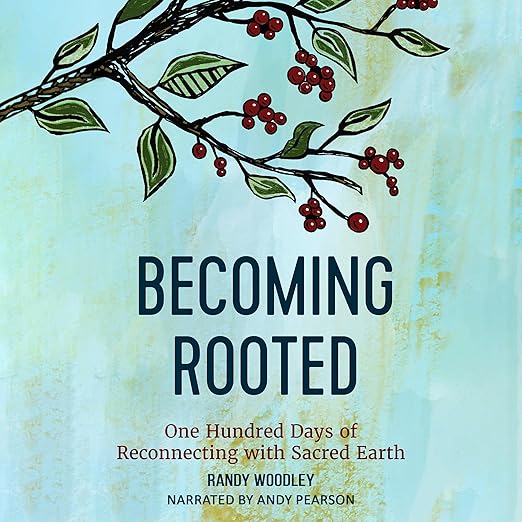
Before You Press Play
- Voice: Andy Pearson reads with quiet steadiness that suits the devotional format, unhurried and respectful of the reflective pauses the text requires.
- Big ideas: Indigenous ecological wisdom, reconnection with land, decolonizing spirituality
- Atmosphere: Contemplative and grounding, with an undertone of gentle urgency
- Worth it?: A hundred-day devotional that asks real questions about how we live in relation to the Earth, more challenging than its meditative format suggests.
I came to Becoming Rooted during a period when I had been listening to too many audiobooks that rewarded speed. Thrillers, mostly. Books where the pace does the work and reflection is optional. I needed something that would slow me down, and a friend recommended Randy Woodley's hundred-day journey as exactly that kind of corrective. She was right, but not entirely in the way I expected. This is not a gentle wellness listen. It is a devotional with genuine political teeth.
Randy Woodley is a Cherokee descendant recognized by the Keetoowah Band, an activist, author, and scholar whose work sits at the intersection of Indigenous spirituality and ecological ethics. Becoming Rooted is structured as one hundred daily meditations, each ending with prompts for reflection and action. The format borrows from the Christian devotional tradition, it was published by Broadleaf Books, which works in that space, but Woodley is doing something more expansive and more uncomfortable than most devotionals attempt.
The Review
The organizing frame is what Woodley calls the harmony way: a way of living that honors balance, wholeness, and connection across the whole community of creation, not just the human portion of it. What makes this more than a pleasant invitation to spend time in nature is the explicit naming of the American Dream as, in Woodley's phrase, an Indigenous nightmare. He does not let listeners settle into an apolitical nature spirituality. The land, the water, the creatures, these are not backdrops for human wellness. They are teachers with prior claims, and the people who lived in relationship with them for thousands of years before European arrival are part of that teaching.
That framing is done without didacticism, which is genuinely hard to achieve. Woodley writes in meditations, not arguments. But the cumulative weight of a hundred days of reconnection, with land, with water, with the creatures around you, with Indigenous history, accumulates into something that presses on the reader's assumptions in productive ways. One reviewer described it as "healing," which it is. Another described it as "good medicine expressed," which captures the spiritual dimension. What those descriptions do not fully convey is the degree to which the book also demands something of you.
Andy Pearson's narration is well-matched to the material. He reads without performance or emphasis that would compete with the meditative quality of the text. The 5-hour 26-minute runtime covers only a portion of the hundred-day experience in direct listening, the full journey is intended to be spread across one hundred days, one meditation per sitting. As an audiobook, it functions both as a guide to be listened to incrementally and as a complete work that holds up as a single listening experience for readers who want the whole before they begin the practice.
Several reviewers noted using this with partners or in groups, reading one meditation aloud together each day. That use case tracks naturally with the audio format. Pearson's unhurried delivery creates space for the conversation the prompts invite. For listeners in spiritual communities, book groups, or ecological activism contexts, this works particularly well as a shared listen.
Weak Spots in Becoming Rooted
Listeners who come to this expecting a neutral, universal nature spirituality will find Woodley more historically specific than that framing suggests. The invitations to reconnect with the land include explicit attention to whose land you are on and what happened there. That specificity is the book's strength, but it will surprise readers expecting something broadly pastoral and non-confrontational.
The reflection and action prompts at the end of each meditation are not optional finishing touches. They are where the book does its actual work. In audio format, pausing to actually engage with those prompts requires more deliberate effort than with a physical copy where you can write. Some listeners will find this a limitation of the format; others will adapt their listening practice accordingly.
Is This One for You?
This audiobook is a strong choice for listeners drawn to Indigenous ecological thought, for readers in progressive spiritual communities looking to expand their framework beyond Western traditions, and for anyone who has felt a vague disconnection from the natural world and wants something more structured than a walk in the woods to address it. Listeners seeking a purely contemplative wellness listen without political or historical content should know what they are entering. Those willing to be challenged alongside being comforted will find Woodley a generous and demanding guide.
Frequently Asked Questions
Can I listen to the whole audiobook at once, or is it designed strictly as a daily devotional?
It is structured as one meditation per day across one hundred days, but the audiobook works as a complete listening experience. Many readers use it both ways, listening through once to get the full shape, then returning to individual meditations in daily practice.
Does this audiobook require any prior knowledge of Indigenous history or spirituality?
No prior knowledge is required. Woodley introduces concepts accessibly and does not assume familiarity with specific tribal traditions beyond his own Cherokee and Keetoowah background, which he draws from with care.