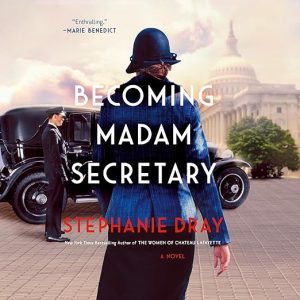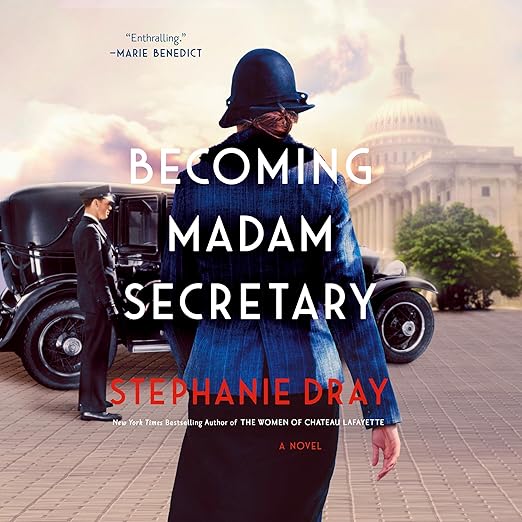
Frances Perkins arrives in this description with a trusty parasol and an unyielding determination to make a difference, and leaves it as the woman facing down the Great Depression as FDR's most trusted lieutenant. What the description never mentions, and what not one of the five reviews under this audiobook mentions either, is that somebody had to read all seventeen hours and seventeen minutes of it out loud. Cassandra Campbell is the name on that credit, and the credit is the whole of what the page says about the recording.
What Stephanie Dray Delivers
Listeners who came for a novel will get one, and a well-shaped one judging by the column. Stephanie Dray builds the book around a partnership that begins as an insult exchange: Frances meets a young lawyer named Franklin Delano Roosevelt at a tea dance and files him as a rich, arrogant dilettante coasting on a handsome face and a famous name, while he decides she is a priggish bluestocking and an insufferable do-gooder. Twenty years later the two of them are running the response to the Great Depression from the White House. That is a durable engine, and it saves the book from the reverence the subject invites.
Two of the five people who wrote here arrived through a reading group. B. Burnham opens by explaining that one of the reviewer's book clubs loves biographical fiction and that this was the month's pick, and Regina closes by recommending it, plainly, as a good read for a Bookclub. That says something true about the shape of the novel, which is built for discussion: a woman most of the group will not have heard of, a period everyone half knows, and a running argument about who gets credit for what.
Most of the seven votes behind the 4.7 badge are invisible, and for once the arithmetic cooperates. A 4.7 average across seven whole-star votes fixes the total at exactly 33 points out of a possible 35. The five reviews you can read carry 24 between them, four fives and one four. That leaves nine points for two people who rated the book and wrote nothing, and nine spread over two whole-star votes has exactly one solution: a five and a four.
Both of the two points missing from a clean sweep are therefore accounted for. One belongs to Regina, whose four stars come attached to the mildest reservation in the column, that the book takes a little getting into before it turns easy. The other belongs to a reader who rated and moved on. That is about as legible as a ratings badge ever gets, and it is worth pausing on, because a seven-vote counter normally tells a buyer nothing whatsoever.
Seven votes, five of them with words attached, and three of those five reach for the verb read. Regina uses it twice, once for the ease of it and once for the book club. Val Mills was excited to read about Frances Perkins. Joanne V Treuhaft enjoyed reading this book and calls the writing excellent. Even the pull quote at the top of the description, credited to the New York Times, lands on inspiring and essential reading. A seventeen-hour performance sits underneath all of that, unremarked.
The credit line is the only audio information this listing offers. Cassandra Campbell is named as narrator, Penguin Audio as publisher, March 12, 2024 as the release date, and that is the extent of it. For a novel running from a turn-of-the-century arrival in New York City to the Great Depression, the performance has to age its central character across the whole span, from a settlement worker in the tenements of Hell's Kitchen to a cabinet secretary under political attack. Seventeen hours is enough time for that to matter a great deal.
Things to Know Before Starting Becoming Madam Secretary
Nothing in the publisher's copy calls Frances Perkins the mother of Social Security, and one reviewer reaches for exactly that framing anyway. B. Burnham uses the phrase and then traces the career behind it, from social work in Hell's Kitchen to the fight for better working conditions, especially for women. Val Mills turns a review into an argument instead: that Perkins was not, and likely still is not, in most history books or taught in schools, and that women who deeply impacted the world get relegated to a footnote at best. Neither point comes from the description, and both are why the book exists.
That title is doing quiet work as well. Becoming Madam Secretary never puts Perkins in it, which means a browsing listener has to open the summary to find out who the book is about, and Val Mills admits to knowing nothing about her beforehand. The cabinet post is the hook offered instead, and it makes a curious choice, because the appointment is the least novelistic thing in the story. The tea dance and the Greenwich Village friendships are where the writing lives.
If you come expecting a tidy political biography, the middle will surprise you. The jacket gives Greenwich Village as much room as Washington: a millionaire socialite named Mary Harriman Rumsey, the flirtatious budding author Sinclair Lewis, and Paul Wilson, the brilliant but troubled reformer she falls deeply in love with. Marriage and motherhood are named as pressures on the career, vicious political attacks and personal tragedies are promised without being described, and the copy stops short of saying what she has to sacrifice. A reasonable tease, and a real gap for anyone weighing how much grief they want.
Who Should Pick Up Becoming Madam Secretary
Where the length will tell is in the years after the appointment. Seventeen hours and seventeen minutes is a long stretch for a novel whose second half turns legislative, and Regina's four stars carry the note that it takes a while to get going. Nobody in the column reports flagging later on, and the enthusiasm elsewhere is unqualified, but a listener choosing between print and audio has only the running time to reason from.
One kind of listener will do very well here: anyone who likes the Greenwich Village to Washington arc, anyone who reads biographical fiction for the argument as much as the story, and anyone running a reading group that wants a subject the members can be indignant about never having been taught. The column is close to unanimous, the writing draws direct praise from two separate reviewers, and the historical material is unusually rich in incident.
Everything that makes the book work will also put some listeners off. The novel is admiring, the arc runs upward, and the destination is printed in the title before the first chapter begins, so anyone who wants their historical fiction ambivalent about its subject should look elsewhere. So should anyone impatient with a long procedural middle. Seventeen hours is a real commitment for a story whose outcome is written on the cabinet room door.
The Short Version
- Narrator: Cassandra Campbell is credited alone for a novel that has to age its lead from tenement social work to a cabinet post.
- Subjects: Women written out of the record, an unlikely political partnership, ambition against marriage and motherhood
- Tone: Admiring and briskly indignant
- Bottom line: A reading-group novel with real teeth, provided you can give it seventeen hours.
Frequently Asked Questions
Would this audiobook suit a book club?
Two reviewers say so from experience. One chose it as a monthly selection for a group that favors biographical fiction, and another recommends it for a book club in the closing line. The subject supports discussion, since much of the appeal is arguing about a figure most members will not have studied.
Does any review here mention the audiobook narration?
No. All five written responses discuss the story, the history and the writing, and three of them use the verb read. The listing supplies the narrator credit, Penguin Audio as publisher, and a running time of seventeen hours and seventeen minutes, which is the full extent of what a buyer can weigh.