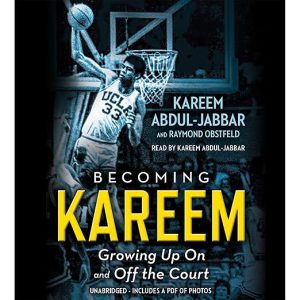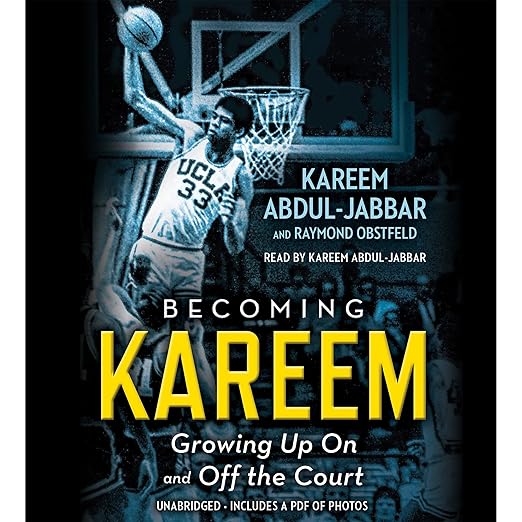
Lew Alcindor grew up self-conscious, shy, and under pressure to please a strict father, long before the world knew him as Kareem Abdul-Jabbar. That gap between the awkward kid from New York City and the record-smashing basketball legend is the actual subject of this audiobook, written specifically for young readers and narrated by Abdul-Jabbar himself. Rather than a highlight reel of championships, the book traces the specific people who functioned as informal coaches throughout his life: his parents, basketball coaches Jack Donahue and John Wooden, and cultural figures like Muhammad Ali and Bruce Lee, each credited with a distinct lesson that shaped who he eventually became both on the court and, later, as a writer and activist.
Abdul-Jabbar Narrates With a Lived Cadence
Abdul-Jabbar narrating his own youth memoir is close to an ideal case for self-narration in this genre. His reflective, unhurried pace suits a book built around looking backward with the wisdom of decades rather than the breathless energy of pure sports highlight-reel content, and it supplies a kind of lived authenticity a professional narrator, however talented, could only approximate secondhand. Listeners get the specific cadence of a man in his seventies looking back at difficult adolescence, at racism and prejudice encountered early, and at the particular gravity of losing versus gaining various father figures along the way, delivered in the actual voice that lived through all of it.
Written especially for young readers does not mean written down. Genre clarity, a specific age target in mind, tends to produce tighter, less self-indulgent prose than sprawling adult memoirs attempt, and that discipline shows throughout: five hours and forty-eight minutes is a real, complete story rather than a padded or abridged one. Adult listeners regularly find these young-readers sports memoirs rewarding on their own terms, not as a lesser version of some real adult book that exists elsewhere. Treat the young-readers label as an invitation into a cleanly told story, not a ceiling on how much an adult listener can get out of it.
The book's own title carries more weight than it first appears to. Becoming Kareem refers not just to athletic maturity but to Lew Alcindor's real, well-documented conversion to Islam and adoption of the name Kareem Abdul-Jabbar as a young man, a transformation of identity that runs alongside the basketball story rather than separate from it. Handled at a level appropriate for young readers, the book treats that change as part of his broader search for who he wanted to become, not a footnote to his athletic career.
His path through UCLA under legendary coach John Wooden is one of the most decorated in college basketball history, and the book uses that well-known chapter not to recount statistics but to explain what Wooden specifically taught him about discipline and preparation that outlasted his playing days. That same throughline extends into his life after retirement, where Abdul-Jabbar became a prolific author and columnist, a detail worth knowing for young readers who may only know him as an athlete and not yet as a writer in his own right.
Why 'Coaches' Sits in Quotation Marks
One reviewer specifically highlights the insight into Abdul-Jabbar's journalism work in Harlem, his presence at the Cleveland Summit, and his relationship with Coach Wooden as the material that resonated most, a level of detail that signals this book goes well beyond basketball trivia into real civic and cultural history. Another reviewer, admitting she did not initially realize the book targeted young readers when she bought it, states plainly that it did not disappoint despite having limited interest in sports generally, drawn in instead by wanting to understand the broader cultural moment Abdul-Jabbar lived through. That crossover appeal, a sports memoir functioning as an entry point into civil rights history, is a real and repeatable strength.
A 4.8 rating across 759 ratings is an exceptional number for any memoir, let alone one filed in a young-readers category, and it reflects a consistency few sports memoirs achieve: reviewers praise it whether they came for the basketball, the history, or the personal disclosure about a strict, difficult relationship with his father. One reviewer calls it simply outstanding, appreciating Abdul-Jabbar's willingness toward real disclosure rather than a sanitized greatest-hits version of his own story, a notable choice for a book explicitly aimed at children and teenagers.
The synopsis itself puts the word coaches in quotation marks, a small but deliberate signal worth noticing: most of the people credited with shaping Abdul-Jabbar were not basketball coaches at all, but a formerly incarcerated mentor, a martial artist, a writing career, a religious conversion. That framing device, borrowing the language of athletics to describe a much wider circle of influence, is exactly the book's real thesis in miniature, and it holds up well across a full listen.
Selectivity Works Here as a Feature
Because this targets young readers specifically, it moves faster through some material adult biography fans might want lingered over: particular seasons, specific statistical achievements, the full scope of his later activism and writing career after retirement. Selectivity is a feature here, not a bug: the book stays focused on the formative relationships and lessons rather than attempting exhaustive career coverage, but readers wanting a complete, detailed record of his athletic statistics and post-retirement decades should look toward his adult-audience memoirs instead, treating this specifically as an origin story rather than a full biography.
Both listed categories here, children's audiobooks and Sports and Outdoors, are genuinely accurate rather than a mismatch worth flagging, unlike a fair number of children's titles more generally, where the category tagging misleads more often than it should. This really is written for younger readers, and it really is substantially about basketball and athletic development, alongside the racism, family pressure, and social-activism threads. Parents previewing this for a child should know the racism and prejudice Abdul-Jabbar experienced growing up is discussed directly rather than glossed over, appropriately for the stated age range but still worth knowing in advance.
Reluctant Readers Respond to Self-Narrated Momentum
Recommended enthusiastically for young readers who love basketball and want a real story behind a legendary name, for parents looking for a sports memoir that treats race and family pressure honestly rather than superficially, and for adult listeners drawn to origin-story memoirs generally. Reluctant young readers specifically, listeners who respond better to a self-narrated audiobook's momentum than to a printed page, are a strong specific match for this format and this particular narrator.
Skip it if a complete adult-audience biography, covering his full NBA career statistics and post-retirement decades in exhaustive detail, is what you actually want; this book intentionally stays narrower and more personal than that. Otherwise, for the stated young-readers audience and for adults willing to meet a genuinely moving origin story on its own terms, this stands as one of the more genuinely accomplished self-narrated athlete memoirs available right now.
Questions Listeners Ask
Does Kareem Abdul-Jabbar narrate his own audiobook?
Yes, and among self-narrated athlete memoirs generally, his performance here is widely considered a real benchmark, since his unhurried, reflective pace suits the book's retrospective tone especially well.
Does this audiobook cover Kareem Abdul-Jabbar's full NBA career and statistics?
No. It focuses on his childhood and formative years as Lew Alcindor, functioning as an origin story rather than a complete career biography. Readers wanting full statistical coverage should look to his adult-audience books.
Is the racism Kareem Abdul-Jabbar experienced growing up discussed directly in this audiobook?
Yes, directly and honestly, though calibrated for the stated young-readers age range. Parents previewing the book for a child should know this content is present rather than glossed over.