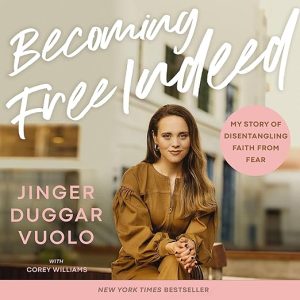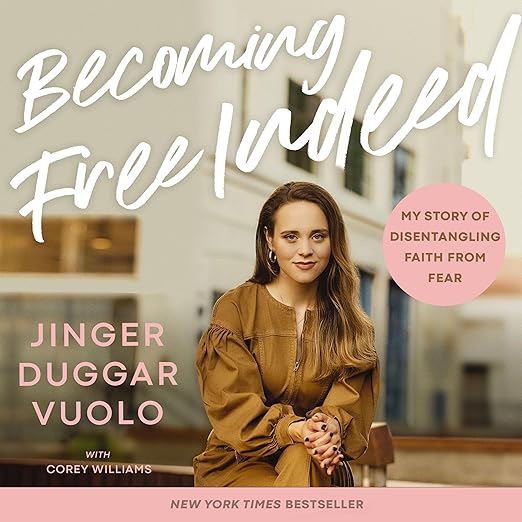
There is a crowded shelf of memoirs about leaving fundamentalist religious communities, and most of them follow a predictable arc: repression, awakening, escape, secular liberation. Becoming Free Indeed is not that book. Jinger Vuolo, the sixth Duggar child and a familiar face from TLC's 19 Kids and Counting, is at pains throughout to draw a line between what she calls deconstruction, the wholesale rejection of a religious framework, and disentanglement, which is something more specific and more difficult: the careful separation of inherited rules from actual Biblical teaching. That distinction is the book's intellectual center, and she holds it with more precision than her earlier New York Times bestseller about religious conviction suggested she might.
I listened to this one on a quiet Sunday afternoon, which felt appropriate. The book has the quality of a conversation rather than a confession, and Vuolo's reading of her own material keeps that register throughout. She is not performing anger or grief, she is working through something still in process, and the audio captures that ongoing quality in ways a read text might not.
The Review
The specific target of Vuolo's disentanglement is Bill Gothard and his Institute in Basic Life Principles, the modesty guidelines, the umbrella of authority doctrine, the courtship standards, the prohibition on worldly music. These were not peripheral preferences in her upbringing: they were the entire operating system of her household and community. Walking away from them required not just personal courage but serious Biblical scholarship, because the IBLP framework presents itself as Biblically derived, and dismantling it means going back to the source texts and reading them without Gothard's interpretive overlay.
Reviewer Kindle Customer made the comparison to Joshua Harris and Rachel Held Evans, both of whom changed their childhood faith by turning to personal experience and cultural consensus rather than back to Scripture. The contrast is the book's most interesting argument. Vuolo is not rejecting the authority of the Bible. She is rejecting a particular man's claim to speak for it. That is a narrower and, she argues, more defensible move.
What Makes Becoming Free Indeed Worth Hearing
Vuolo narrates her own memoir, and the self-narration is where this audiobook earns its place as a listening experience rather than a reading one. There is a specific quality to her voice when she describes the fear she felt as a child trying to measure up to Gothard's standards, the private anxiety behind the public compliance, that would be impossible to replicate with a professional narrator. The emotional memory is in her voice, not just her words.
Reviewer A Wooff noted that the book produced moments of recognition even for listeners who did not grow up in IBLP communities, that the dynamics of rule-based religious anxiety are recognizable across different traditions. That broader resonance makes the memoir worth hearing even for listeners without a direct connection to the Duggar family or the IBLP specifically.
The Caveats
The sections on her brother-in-law's influence deserve particular attention. This is the pivot point of the memoir, the moment when someone raised outside the IBLP framework entered her immediate circle and demonstrated that a person could be seriously committed to the Bible without accepting Gothard's interpretation of it. The contrast this created in Vuolo's mind, and the studious, slow process by which she followed it, is the book's most carefully narrated sequence.
Also watch for Vuolo's language when she describes the relationship between fear and obedience in her upbringing. She is precise about the distinction between external compliance and internal belief, and that precision is what separates this memoir from the genre's typical anger-and-liberation structure.
The Right Listener for Becoming Free Indeed
Readers navigating their own relationship with inherited religious frameworks, particularly those wrestling with how to keep what is meaningful while releasing what is harmful, will find Vuolo's framework genuinely useful. It is also valuable for anyone curious about the IBLP specifically, the Duggar family's backstory, or the broader phenomenon of authoritarian religious subcultures in American Christianity.
Those looking for a wholesale rejection of Christian faith will not find it here and will likely be frustrated. Vuolo's destination is a more grounded, Scripturally based faith, not secular freedom. The book is honest about that from the first chapter.
Key Details
- Voice: Jinger Vuolo reads her own memoir, the self-narration carries the vulnerability of someone still working through what she is describing.
- Big ideas: faith deconstruction versus disentanglement, spiritual abuse, the difference between rule-following and belief
- Atmosphere: Measured and searching, not angry, but deeply honest
- Worth it?: A rare memoir about leaving religious legalism that keeps its faith intact, the distinction Vuolo draws between deconstruction and disentanglement is the book's most important and most carefully argued idea.
Common Questions
Do I need to know the Duggar family or have watched 19 Kids and Counting to follow this memoir?
No prior familiarity is required. Vuolo provides enough context about her upbringing and family situation for the memoir to be fully accessible to new readers.
What exactly is the difference between deconstruction and disentanglement as Vuolo uses those terms?
Deconstruction, in her framework, refers to abandoning a religious faith entirely or replacing it with personal experience as the authority. Disentanglement is the more specific process of removing teachings that were added to Biblical faith by human teachers, in her case, Bill Gothard, while returning to Scripture as the ultimate authority.
Does Jinger Vuolo address her relationship with her family and the wider Duggar situation directly?
She focuses primarily on her own spiritual journey and her relationship with the IBLP's teachings rather than on family dynamics or the events that have made the Duggar name controversial in recent years.
Is this audiobook recommended for non-Christian listeners, or is it primarily for believers working through similar experiences?
Non-Christian listeners interested in the anthropology of fundamentalist religion will find it illuminating, though the book's internal argument assumes the reader accepts Scriptural authority as a meaningful category. It is written from within faith, not from outside it.