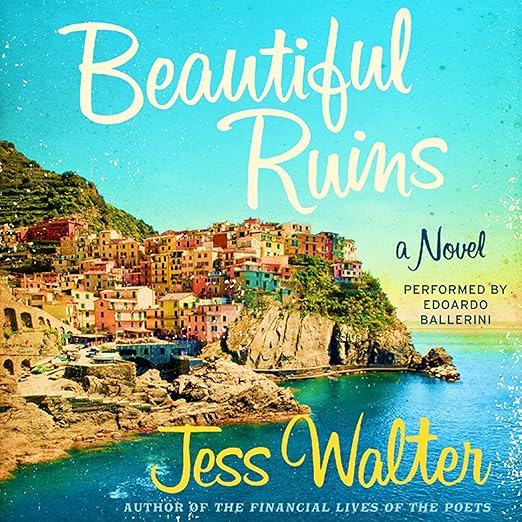
Jess Walter switches timelines, points of view, and even document formats within single chapters of Beautiful Ruins, moving from 1962 Italy to present-day Hollywood and back without ever losing the reader, and reviewer M. de Koning Gans singles out exactly this structural ambition in the audiobook, noting how each chapter shifts perspective and even letter types while somehow keeping everything clear.
That structural confidence is the first thing you notice across nearly thirteen hours that connect a dying actress waiting in a tiny Italian coastal town in 1962 to a Hollywood pitch meeting fifty years later. Walter, previously known for The Financial Lives of the Poets, builds Beautiful Ruins around an almost-love-affair that spans that entire gap, and the novel's confidence in jumping across decades is part of what critics responded to.
Beautiful Ruins Means the Characters Themselves
Richard Russo's blurb calls it 'an absolute masterpiece,' and reviewer Chelsea Heidt frames the title itself as the key to the whole book, describing it as the story of the beautiful ruins of the characters' lives rather than any literal ruin. The plot centers on three people, Dee Moray, Pasquale Tursi, and Michael Deane, and Heidt's review notes Dee first appearing as a dying actress in a small Italian town, a detail that sets the emotional stakes for everything that follows across the decades-spanning structure.
Walter works across genres in his broader career, and that versatility shows in how comfortably Beautiful Ruins moves between literary drama, Hollywood satire, and genuine romance without fully committing to any single genre's conventions. The novel's willingness to be funny about the film industry while still taking its central love story seriously is part of what several reviewers, and blurb writers, responded to.
Ballerini Signals Every Tonal Shift Clearly
Edoardo Ballerini narrates, and his reputation as one of contemporary audiobook narration's most respected voices, particularly for literary fiction that demands tonal range across shifting perspectives, suits Walter's structure well. A book that moves this freely between eras, character viewpoints, and even document styles within chapters needs a narrator capable of signaling those shifts clearly without over-explaining them, and that kind of control is exactly what this material calls for.
M. de Koning Gans also calls it an extremely funny story despite the emotional weight of its central premise, and that tonal balance, comedy and genuine heartbreak sitting close together, is part of what makes Beautiful Ruins distinct from a straightforward literary romance. The New York Times blurb calling Walter 'a ridiculously talented writer' is doing real work here too, since the novel's confidence in tone-shifting is exactly the kind of skill that blurb is pointing at.
Ballerini has built a reputation across a large catalog of literary fiction narration, and audiobook trade press has repeatedly singled him out for exactly the kind of controlled, character-differentiated performance this novel requires. That track record matters here specifically because Beautiful Ruins introduces a genuinely large ensemble across its two timelines, and a less capable narrator could easily let minor characters blur together.
Tracking Two Timelines Takes Careful Listening
The structural ambition that makes this novel distinctive also means it asks more of a listener's attention than a linear narrative would. Jumping between 1962 Italy and modern Hollywood, following three central characters across decades, requires tracking timeline and context shifts by ear, without the visual chapter breaks a print reader gets for free. Listeners who prefer straightforward chronological storytelling should know this before committing to the full runtime.
Reviewer C. Irish, who says she does not usually read bestsellers and came to this one somewhat by chance, still rated it highly, but her review also signals that this book's appeal depends on being drawn in by the premise itself, an almost-love-affair spanning fifty years, rather than by genre conventions. If that specific hook does not grab you from the synopsis, the payoff across thirteen hours may feel less earned.
The novel's Hollywood sections, set in the present-day film industry, also carry a satirical edge that sits in a slightly different register than the 1962 Italian coastal sections, and listeners should expect that tonal gear-shift rather than a single consistent mood sustained across the full runtime.
Michael Deane Anchors the Hollywood Half
Michael Deane, the third central figure alongside Dee Moray and Pasquale Tursi, anchors the novel's Hollywood satire specifically, and his presence lets Walter needle the film industry's excesses without losing sympathy for the more sincere, earthbound story unfolding in Italy decades earlier; balancing those two registers within one ensemble cast is a genuine structural achievement. Beautiful Ruins built a substantial readership beyond typical literary fiction circles, helped along by blurbs from writers like Richard Russo carrying real weight with readers who trust that kind of endorsement, and the audiobook gives new listeners a chance to discover why it resonated with such a wide range of readers when it was first published.
This audiobook suits listeners who enjoy literary fiction with real structural ambition, multiple timelines, shifting perspectives, and tonal range between comedy and heartbreak, narrated by someone with the range to make those shifts legible. Fans of Walter's earlier The Financial Lives of the Poets, or listeners who appreciate novels that reward close attention, will find plenty here. Listeners who enjoyed other structurally adventurous literary novels of the same era, ones that trust readers to hold multiple timelines and perspectives at once, will find Walter working in comfortable company here.
If you want something linear and easy to half-listen to, this is probably not the best match; the structure demands real attention. But for anyone drawn to the central premise, an almost-romance that survives fifty years and two continents, Beautiful Ruins delivers a genuinely well-constructed, emotionally rewarding listen backed by a narrator capable of doing the material justice.
Do I need to have read The Financial Lives of the Poets before listening to the Beautiful Ruins audiobook?
No, Beautiful Ruins stands entirely on its own; no prior familiarity with Jess Walter's earlier novel is needed.
Is the Beautiful Ruins audiobook told in chronological order?
No, it moves between 1962 Italy and modern Hollywood across multiple character perspectives, which asks more careful attention from listeners than a straightforward timeline would.
How long is the Beautiful Ruins audiobook?
It runs twelve hours and fifty-three minutes.