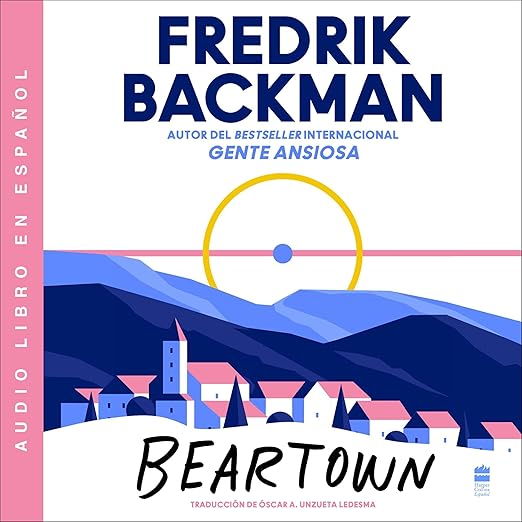
Beartown begins not with a game but with a community's hunger for one. Fredrik Backman opens his novel in the place where Beartown's entire identity lives: the rink beside the lake, where Kevin, Amat, Benji, and the rest of the junior ice hockey team are preparing for a semifinal that the town has built its collective self-image around. That setup sounds like a sports novel, and for its first act it almost is. Then something happens in the dark after a party, and nothing about Beartown is simple again. This Spanish-language audiobook, narrated by Irene Repeto, runs nearly sixteen hours and delivers Backman's layered moral inquiry into small-town loyalty in translation, carrying one of the most serious novels of his career into a different linguistic register for a different audience.
The edition context matters here: this is the Spanish-language version of Beartown, not the English-language release. For listeners practicing Spanish or preferring to experience Backman's work in their language, that is exactly what this audiobook is for. Reviews are split sharply on the translation quality. One listener appreciated the edition for language practice and found the translation satisfying. Another, a native Spanish speaker, found the translation "deficiente" and objected to regional Hispano-American idioms that felt incomprehensible from a Castilian Spanish perspective. That translation controversy is a real consideration worth understanding before purchasing.
Backman's actual novel is among the most serious things he has written. Most English-reading audiences know him through A Man Called Ove or Anxious People, works that deploy humor and sentiment in roughly equal measure. Beartown has some of that warmth in its portrait of a community, but the novel's central event, a violent act whose perpetrator the town knows and whose victim the town struggles to support publicly, cuts through any comfort quickly. The book is about what happens when collective love for a person or an institution becomes a reason to protect rather than confront wrongdoing. It is not a comfortable inquiry, and the audiobook format, which places you inside these characters' choices for sixteen hours, makes the discomfort productive rather than avoidable.
Repeto handles the ensemble with clarity. Backman writes in an omniscient register that moves fluidly between Kevin's certainty, Amat's ambition, Benji's complexity, and Maya's trauma, and across a long audiobook that ensemble management requires consistent vocal differentiation. Repeto maintains that tracking without theatrical exaggeration, which is the right call for a novel this emotionally dense. The temptation to dramatize characters in a sports-town context is real, and her restraint serves Backman's understatement.
Hockey's Load-Bearing Wall Cracks Under Real Weight
The novel's central question about what a community owes to its victims when the perpetrator is its greatest asset is asked through the specific grammar of hockey culture in a small, economically struggling forest town. Backman is precise about how that specificity works: the sport is not interchangeable with any other. Hockey in Beartown represents economic survival, collective identity, and a version of masculine virtue that the town has organized itself around. When that structure is forced to account for the violence it may have enabled, the cracking sound is loud because the load-bearing wall was so thick, and the community had invested so much in believing it would hold forever.
Readers who found Anxious People emotionally devastating will recognize Backman's structural technique. He builds attachment to characters across a wide ensemble through small comic or tender details, and then tests that attachment against moral decisions. The decision points in Beartown hit harder than in his lighter work precisely because the stakes are not just personal but collective and communal. A whole town has to decide what kind of place it is, and the audiobook format makes sitting with that decision feel inescapable in the best way.
This Edition's Hispano-American Spanish May Frustrate Castilian Ears
The Spanish-edition translation issue warrants full attention before purchasing. The one-star review from a native Spanish speaker cited idiomatic turns that did not translate cleanly into her regional Spanish, a real problem with literary translations of dense, character-driven novels where regional vocabulary choices can create comprehension friction. This edition appears to use Hispano-American Spanish, which may create difficulties for listeners from Spain who expect Castilian constructions and register. If that describes your linguistic background, the translation experience may add unnecessary friction to what is already a demanding novel emotionally and structurally.
The novel is also significantly darker than Backman's international reputation might lead a listener to expect. If Beartown appears on your radar because you loved the gentle melancholy of A Man Called Ove, prepare for something considerably more unsparing. The novel handles sexual violence with seriousness and specificity, and some of what Backman describes is deliberately difficult to read or to hear. That difficulty is not gratuitous but necessary to the novel's moral purpose.
Repeto's Narration Suits Intermediate Spanish Learners
This specific audiobook is best suited for Spanish-language listeners comfortable with Hispano-American Spanish who want to experience Backman's most morally serious novel in their preferred language. Language learners at an intermediate-to-advanced level using the audiobook to build literary vocabulary will find Repeto's narration clean and the subject matter rich with the kind of character-driven, socially embedded language that literary learning benefits from. Listeners who want the full English-language experience of Beartown should seek the English edition. Those who are sensitive to depictions of sexual violence and its community aftermath should approach this novel with full awareness of what Backman is working through. This is not background listening by any measure.
Questions Listeners Ask
Is this audiobook the English-language version of Beartown, or is it a different edition?
This is the Spanish-language edition of Beartown, translated from Fredrik Backman's original Swedish. The synopsis and reviews confirm this is a Spanish translation. Listeners expecting the English edition should verify which version they are purchasing before buying.
Does this audiobook work for listeners who are learning Spanish and want to use Beartown as a practice text?
One reviewer specifically used this audiobook to practice Spanish and found the translation and narration satisfactory for that purpose. The novel's literary language is demanding, so intermediate-to-advanced learners will get the most from the experience.
At nearly sixteen hours, does this audiobook sustain its momentum across the full runtime?
Most readers find that Backman's technique of building deep character attachment before subjecting those characters to moral tests sustains engagement throughout. The early sections establish the world and its people carefully, and that investment pays off in the novel's second and third acts where the community fractures.