January Andrews writes happily ever afters and has stopped believing in them, which is the joke this audiobook runs on for ten hours. Augustus Everett writes literary fiction and kills off his entire cast. They spend a summer in neighboring beach houses, both broke, both blocked, and strike a deal: he will write something happy, she will write the Great American Novel, and nobody will fall in love. That last clause is the one nobody believes, the book included.
How Beach Read Holds Up
Augustus gets the better half of the bargain on paper and the worse one in practice. January's assignment for him is a run of field trips worthy of any rom-com montage; his for her is interviewing surviving members of a backwoods death cult, which the description flags as the obvious choice with a parenthetical. That asymmetry is the structure. One writer is being taught to look at joy deliberately, the other that misery has research behind it and not only mood.
Ninety-nine ratings sit on a listing whose own copy opens by announcing a number one New York Times bestselling author, then names nine outlets that featured the book, from Entertainment Weekly to CNN. Those two facts do not sit comfortably together. The description is performing the reputation of a much larger book than the counter reflects, which usually means the readership found this novel somewhere other than this particular page. Anyone treating the rating count as a proxy for how widely read it is will be wrong by a wide margin.
Filing this under literature and fiction alongside romance is, unusually, exactly right, and the coincidence is almost too neat: a novel about a literary writer and a romance writer arguing over which genre tells the truth has been shelved in both at once. The tags underneath read Contemporary, Romantic Comedy and Women's Fiction. Whatever the cataloging intent was, the record has reproduced the book's own premise. The copy's opening line does something less useful, selling a novel published years afterward as the reason to try this one.
Why Beach Read Works as an Audiobook
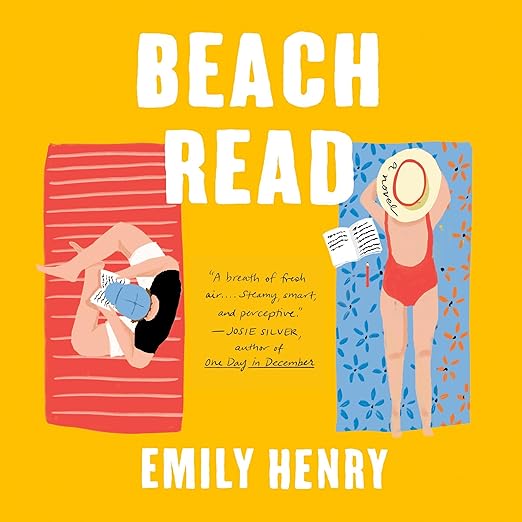
Grief is the load-bearing element under the comedy, and it arrives earlier than the cover art suggests. The page's lowest grade, a three awarded in February 2026, recounts the setup at length: January inherits her late father's beach house and learns things about his life she had not known. That is the engine. The romantic comedy is constructed on top of it rather than parked beside it, which is why the book keeps outrunning its own title.
Chemistry between the two is a slow burn by construction rather than by delay, since the deal keeps them inside each other's work instead of merely in each other's way. Four stars in January 2022 single out the darker material the pair research together as what that reader loved most, alongside the slow burn and an ending it calls refreshingly realistic. That last phrase is the useful one: the resolution is not a genre reflex arriving on schedule.
Julia Whelan is credited as reader on a first-person novel narrated by a romance writer, and the material makes a specific demand. It needs a voice that can carry sardonic interior monologue and then handle a scene about a dead parent without switching register so abruptly that the joke curdles. Add a second writer who talks in an entirely different key, and the whole difficulty of this book in any format lands on one performer.
Weak Spots in Beach Read
Nothing in the five written responses addresses the reading. Every one of them discusses the novel: pacing, chapter length, January's temperament, the balance of comedy and grief, the ending. Not one mentions the reader, the delivery, or the experience of hearing this rather than turning pages, on a listing whose narrator credit is among the better-known names in the field. That is not a verdict on the recording. It does mean the star average has nothing to say about this edition in particular.
Crying and vomiting are the pool's most concrete objection. One star came off in August 2025 for exactly that reason, and the buyer says so directly: January spends a great deal of the book in tears or being sick, with repeated references to a weak stomach, until the repetition turned distracting. Anyone sensitive to that deserves the warning, and it is fair: a recurring physical tic reads differently across ten hours than it does across a few hundred pages.
Ten hours and thirteen minutes is a long stay in one beach town, and this format sharpens a structural issue the book already carries. Where chapters run long, natural stopping points get scarce, and a listener who pauses in the middle of one loses the thread more easily than a reader who leaves a bookmark. The middle stretch, where the deal is working and neither writer has broken yet, is where that friction will actually be felt.
The Right Listener for Beach Read
Romance listeners who want the genre argued for rather than simply supplied are the natural audience, because that argument is the plot. The January 2026 five describes the novel as more reflective than the title suggests and notes that the pacing runs slower and the chapters longer than a beach book implies, while awarding five stars anyway. Emotional depth is the phrase it reaches for, and the phrase is doing real work.
Writers of any description will find the professional detail unusually exact: the blocked-manuscript panic, the contempt each genre keeps in reserve for the other, field trips as procrastination dressed up as research. Listeners arriving from this author's later novels should know the machinery is already fully assembled here, which is presumably why the description leads with a book published afterward. And anyone who likes a romance willing to take a death seriously has come to the right place.
Avoid it if you want the light beach read the title promises, because the book spends much of its length arguing that such a thing is mostly a story people tell about books. Anyone drawn in by the death cult should know it is a research trip rather than a plot. And anyone who needs one clean genre label should note that this record carries two, accurately. That is the trick the novel pulls, and the shelving has documented it by accident.
- Performance: Julia Whelan is credited on a first-person novel narrated by a romance writer, casting that the page's five written responses never get around to grading.
- What it covers: Rival genres and rival writers, grief after a parent's death, slow-burn enemies to lovers, writer's block.
- Feel: Funny on the surface, considerably heavier underneath.
- Our call: A romantic comedy carrying more grief than its title admits, and better for carrying it.
Good to Know
Does the audiobook work in short listening sessions?
Less well than most romantic comedies, because the chapters run long and the middle depends on tension accumulating between two people who talk constantly. Ten hours broken into brief pieces will cost you some of that momentum. Longer sessions suit it better, which is inconvenient for exactly the audience the title is courting.
How much of the audiobook takes place at the beach houses?
Most of it. The premise puts the two writers in neighboring houses for three months, and the field trips are excursions out and back rather than a change of setting. Ten hours in one town with two people is a great deal of proximity, which is the design: the deal only works because neither can avoid the other.