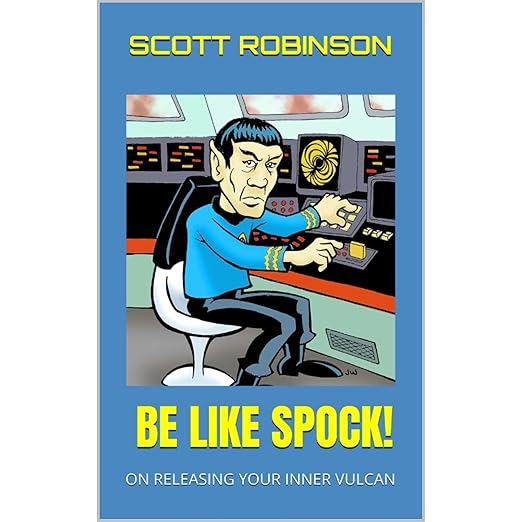
Zeno got to reasoned self-command roughly seven centuries before Surak did, which is the premise this audiobook runs on. Scott Robinson's argument is simple and it holds: the Vulcan philosophy of logic, emotional mastery and cosmic connectedness that Star Trek gave to its Vulcans is a fictionalized restatement of something Greek thinkers built long before. Paleos Media released the recording in March 2026 at two hours and twenty minutes, and the reader credit on the record is not a person.
Zeno Beat Surak to This by Seven Centuries
Stoicism and Vulcan discipline arrive as the same argument twice, and the copy lays the chronology out plainly. Trek lore places Surak around Earth's fourth century, some two thousand years before the era most viewers know. Zeno began sketching a very similar course more than three hundred years before the common era, which the description points out is a full seven hundred years earlier. Reason, contemplative mastery of emotion, the connectedness of the universe, strict self-governance: the shopping list matches almost item for item.
Something has gone wrong in the series slot. The record carries a series name of Be Like Spock! Modern Stoicism, Vulcan-Style with a volume number of one, which means the phrase that actually tells a browser what this book is has been parked where a multi-volume set should go. The displayed title is three words and an exclamation mark. A buyer scanning results sees a Trek joke and has to click through to learn that the subject is philosophy.
Shelving is the second oddity. This sits under arts and entertainment with a single tag reading Art, which is a category built for books about painting and performance. Anyone browsing for practical philosophy will not pass through here, and anyone browsing Art will find a Vulcan on the cover and keep going. For a self-released title with two ratings, that misfiling is not cosmetic. It is most of the reason nobody has found it.
The Lore Is Doing Real Teaching Work
Fandom turns out to be a serious pedagogical asset. Vulcan discipline is the most widely understood model of emotional regulation in popular culture, which means a reader arrives already fluent in the intuition the philosophy is trying to install. Robinson does not have to explain what it looks like to govern a feeling rather than obey it, because the demonstration has been familiar from the screen for most of a lifetime. The conceit saves whole chapters of groundwork.
D&S, writing at five stars in the final hours of 2025, describes exactly that effect from the other side: a nerdy Trek fandom and a love of Stoic reading meeting in one short book, with the Vulcan imagined history working as a device that illuminated the philosophy and prompted further thought. That response also confesses to not having realized how deep the Vulcan folklore ran, which is the tell. The lore is doing real teaching work, not decoration.
Brevity is the last virtue worth naming. Two hours and twenty minutes is an evening, and the description is refreshingly unwilling to oversell what fits there, hoping only to offer some useful information and insights for anyone who might undertake the study. Introductions to philosophy usually arrive at four times this length and half this honesty about their own ambitions. A listener who wants to know whether the subject is for them can find out in one sitting and lose nothing if the answer is no, which is a fair bargain and a rarer one than it sounds.
A Recording With No Human Timing Behind It
Virtual Voice sits in the reader field, which is a synthetic text-to-speech credit rather than a person, and it costs this particular book more than it would cost a manual. The material is affectionate, jokey and occasionally sly, and the pleasure of a line about Vulcans depends on somebody landing it. A recording with no human timing behind it hands the whole comic register back to the listener to supply.
Both written responses predate the recording. One landed on November 3, 2025, the other on the last day of that year, and the audio arrived on March 15, 2026, so the two ratings on this page were earned by a text and belong to it. Both use the word read, and both were describing a text. Useful signals about the writing, none about the release you are actually buying.
Nothing on the page indicates what ground the book covers. No table of contents, no chapter titles, no note of which Stoic ideas get treated and which get named and left. For an introductory volume of this length that matters, because the difference between a survey and a sampler is the difference between a starting point and an afternoon. You find out by listening, which is a poor way to decide whether a book is the one you needed. Self-released titles carry this problem constantly, and it is the easiest of all the flaws here to fix.
A Door Rather Than a House
Trek fans curious about the philosophy underneath a character they already love are the obvious audience, and Paul T's five-star note puts it well: a light-hearted guide that applies the character's principles of logic and emotional control to ordinary human problems, aimed at anyone wanting more rational decisions and a little calm in a chaotic world. That is the promise, delivered at the scale it promises.
Wrong book for anyone already deep in the ancient texts, who will find familiar ground crossed at speed and with a costume on. Wrong book, too, for listeners who cannot tolerate synthetic narration, since that is what the credit says you are getting. And anyone hoping for citations, translations or a reading list will have to go looking elsewhere.
Short, cheerful, and smarter about its own limits than most introductions manage. The Vulcan framing earns its keep instead of decorating a lecture, and the book knows it offers a door rather than a house. Whether the synthetic reading spoils that depends entirely on how much of the humor you are willing to supply yourself.
Frequently Asked Questions
Do you need to know Star Trek to follow this audiobook?
A little helps. The description leans on Spock calling Surak the greatest of all who ever lived on our planet and the father of all we became, and assumes you recognize why that matters. You do not need episode knowledge, but the names and the Vulcan temperament need to mean something to you already.
Does the audiobook teach real Stoicism or mostly Vulcan lore?
Real Stoicism, with the lore as the lens. The copy states the equation directly: studying Stoicism is in essence studying what it means to be a Vulcan, logical, contemplative, peaceful, with emotions well managed. Trek supplies the vocabulary and the examples, while the underlying material is the Greek tradition.
How much philosophy background does it assume?
None. The book calls itself introductory and its stated aim is modest, offering some useful information and insights to anyone who might take up the study. Expect orientation, definitions and a case for why the pursuit is worth making, rather than close work on primary texts or competing schools.