Behind Schindler's List's Wedding Scene, a Fuller Story
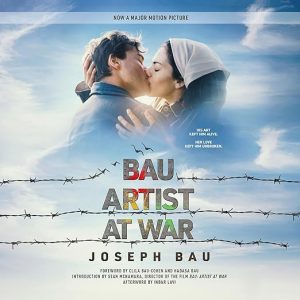
Joseph Bau's memoir occupies a specific and remarkable position in Holocaust literature. Most people who have seen Schindler's List carry a memory of the clandestine wedding scene in the Plaszow concentration camp, one of the film's most quietly devastating moments. The couple married in that scene, Joseph and Rebecca Bau, are the subjects of this audiobook, and what Bau: Artist at War provides is the first-person account behind that image. Narrated by Assaf Cohen, the audiobook runs six hours and twenty-five minutes and includes a foreword by Clila Bau-Cohen and Hadasa Bau, daughters of Joseph and Rebecca, and an introduction by Sean McNamara, director of the 2025 film adaptation starring Emile Hirsch. The book is presented as what it is: a survivor's testimony that is also, inescapably, a love story.
The craft challenge Bau faced in writing this memoir was formidable. How do you maintain honesty about the Plaszow concentration camp, the bombing of Krakow, the ghetto's brutality, and the last desperate days at Oskar Schindler's factory, while sustaining the memoir's genuine tonal counterweight: the surprising wit and irony that Bau deploys throughout? The answer, as the audiobook makes clear, is that the tone is not a defense against the horror but a product of the same sensibility that drove Bau's art. His brilliant black-and-white drawings, referenced throughout and available as a PDF with the audio purchase, illuminate the text with a draftsman's precision that extends into the prose itself.
Assaf Cohen Holds Horror and Wit Together
Cohen is the right narrator for this material. He brings a measured emotional authority to Bau's first-person account without sentimentalizing the memoir or flattening its sardonic edges. The shifts between the documentary horror of concentration camp life and the passages of genuine comedy, Bau writes with surprising wit about bureaucratic absurdities and human resilience that manages to coexist with atrocity, require a narrator who can hold both registers without forcing a reconciliation between them. Cohen does this consistently, and the result is a narration that honors the memoir's tonal complexity rather than simplifying it for an audience that might expect unrelieved tragedy.
The memoir's framing of Rebecca Bau is worth special attention. One reviewer noted that the book felt more like "a wartime memoir with the relationship mentioned rather than a love story in wartime," and while this is a fair description of the memoir's emphasis, it misses something important. Bau is explicit that "above all" his story is a celebration of Rebecca, whose mutual devotion with her husband fueled their humor, resilience, and survival. The love story is not a conventional romance arc; it is the emotional fact that makes the survival meaningful rather than merely lucky. The audiobook format suits this because Cohen's narration gives the moments in which Rebecca appears a particular warmth that accumulates across the runtime rather than requiring a single dramatic payoff.
The foreword by the Bau daughters adds a layer that the audio format handles particularly well. Hearing family members speak to their father's experience in their own voices, however briefly, before the memoir begins establishes a chain of testimony that deepens the historical weight of what follows. This is exactly the kind of contextualizing material that tends to get skipped in print but is harder to bypass in audio.
Bau's Drawings and Prose Work in Dialogue
Bau's painstaking prose is the result of a draftsman's sensibility applied to language: he describes physical environments, human faces, and moments of violence with the precision of an artist whose medium is normally visual. The drawings that accompany the text, available in the PDF, work in dialogue with the memoir rather than as illustration. Listeners who engage with both will find that the visual and textual perspectives on the same events create a richer composite than either provides alone. The audio of Cohen reading Bau's descriptions of what he drew, paired with the drawings themselves, is a more layered experience than simply hearing the story told.
The book covers ground familiar from Schindler's List while adding dimensions that the film could not include. The memoir's account of daily life inside the Plaszow camp, the specific social dynamics among prisoners, the particular cruelties of individual guards alongside the unexpected moments of grace, all of this carries the authority of lived experience rather than narrative reconstruction. Bau is not writing for dramatic effect; he is writing because he is one of the last people who can write from inside these specific experiences.
The book's timing is explicitly noted in the materials: it comes at a critical moment when the last survivors of the German concentration camps are dying and the Holocaust is slipping from living memory. This is not rhetorical pressure applied to the reader but a factual observation that gives the memoir its particular urgency as a document. Cohen's narration carries this weight without the text having to announce it repeatedly.
Essential for Readers of Levi, Wiesel, and Frankl
This audiobook is essential listening for anyone with an interest in Holocaust memoir, in the specific stories behind Schindler's List, or in the intersection of visual art and survival narrative. Assaf Cohen's narration makes the six-hour runtime feel both complete and insufficient: the story is both fully told and impossible to exhaust. Readers of Primo Levi, Elie Wiesel, or Viktor Frankl will find in Bau a voice that belongs in that company while being entirely its own.
Those who find Holocaust literature emotionally overwhelming and require distance from the material will find Bau's wit provides some respite, though the audiobook does not soften the historical record. Listeners looking for a conventional love story with narrative arc and resolution will find the memoir's emphasis on wartime testimony rather than romantic progression initially surprising, but the accumulation of detail about Joseph and Rebecca's relationship across the full runtime is more affecting for its restraint than a more conventional love story arc would be.
Quick Take
- Voice: Assaf Cohen brings genuine emotional authority to Joseph Bau's memoir, handling the shifts between horror and sardonic wit with a calibration that avoids both sentimentality and detachment.
- Big ideas: Love and survival in the Holocaust, art as resistance, the clandestine marriage at Plaszow
- Atmosphere: Harrowing and luminous in equal measure
- Worth it?: Joseph Bau's memoir is an extraordinary document of art, love, and survival that the audio format delivers with the intimacy the first-person account deserves.
Common Questions
Is the Bau: Artist at War audiobook the same story depicted in the Schindler's List wedding scene?
Yes. Joseph and Rebecca Bau are the couple shown in the clandestine wedding scene in Steven Spielberg's film. This memoir is Joseph Bau's own first-person account of their survival, their secret marriage at Plaszow, and the broader context of their experience through the bombing of Krakow, the ghetto, and Schindler's factory.
Does the Bau: Artist at War audiobook include access to Joseph Bau's drawings?
The accompanying PDF, which includes Bau's black-and-white drawings, is available in your Audible library when you purchase the audiobook. The drawings are referenced throughout the narrative and complement the text significantly, so engaging with the PDF alongside the audio is worthwhile.
Is this audiobook more focused on the love story or the historical wartime account?
The memoir emphasizes historical testimony more than conventional romantic narrative. One reviewer noted it felt more like a wartime memoir in which the relationship is present but not the primary engine. That said, Bau explicitly frames the whole memoir as a celebration of Rebecca, and the emotional weight of their devotion accumulates throughout rather than being concentrated in dramatic romantic scenes.