- Narrator: Mauricio Rivero Borrell handles both the political dialogue and the mech combat sequences with confidence, giving distinct presence to Julian Davion and Erik Sandoval.
- Subjects: Political rivalry within military alliance, feudal loyalty vs. self-interest, the cost of liberation
- Tone: Dense with intrigue and punctuated by sharp military action, rewarding for series veterans
- Bottom line: One of the stronger entries in the BattleTech novel line, but requires prior investment in the Federated Suns arc to land with full impact.
I came to the BattleTech universe late, through a listener recommendation after I reviewed a different military science fiction title, and I will admit I spent the first hour of The Damocles Sanction doing some catching up. This is the twenty-third novel in a sprawling shared-universe franchise spanning decades of fiction, and author Michael J. Ciaravella is not writing for newcomers. If you walk in cold, you will know it. Once I had enough orientation to follow the political fault lines, though, I was in.
The book's central situation is one of the most compelling in recent BattleTech fiction, from what I can assess: the Federated Suns, long one of the dominant interstellar powers in the Inner Sphere, has been weakened by internal conflict and enemy occupation. Its capital world, New Avalon, has been held by the Draconis Combine for years, forcing First Prince Julian Davion to govern his fractious nation on the run. The liberation of New Avalon is finally at hand, but the relationship between Julian and his Prince's Champion, Field Marshal Erik Sandoval, is one of barely contained rivalry as much as it is one of alliance.
How BattleTech: The Damocles Sanction Holds Up
What elevates this above standard military science fiction is the depth of the political texture. Ciaravella takes the BattleTech franchise's foundational premise of space feudalism seriously rather than treating it as window dressing. The Great Houses in lesser BattleTech novels, as one reviewer noted, often function like modern nation-states with nobles who simply take orders. Ciaravella renders them as actual feudal structures, complete with competing loyalties, self-interest, and the kind of multi-layered intrigue that makes every apparent alliance feel provisional.
Julian and Sandoval's dynamic drives this. Two men who need each other and distrust each other, working toward the same military objective while positioning themselves for the political aftermath. Ciaravella manages the balance well enough that I never felt entirely sure whose side I was supposed to be on, which is probably the right feeling for a novel about political survival in a feudal interstellar context.
Why BattleTech: The Damocles Sanction Works as an Audiobook
Mauricio Rivero Borrell is a strong choice for this material. BattleTech fiction requires a narrator who can handle both military briefings and personal political confrontations, and Borrell manages both registers. His voice work on Julian gives the First Prince a weight that suits someone carrying both the burden of office and the memory of his predecessor's catastrophic decisions. The mech combat sequences, which BattleTech readers will come for, are handled with enough kinetic energy to feel genuinely exciting rather than merely technical.
The novel runs nearly ten hours, which is appropriate for a story with this much political architecture. Some reviewers noted the pacing is slow and drawn out in places, and I think that assessment is fair. Ciaravella is doing serious character and political work between action sequences, and readers who come primarily for the mech fights may find the middle sections testing their patience.
Weak Spots in BattleTech: The Damocles Sanction
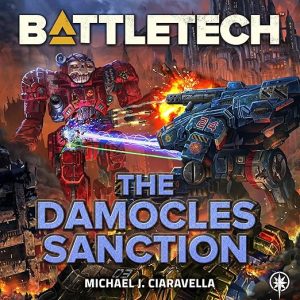
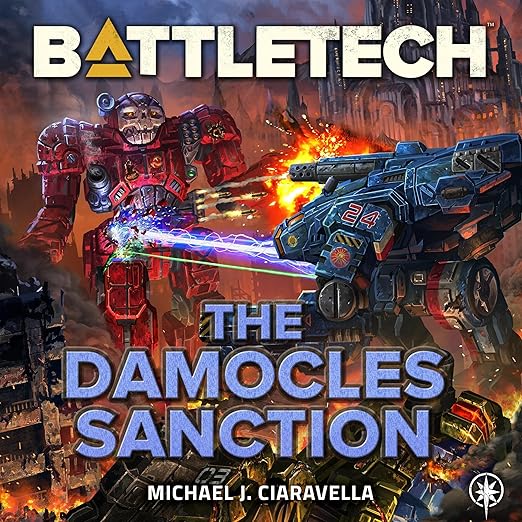
The military hardware in BattleTech fiction is part of the franchise's appeal, and Ciaravella handles it with evident enthusiasm and knowledge. The Vulpes Battlemech, which features prominently in the novel, is described in enough detail to satisfy equipment enthusiasts without becoming a technical manual. Erik Sandoval's mech selection is treated as characterization as much as tactical choice, which is the right instinct for a book that cares as much about personality as it does about firepower.
One editing concern flagged by multiple reviewers deserves mention: the text reportedly contains a higher-than-expected number of simple errors that should not have survived editorial review. In audio form, this is less intrusive than it would be in print, but listeners who notice grammatical inconsistencies may find it mildly distracting.
The Right Listener for BattleTech: The Damocles Sanction
Series veterans who have followed the Federated Suns arc, particularly anyone who read Grey Watch Protocol or Paid in Blood, will get the most from this novel. The political payoff is substantial for anyone who has been tracking the consequences of Caleb Davion's catastrophic earlier decisions, and the liberation of New Avalon carries genuine emotional weight if you have the context for it.
New listeners to BattleTech can technically start here, but should expect to spend time getting oriented. The universe is complex, the cast is large, and Ciaravella writes with the confidence of someone who assumes a knowledgeable audience. If you are curious about the franchise and want a strong entry point, this is a reasonable choice, but managing expectations about the learning curve is important.
Frequently Asked Questions
Do I need to read other BattleTech novels before The Damocles Sanction?
For full impact, yes. The novel builds on events set in motion by Caleb Davion's earlier decisions, and the Julian-Sandoval rivalry has backstory that makes their dynamic significantly richer with prior context. Reviewers who had read Grey Watch Protocol and Paid in Blood found the payoff especially strong.
How does Mauricio Rivero Borrell handle the large cast of characters?
He gives clear vocal distinction to the principal characters, particularly Julian and Sandoval, and manages the political scenes with appropriate gravity. The mech combat sequences benefit from his ability to shift pacing without losing clarity.
Is the novel primarily political intrigue or military action?
Both, with politics driving the overall structure and military action punctuating it. The balance leans more toward intrigue than straight combat, which reviewers with different expectations received differently.
How does this compare to other BattleTech novels in terms of quality?
Multiple reviewers placed it among the top tier of BattleTech fiction, specifically praising Ciaravella's treatment of feudal politics as genuine character material rather than background. The editing concerns noted in reviews are worth knowing about but do not undercut the novel's strengths.