Key Details
- Read by: Cameron Stewart narrates with no confirmed prior track record; Max Hastings's own eyewitness reporting credentials carry the weight instead.
- At its heart: the 1982 Falklands War, wartime journalism, imperial legacy, political fallout at home
- Vibe: Dense, authoritative, and unhurried
- Short version: The definitive British-perspective account for serious military history listeners, best paired with an Argentine source for real balance.
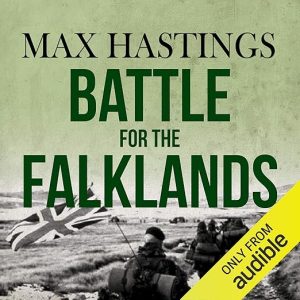
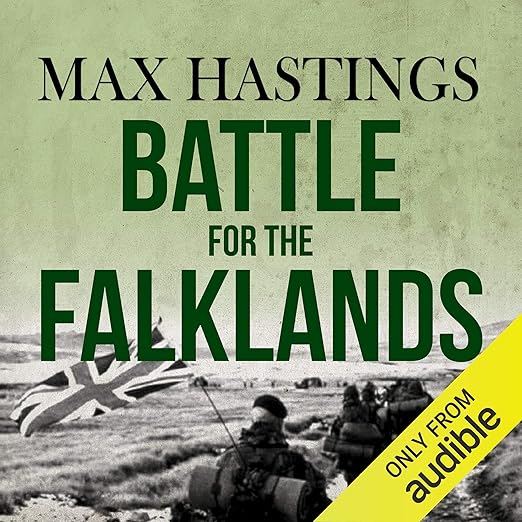
Max Hastings covered the Falklands War as a correspondent embedded with British forces in 1982, which means Battle for the Falklands isn't secondhand military history assembled from archives years later: it's an account partly built from his own reporting under fire. This audiobook, co-written with Simon Jenkins and narrated by Cameron Stewart across sixteen hours and twenty-four minutes, carries that firsthand authority into a genre often dominated by historians who weren't present for the events they describe.
Taught No Lessons but Boosted Fortunes
The scope here is genuinely comprehensive: 28,000 British troops sent 8,000 miles to defend, as the synopsis puts it, 'a tiny relic of empire,' covered from the political maneuvering that led to war through the military operations themselves and into the conflict's long political aftermath at home. The synopsis is candid that the war 'taught no lessons' in any larger strategic sense even as it boosted the political fortunes of the government that fought it, a tension the book treats as worth sitting with rather than resolving neatly.
This edition is part of the Pan Military Classics series, a reissue line specifically built around books already established as essential reading in their field, and the synopsis's own description, 'a modern classic of war reportage' and 'the definitive book on the war,' reflects that positioning rather than ordinary marketing language; this book has had four decades to earn or lose that reputation, and by most accounts it's held up.
The logistics alone make the war a genuine historical anomaly worth dwelling on: a naval task force sailing 8,000 miles to fight over an archipelago most Britons couldn't have located on a map before 1982, then successfully retaking it in a matter of weeks. The book treats that logistical achievement with the same rigor it brings to the political controversy, refusing to let the 'tragic absurdity' framing overshadow the genuine military accomplishment underneath it.
Simon Jenkins brings his own credentials to the collaboration beyond what the synopsis details, having built a long career in British political journalism and commentary; pairing a correspondent who covered the war directly with a journalist known for domestic political analysis is a sensible division of expertise for a book that has to cover both battlefield and Westminster.
The synopsis's mention of boosted political fortunes refers, without naming her directly, to Margaret Thatcher's government, whose approval ratings recovered sharply after the war's successful conclusion; that political dimension, a military campaign reshaping a prime minister's domestic standing, is exactly the kind of consequence the book treats as inseparable from the battlefield narrative itself.
Depth of Research, Political and Military Both
Hastings brings journalistic credentials that matter directly to this material: editor of both the Daily Telegraph and the Evening Standard, with, per the synopsis, awards specifically for his south Atlantic reporting in 1982. Reviewer Emily C. praises the 'depth of research' across 'both the political context and the military operations,' exactly the dual expertise a working war correspondent turned editor would be positioned to deliver.
Reviewer EDH Father of Four highlights a specific, less commonly known detail the book covers: lobbying by the Falkland Islands Company that helped block an earlier transfer of the islands back to Argentina, a piece of pre-war political history that explains motivations most surface-level accounts skip entirely. That kind of granular political detail is exactly what separates a definitive account from a competent summary.
The Pan Military Classics series exists specifically to keep essential, out-of-print or hard-to-find war histories in circulation, and being selected for that reissue line functions as a kind of peer endorsement: editors specializing in military history judged this account worth preserving over the many competing histories of the same conflict written in the decades since.
Listeners drawn to books that blend journalism and history should note how unusual it is for a war correspondent's own on-the-ground reporting to mature into the definitive historical account decades later; Hastings's later career as a newspaper editor gave him the institutional standing to revisit and expand his original wartime reporting into something more comprehensive.
Cameron Stewart Carries Two Authors' Voices
This is dense, serious military and political history, not a breezy popular narrative. Reviewer D. Samuel Coles mentions using the book as a reference during graduate school research on the conflict, a strong signal of the level of detail and rigor to expect, and a reason to budget real attention across sixteen-plus hours rather than treating this as background listening.
Coles also recommends pairing this account with Ruben Moro's History of the South Atlantic Conflict for 'the other side of the hill,' a pointed way of flagging that Battle for the Falklands is written from the British perspective by British authors. That's not a flaw exactly, most war histories are written from one vantage point, but listeners wanting genuine balance between British and Argentine accounts should treat this as one half of a fuller picture rather than the whole of it.
No confirmed prior track record turned up for narrator Cameron Stewart, so the recommendation here leans on the strength of the source material and Hastings's own reporting credentials rather than a proven narration history.
A single narrator carrying two authors' distinct voices, Hastings's direct battlefield reporting and Jenkins's political analysis, is worth noting as a structural choice; listeners should expect one steady narrative voice throughout rather than any audible shift in register between the more visceral wartime chapters and the more analytical political ones.
The tension between 'tragic absurdity' and a war that 'confirmed the quality of British arms,' both phrases lifted directly from the synopsis, isn't an accident of marketing copy; it's the book's actual argument, that a conflict can be strategically pointless and still meaningfully consequential for the people who fought it and the government that sent them. Listeners expecting the book to resolve that tension one way or the other should expect it to stay unresolved instead.
The rating itself, 4.5 from 860 listeners, reflects a specialist audience finding exactly what it came for rather than a mainstream crossover hit, consistent with a dense, four-decades-old military history reissue rather than a book actively competing for casual browsers' attention.
Clean Case Study in Post-Imperial Conflict
Recommended for military history readers, students of the Cold War-era Conservative British government, and anyone interested in journalism that comes from direct, personal exposure to the events being described rather than after-the-fact archival research.
Listeners interested in the broader pattern of post-imperial conflicts, wars fought over the last scattered remnants of a former empire, will find the Falklands case an unusually clean example, since so little beyond national pride and legal sovereignty was genuinely at stake.
Skip it if you want a concise overview rather than a comprehensive one, or if a purely British-perspective account without an Argentine counterpoint feels like an incomplete way to understand a war between two countries.