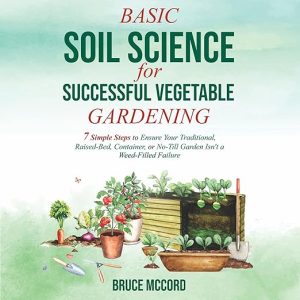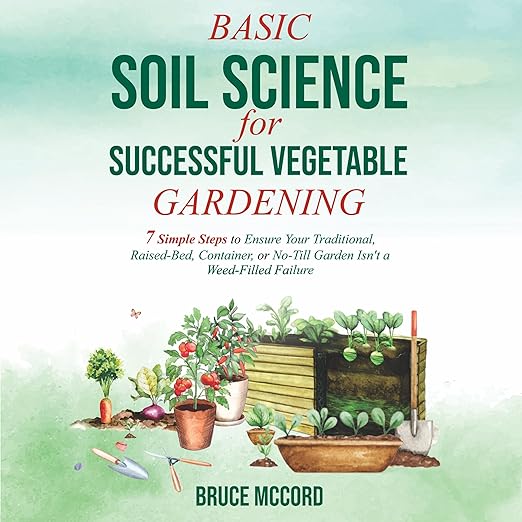
My first real vegetable garden failed in a way that retrospectively seems completely predictable. The soil was wrong. Not wrong in any dramatic way, but wrong in the compacted, nutrient-depleted, water-shedding way that is endemic to most suburban plots that have spent decades under lawn grass. At the time I did not understand what I was looking at, and nothing I had read about gardening had bothered to tell me. A book like Bruce McCord's would have saved me that first season of bafflement, because it addresses exactly the foundational knowledge that most beginning gardeners are missing when they buy seeds and start digging.
Released as the first volume in the Bruce's Basic Garden Guides series, this audiobook runs just over three hours, making it one of the more compact gardening resources I have listened to. At that length it cannot cover everything, and McCord does not pretend otherwise. What it does, with notable consistency, is give a first-time or near-first-time gardener the conceptual vocabulary to understand what is happening beneath the surface of their planting beds, which turns out to be the foundational piece that most beginner gardening advice skips entirely in favor of discussing seed varieties and watering schedules that mean nothing without soil context.
McCord's core argument is that most gardening mistakes trace back to not understanding what the soil is doing. Once you know what healthy soil structure looks like, why compost works the way it does, how drainage and water retention are related to soil composition rather than just rainfall, and what the five basic at-home soil tests can tell you, you can start making decisions based on observation rather than guesswork. That shift from random trial to informed adjustment is the book's real offering, and it is a meaningful one for anyone who has spent seasons fighting their own soil without quite knowing why the plants were not responding the way they should have been.
The coverage of composting is particularly thorough for a book this short. McCord explains not just what compost is but how to construct it, maintain it, and apply it to improve different soil types, a sequence that is practically actionable in a way that most gardening advice at this level is not. The section covering seven common beginner mistakes is likely to produce recognition in anyone who has lost crops without quite knowing why: overwatering is there, but so are less obvious errors around harvest timing and garden type selection that beginners rarely think to question until a second or third season has come and gone.
Morrison Delivers Soil Humor With Practical Authority
Several reviewers mentioned being surprised by McCord's sense of humor, and one noted that her husband was perplexed when she burst out laughing while someone was reading about dirt. This is one of the more charming reviews I encountered for a gardening book, and it points to something real about the listening experience. McCord writes with genuine warmth and an occasional deadpan that surfaces in unexpected places, which makes the three-hour runtime feel considerably lighter than the subject matter might suggest to someone who has never found soil science entertaining before.
James Morrison's narration reinforces this quality. He reads with a practical, slightly informal authority that avoids the tedious sonority some readers bring to instructional material. He sounds like someone who has actually worked in a garden rather than someone performing the role of agricultural expert from behind a lectern, which is a more useful register for a book aimed at beginners who may already be intimidated by the gap between their knowledge and what they want to grow. The combination of McCord's humor and Morrison's delivery makes this a surprisingly enjoyable listen for a how-to guide.
No Microbiome Deep Dive for Intermediate Growers
The word basic in the title is doing genuine work, and one dissenting reviewer flagged this clearly: if you arrive expecting a rigorous treatment of soil chemistry, microbiome ecology, or advanced amendment strategies, you will be frustrated. McCord is addressing people starting from very close to zero, and the depth calibrates accordingly. For that audience, the book is extremely well-executed. For the intermediate gardener who wants to understand how to interpret detailed soil test results or build a specific amendment plan for a diagnosed deficiency, the content runs out before the questions do and a more technical resource will be necessary.
Three Hours Cheaper Than a Bag of Potting Mix
The companion PDF available in the Audible library alongside the audio adds some of the visual reference that soil science genuinely benefits from, including the breakdown of different garden types with their comparative pros and cons. McCord covers raised beds, in-ground gardens, and container gardening, and seeing those comparisons laid out visually makes the audio treatment considerably more useful than listening alone. At three hours, the audiobook can slot into a single weekend morning without disrupting anything else. For a first-season vegetable gardener deciding where to invest their preparation time, starting here before spending money on raised bed materials and soil amendments is the logical sequence. Three hours of audio and a companion PDF for the price of a bag of potting mix is a genuinely good investment. Most of what goes wrong in a beginner's garden goes wrong underground, and McCord is one of the few voices in this space who addresses that root cause directly and without assuming you already know the basics he is trying to teach.
In Brief
- Voice: James Morrison reads with a practical, friendly authority that suits a how-to guide aimed at beginners without any gardening background.
- Big ideas: Soil health fundamentals, composting, beginner gardening mistakes
- Atmosphere: Warm and accessible, with occasional humor that surprised reviewers
- Worth it?: An honest, well-structured introduction to vegetable garden soil science that delivers exactly what its title promises, though experienced gardeners will want more depth.
Does Basic Soil Science for Successful Vegetable Gardening include practical exercises or is it purely explanatory?
It includes five basic soil tests that can be done at home without laboratory equipment, which gives the content a practical dimension beyond explanation. The composting sections also include actionable guidance on building and maintaining compost rather than just describing what it does.
Is there a PDF companion document included with the audiobook?
Yes. The synopsis specifically notes that a PDF companion document is available in the Audible library alongside the audio, which helps with visual content like the garden type comparisons and soil science illustrations that are harder to communicate in audio alone.
Does James Morrison's narration make the technical soil science content accessible in audio form?
Reviewers found the content accessible in audio, partly due to McCord's clear and occasionally humorous writing and partly due to Morrison's grounded delivery, which avoids the flat recitation that technical content can fall into. The companion PDF addresses the visual elements that are hardest to convey through narration alone.