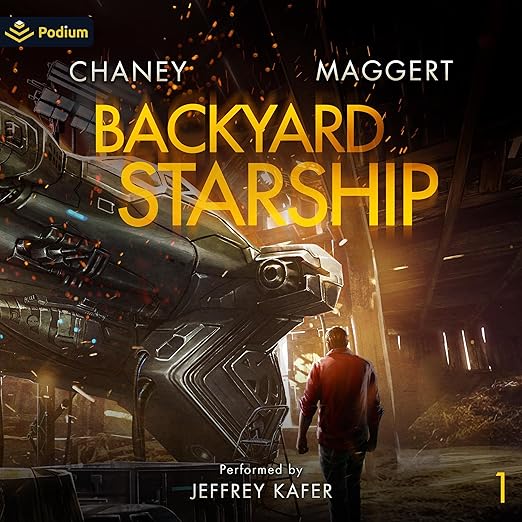
J.N. Chaney and Terry Maggert built the Backyard Starship audiobook around an idea so simple it should feel tired: ordinary man inherits extraordinary thing, discovers the world is bigger than he knew. What keeps it from feeling like a retread is the specificity of how that inheritance lands. Van Tudor does not stumble into a cave or receive a mysterious message from a stranger. He comes home to bury his grandfather and finds a starship under the old barn. The gap between those two things, farmhouse grief and galactic legacy, is where the book lives, and Chaney and Maggert spend real time in that gap before the engines fire. That choice to ground the fantastic in something genuinely sad gives the opening chapters an emotional texture unusual for this subgenre.
Jeffrey Kafer handles Van's first-person narration with an ease that earns trust quickly. His voice sits in that useful register between cocky and uncertain, which suits a protagonist who has to absorb an impossible reality without becoming either a wide-eyed idiot or an implausibly competent action hero. One reviewer specifically noted that the first-person construction makes the political and emotional upheaval of Van's situation easy to inhabit, and Kafer takes full advantage of that intimacy. When Van talks to Perry, the android bird who serves as his combat AI and reluctant companion, Kafer differentiates the two without resorting to caricature. Perry is dry where Van is earnest, and the dynamic between them is one of the audiobook's steadiest pleasures.
The book wears its influences openly. One reviewer invoked Doc Smith's Lensman series as a comparison point, and that lineage is audible. This is space opera in the classical mode, built around clear moral stakes, fast plotting, and characters you root for without being required to agonize over them. That is not a limitation but a design choice. Chaney and Maggert are not trying to deconstruct the genre. They are trying to write the kind of book you finish in a weekend and immediately want more of, and on those terms the first volume succeeds with real confidence. The appeal is recognizable to anyone who came to science fiction through mid-century pulp, and it translates well to audio.
The worldbuilding is light but purposeful. Space is described as far busier and more dangerous than Van could have imagined, and the authors earn that description through encounter rather than exposition. Van does not receive a lecture about galactic politics; he runs into consequences. The pacing reflects that approach throughout, with information arriving when it is immediately relevant and the story keeping its forward momentum. At just under thirteen hours, the audiobook does not outstay its welcome. Each chapter resolves enough to feel complete while introducing something new that makes the next chapter necessary.
What Makes Backyard Starship Worth Hearing
The audio format suits this book particularly well because Kafer's narration carries emotional texture that the prose alone might smooth over. Van's grief for his grandfather is real, and it threads through the adventure without becoming maudlin. When the old man's stories, the ones Van dismissed as elaborate fictions throughout his childhood, are revealed to be literal history, the moment lands with weight rather than just surprise. That weight is Kafer's work as much as the authors', and it is the kind of thing you feel in audio that a silent read can sometimes bypass.
The book has also been praised as genuinely family-friendly. One reviewer noted it as kid-safe while still delivering real action, including space battles and hand-to-hand combat with what they called space swords. The violence is present but not graphic, the romantic content barely registers, and the emotional stakes are clean enough that younger listeners can follow them without adult context. That is a rarer thing than it sounds in contemporary science fiction, where the genre has moved substantially toward content and moral complexity that excludes family listening.
Things to Know Before Starting Backyard Starship
The first section is slower than the rest. Chaney and Maggert take Van through the grief of returning home before they introduce the starship, and while that setup pays off, listeners expecting immediate liftoff should know the book earns its momentum rather than starting with it. It does not drag, but it takes its time establishing the emotional stakes before it rewards them with spectacle.
The plot of this first volume is also more about Van finding his footing than delivering a fully resolved conflict. This is a series opener, and it reads like one. The ending provides satisfaction without complete closure, which is exactly right for a first installment, but listeners who prefer self-contained story arcs should factor that in before committing to what appears to be a long series. The substantial following the series has built suggests the later books reward patience with the early groundwork.
Who J.N. Chaney Is Writing For
If you spent your teenage years working through Heinlein's backlist and have been looking for contemporary science fiction that shares that spirit without the dated social attitudes, this audiobook lands in exactly that space. It is also well-suited for listeners who want something the whole family can share. The adventure is genuine, the stakes feel real, and nothing requires content warnings beyond routine action-story violence. Readers who need morally complicated protagonists or literary ambiguity will find the book pleasant but unchallenging. Those who come to science fiction for the sense of wonder and the clean pleasure of a hero finding his place in a larger universe will find it more than satisfying.
Quick Take
- Read by: Jeffrey Kafer delivers Van Tudor's first-person voice with the kind of grounded warmth that keeps pulpy space opera from feeling lightweight, he earns every moment of wonder.
- At its heart: Inherited legacy, found family in space, the gap between myth and reality
- Vibe: Propulsive and fun, with genuine heart underneath the adventure
- Short version: A confident, entertaining series opener that rewards readers who grew up on Heinlein and want something new to devour.
Does the Backyard Starship audiobook work if you have not read anything else by J.N. Chaney?
Yes, this is the first book in the series and functions as a complete introduction. No prior Chaney titles are required, and the worldbuilding is built up from scratch through Van's perspective.
How does Jeffrey Kafer handle the android character Perry in the audiobook?
Kafer differentiates Perry's voice from Van's without exaggeration, playing the combat AI as drier and more clipped. The dynamic between them is one of the audiobook's consistent strengths.
Is the Backyard Starship audiobook appropriate for younger listeners?
Based on reviewer feedback, yes. The violence is described as space battles and sword fighting without graphic content, romantic elements are minimal, and the emotional stakes are straightforward enough for family listening.
Does the first audiobook resolve its plot, or does it end on a cliffhanger?
The ending provides enough resolution to feel satisfying but clearly sets up the series. Van's immediate situation concludes; the larger story is just beginning. It reads like a confident series opener rather than a frustrating cliffhanger.