At a Glance
- Narration: Ivan Busenius delivers the two-part structure clearly, well suited to hands-busy, companion listening while working outdoors.
- Themes: Backyard homesteading, raising chickens, food self-sufficiency
- Mood: Practical, encouraging, beginner-friendly
- Verdict: A genuinely useful beginner foundation for suburban and small-lot growers, best paired with print notes for the specific lists.
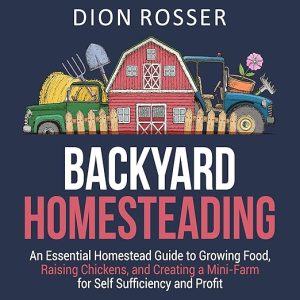
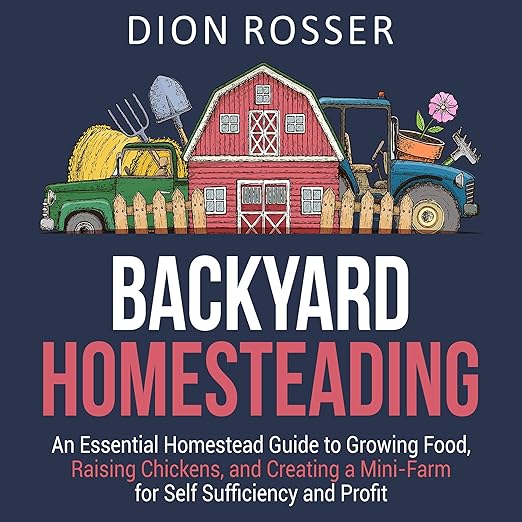
Panic buying, chemical-laden produce, and heavily processed food are the three problems Dion Rosser opens with, and growing at least some of your own food is the answer this audiobook spends six and a half hours building toward. Backyard Homesteading is the first entry in Rosser's Self-sustaining series, and it's built specifically around the premise that a listener doesn't need to buy a plot of land to start: working with whatever yard space is already available is enough to begin. Ivan Busenius narrates a two-part structure that moves from general homestead planning into a dedicated deep dive on raising chickens.
The book splits cleanly into two practical halves. Part one covers the planning fundamentals: sizing a homestead plan to an actual yard, selecting chickens, building a coop, laying out a garden across the growing season, and choosing perennial vegetables built to produce year after year rather than requiring a fresh planting cycle annually. Part two narrows in specifically on poultry care, walking through feeding and raising chicks, pullets, layers, and broilers as four genuinely distinct stages with their own requirements.
Reviewer Mike S. titled his four-star review plainly, 'the Backyard Homestead book is good basic beginner book, for someone thinking about homesteading.' The review itself confirmed the series positioning directly, noting 'Book 1. Backyard Homestead' before describing how it 'takes you through reasons to start a homestead.' That beginner-first framing matches the synopsis's own pitch: this is meant as a foundation-builder for someone at the very start of the homesteading decision, not a reference for someone already three growing seasons in.
The book opens by naming a real, current anxiety directly: panic buying, produce contaminated with chemicals, and food increasingly processed with artificial additives. That framing matters for who this book is actually written for; Rosser isn't pitching homesteading as a rural lifestyle fantasy so much as a practical response to real uncertainty about the food supply, which explains why the guidance stays grounded in what's achievable on an existing suburban yard rather than assuming a listener is ready to relocate to acreage.
Seven Years of Experience, Still Halfway Through by Day Two
CheckAmazonFirst's five-star review is the most enthusiastic of the three attached here, calling the book 'fantastic' and specifically praising how thoroughly it backs up its own advice, writing that 'this author doesn't leave questions unanswered' and that the book 'puts the lists and specifics in the book to back up the process.' That reviewer, with seven years of their own growing experience already behind them, still found real value in it, noting they were 'halfway thru' by day two, a genuinely fast pace for a six-and-a-half-hour instructional audiobook.
Will's review speaks directly to the suburban-scale audience the book is built for, describing efforts to 'grow our own food and meat' in the suburbs and crediting the book with new ideas both for the small space currently available and for planning ahead toward a larger property down the line. That two-horizon usefulness, practical for right now and a genuine planning document for later, is a real strength for a book explicitly aimed at people without existing farmland.
Part one's content previews are genuinely specific rather than vague: seven curated resources for new homesteaders, guidance on selecting chickens and building a coop, a full seasonal garden-planning calendar, and a named list of the ten best perennial vegetables for a yield that returns year after year without replanting. That level of specificity, actual named quantities and concrete categories rather than general encouragement, is exactly what separates a working reference from motivational content about self-sufficiency.
One specific bullet point from the synopsis deserves its own mention: guidance on 'mistakes to avoid that can lead to low-yield or no-yield seasons'. That's a meaningfully different kind of content than the success-only framing most beginner gardening material leans on, and it suggests Rosser is drawing on real observed failure patterns rather than only curating success stories, which tends to produce more durable, specific advice than pure encouragement does.
The synopsis frames its whole approach around one guiding instruction: 'use what you have on hand, and cultivate for the future.' That's a meaningfully more accessible starting point than most homesteading content, which often assumes acreage or a significant upfront investment before anything productive can begin. Building the entire beginner curriculum around present-tense resourcefulness rather than future land acquisition is what makes the suburban and small-lot framing feel genuine rather than aspirational marketing copy.
Great for Hands-Busy Outdoor Listening, Less for Charts
Specific plant lists, yield comparisons, and seasonal planning charts are exactly the kind of reference material that print or an accompanying PDF handle better than straight audio narration; a listener trying to remember which ten perennial vegetables were recommended, or exactly how a coop should be built, will likely want to revisit that material in text form rather than replaying an audio chapter. This is common to the genre generally, but worth flagging specifically for a book this list-heavy.
Mike S.'s own four-star framing, 'good basic beginner book,' is an accurate ceiling on what to expect: this is entry-level material by design, and anyone who has already been homesteading for several seasons, closer to CheckAmazonFirst's seven years of experience, may find part one covers ground they've already internalized, even if the poultry-specific detail in part two still has something new to offer.
How-to audio like this suits a specific listening context well: playing through a full chapter while actually out in the yard clearing space for a coop or mapping out garden beds, hands busy, information arriving passively rather than requiring a book open on a workbench. That practical companion-listening use case is a real strength of the audio format here, distinct from the reference-material limitation already noted above; the two aren't in tension so much as describing two different moments in the same homesteading project, planning at a desk versus building outside.
Little independent biographical information about Dion Rosser accompanies this listing, and reviewer CheckAmazonFirst's own uncertain 's/he' when describing the author is a small but telling sign of how little public profile exists here compared to a platform-driven homesteading personality with an established following. That's not disqualifying, the content itself is what reviewers consistently praise, but listeners who weigh an author's public track record heavily should know the available context stays limited beyond the book itself.
Best Entry Point for No-Farmland Chicken Starters
A serious itch to start growing food but no real farmland to speak of is the exact starting position this book is written for, especially for anyone drawn to the idea but intimidated by the assumption that homesteading requires acreage. Anyone specifically considering chickens as a starting point will get real, structured value from part two's dedicated feeding and care breakdown across all four poultry life stages.
Experienced homesteaders and anyone who already keeps chickens should expect this to function more as a refresher or a gap-filler than a source of new information, since the book is explicitly positioned as book one in a beginner-oriented series. And with only 48 ratings behind its 4.4 average, this is a smaller, newer listing than its genuinely strong reviewer enthusiasm might suggest at a glance.
Common Questions
Does this audiobook require owning land, or can I start homesteading on a small lot?
No land purchase required. The book is built specifically around using whatever yard space is already available rather than assuming acreage.
Does this audiobook cover raising chickens in detail?
Yes, the entire second half is dedicated specifically to feeding and caring for chicks, pullets, layers, and broilers as four distinct stages.