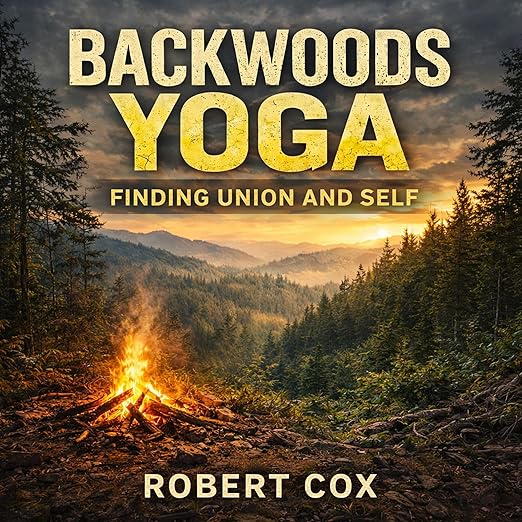
At a Glance
- Narration: author and reader are the same credit, Robert Cox, across fifty minutes of first-person field notes.
- Themes: Discipline without dogma, consistency after motivation fails, solitude and boredom, movement as psychological training.
- Mood: Terse, unsentimental, closer to a training log than a meditation.
- Verdict: A short, honest set of essays for people the studio never suited, sold on a page with no outside voice at all.
Fifty minutes of runtime is what this audiobook offers, and for once the brevity looks deliberate rather than thin. The material is described as essays, field notes and lived experiments, written from gym floors, basements, campsites and classrooms. Field notes are supposed to be short. What makes the length worth examining anyway is the topic list the same description supplies, which runs from consistency and psychological training through Yin practice, leadership, Western esotericism, Eastern philosophy and modern burnout.
Robert Cox occupies three fields on this listing: author, publisher and reader. On most self-published titles that concentration is a warning sign about editorial oversight. Here it is arguably the correct arrangement, because the book is built from personal field notes and the person who took them is the one saying them aloud. A hired professional reading somebody else's notes on cold mornings and empty gyms would be doing an impersonation. This avoids that problem entirely, at the cost of every other kind of outside input.
The stated position is combative from the first line. Not a studio manual. Not a detox plan. Not about incense, playlists, or pretending life is soft. What follows that triple negation is a definition worth arguing with: yoga as a technology of self-regulation, resilience and awareness, a way to sharpen the nervous system and stay upright in a world that keeps trying to pull you sideways. That framing puts the book closer to strength culture than to the wellness shelf it has been filed on.
Yoga in this account sits alongside strength work, controlled suffering, team dynamics and shared struggle, which is an unusual set of neighbors for the word. The copy also names a subject most practice books avoid: progress that is not linear and never polite. Anyone who has kept a practice going through a stretch where nothing improved will recognize the honesty in that phrase, and it signals a writer more interested in the ugly middle of a discipline than in the arrival. The same instinct shows in the promise of reflections on building consistency when motivation disappears, which is the only part of any practice that actually determines whether it survives the year.
Cox Narrates His Own Cold Mornings and Highways
Football programs, highways in Wyoming, bad habits, good teachers, empty gyms and cold mornings are the raw material the description promises, and that list is the strongest argument for pressing play. Those are memoir details rather than instructional ones, which means the book is likely to work as company rather than as curriculum. Fifty minutes of specific, located experience beats several hours of general encouragement, and the copy is refreshingly unembarrassed about where it was written. Basements and classrooms are not aspirational settings, and putting them in the pitch rather than hiding them tells you what register to expect.
Wyoming and gym floors also explain the title. Backwoods here signals distance from studio culture rather than any particular landscape, and the description hammers the point with a closing run of refusals: no gurus, no fake serenity, no curated enlightenment, just practice, just repetition. Read that as a stylistic warning as much as a philosophical one. The prose in the description moves in fragments and hard stops, and since the author is the reader, that clipped cadence is what a listener signs up for.
Essays suit audio better than instruction does, and this is squarely a collection rather than a program. Nobody needs to see a diagram to follow a reflection on solitude, boredom and learning to sit with yourself. Nothing here asks a listener to hold a sequence in memory or check a posture against a photograph, which removes the usual objection to practice books in this format. What it asks instead is tolerance for a voice that has decided, in advance, to be unsentimental about you.
Its Own Header Drops Finding Union and Self
Discipline without dogma is the promise on the final line, along with strength with meaning and stillness with teeth. Those phrases are doing a lot of persuasive work for a book that lasts under an hour, and a listener should keep expectations proportional. Seven areas of reflection are advertised, which leaves each of them a handful of minutes at best. Western esotericism and Eastern philosophy share a single bullet point. Whatever arrives under those headings will be a gesture, not a treatment. Taken as provocations to think about later, they work; taken as coverage, they do not.
Union and Self are missing from the header. The description's own opening words give the book as Backwoods Yoga: Finding Union and Self, while the listing shows only the first two, dropping the half that states what the practice is for. A browser looking for the complete title will not find this page, and the truncated version reads as a location where the full one reads as an aim. That is a meaningful amount of meaning to lose in a header field.
Practice books that reject the wellness industry are still sold inside it, and this listing proves the point in a single line of metadata. The tag reads Fitness, Diet and Nutrition, on a book whose second sentence declares it is not a detox plan and which mentions food nowhere at all. Add an empty rating field, no written response since the March 2026 release, and a publisher name identical to the author's, and a prospective listener has nothing here except the author's own manifesto to judge by.
Lifters Fit Best, Pose-Seekers Should Look Elsewhere
Lifters, athletes and anyone who came to yoga sideways through strength training are the obvious fit, along with people who find studio language alienating and want the practice described in terms of nervous systems and repetition. It suits listeners in a slump who need company rather than instruction, and it fits a single walk or a commute exactly. Anyone drawn to the phrase controlled suffering already knows whether this is for them.
Skeptics of the anti-guru stance may find fifty minutes of refusals wearing, since a book defined this heavily against something eventually has to stand for something too, and anyone looking for poses, sequences, breathing counts or a beginner's on-ramp will find none of that on offer here. Cox recorded this for people who want stillness with teeth, and the page is unusually clear about who that leaves out.
Does this audiobook teach poses or sequences?
No, and it says so in its opening line. The description rules out the studio manual format explicitly and offers essays, field notes and reflections instead. Nothing on the page suggests postures, breathing counts or a beginner's progression, so anyone wanting practical instruction should treat this as commentary rather than teaching.
Who reads the audiobook?
Robert Cox, who also wrote it and appears as the publisher. Three fields, one name. For a book assembled from personal field notes taken in gyms, basements and campsites, the author reading it is arguably the right call, though it does mean no external editorial or production voice touched the result.
Is fifty minutes enough for the topics listed?
Only at gesture level. Seven areas of reflection are advertised, and Western esotericism, Eastern philosophy and modern burnout share a single line between them. Expect brief, pointed takes rather than developed arguments. The essay format makes that defensible, but the topic list still oversells what an hour can carry.