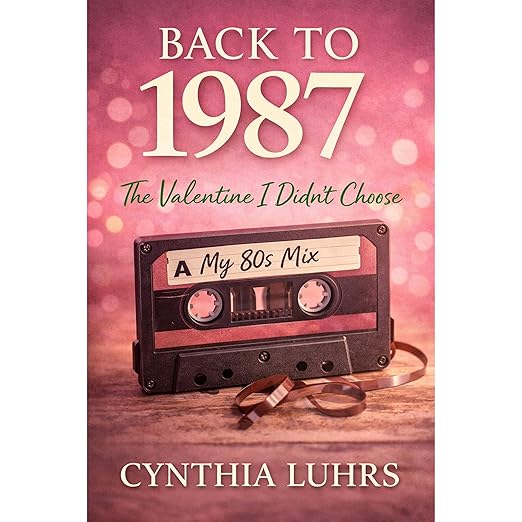
A phone that rings without any way to know who is calling until you pick it up: that is the texture Back to 1987 leans on hardest, and the audiobook treats it as a genuine plot mechanic rather than a nostalgia prop. Maggie Shaw is fifty, successful, and alone when the story opens, then wakes up twenty-seven years earlier at twenty-three, given a second run at the Valentine's Day she once used to walk away from Jack Cavanaugh. Cynthia Luhrs opens the If I'd Known Then series on that single premise and does not complicate it with a large cast or a mystery to solve.
The stakes are unusually clean for a time travel romance. Maggie is not trying to fix a timeline or prevent a disaster; she has thirteen days to decide, a second time, whether to stay with Jack or leave, knowing exactly what leaving cost her the first time around. The synopsis frames the choice in blunt terms: stay and lose the future she already lived, leave and lose the only man she never stopped loving. That symmetry, rather than any twist, is the engine of the book, and it asks the listener to sit with a genuinely uncomfortable question about whether a safe choice made at twenty-three deserves a second chance at fifty.
Jack Cavanaugh gets a specific, unflattering shift in this version of events: the synopsis says he is done chasing and is learning to let go, which means Maggie returns to find him further along in moving on than she expected, not frozen in place waiting for her. That choice avoids the laziest version of this trope, where the love interest exists only to be won back on command. Whether Cynthia Luhrs sustains that harder, more interesting version of Jack across six hours is impossible to confirm without reviews to check it against, but the setup itself earns real credit for resisting the easy option. It also raises the stakes of the thirteen-day countdown: Maggie is not just working to win Jack back, she is working against a version of him who has genuinely started to move forward without her.
What Stands Out
Period detail is doing real work here, not just decoration. Mixtapes, newspaper deadlines, shoulder pads, and phones with cords that force you to answer without knowing who is on the other end are all named directly in the synopsis, and they double as the mechanism of the plot rather than just its backdrop: a Maggie who cannot screen a call or text ahead has to actually show up and speak, which lines up with the growth the synopsis promises her, learning to talk without hiding behind sarcasm.
This is a Virtual Voice narration, meaning the audiobook was produced through Amazon's automated reading system rather than cast with a human performer, leaving no vocal choices to evaluate, only the text itself. That matters more than usual here specifically, because so much of the book's appeal depends on selling a very particular decade through texture rather than plot mechanics alone; a synthetic voice has to carry mixtape needle drops and staticky phone calls without the color a trained narrator might bring to them. Listeners who want a strong human performance driving the nostalgia should know that is not what this edition offers.
Things to Know Before Starting Back to 1987: The Valentine I Didn't Choose
Nothing else on this listing is available to check the rating against, which makes the arithmetic itself worth spelling out: zero written reviews sit underneath four counted votes averaging 4.5. Four whole-star ratings must add up to precisely eighteen points to produce that number, only two shy of a perfect twenty, meaning every one of the four silent voters rated this near the top of the scale, most likely a run of fours and fives, without a single one leaving so much as a sentence explaining why. It is about as strong an endorsement as a listing can carry while saying nothing at all in words.
The closed-door labeling in the synopsis is worth taking at face value, since nothing else in the listing contradicts it. Readers expecting a higher heat level should recalibrate: this is a story about longing, timing, and a second chance built on conversation and small gestures rather than physical intimacy on the page. That is not a flaw, but it does mean the romance and the tension both live in dialogue and decision-making rather than in scenes some listeners might expect from the premise alone.
One more gap worth naming plainly: the listing carries a price of zero dollars, which usually signals a promotional or membership arrangement rather than an actual giveaway, though the page itself does not clarify which. Combined with the complete absence of written reviews on a book already showing four ratings, this reads like a very early snapshot of the listing rather than a settled one, and the numbers here may look different by the time a new listener checks for themselves.
Best Suited For
This suits readers drawn to second-chance romance specifically, the trope built entirely around two people who already know each other's worst mistakes and have to decide whether to repeat them. Anyone with real affection for 1980s pop culture, mixtapes and newspaper newsrooms included, gets an extra layer of pleasure from a book that treats the decade as more than set dressing. Because the story opens the If I'd Known Then series, readers who like starting a series at its actual beginning, rather than picking up mid-stream, are also well served here. Readers who specifically enjoy a heroine correcting one clearly defined mistake, rather than untangling a whole life's worth of regret, will find Maggie's thirteen-day window easy to invest in from the very first chapter.
Skip it if a closed-door romance reads as a dealbreaker, or if a Virtual Voice narration matters more to you than the story itself; both are fixed facts of this specific edition rather than judgment calls open to interpretation. For everyone else, four quietly strong ratings and a genuinely clean, well-built time travel premise make a reasonable case for taking a chance on a book that has no written reviews yet to vouch for it, at least not until more listeners weigh in.
Quick Take
- Performance: Virtual Voice reads this one, so the 1980s texture, mixtapes and staticky phone calls included, has to travel entirely through the text itself rather than a performer's choices.
- What it covers: second-chance romance, time travel, 1980s nostalgia
- Feel: Wistful and gentle, closed-door throughout
- Our call: Nostalgia carries this one further than any twist the time travel setup delivers.
Common Questions
Is the Back to 1987 audiobook explicit, or does it stay closed-door?
It stays closed-door. The synopsis explicitly labels this an eighties time travel romance built on regret, courage, and missed connections rather than physical intimacy on the page, and nothing in the listing contradicts that. Readers looking for a steamier read should look elsewhere in Cynthia Luhrs's catalog rather than expecting this specific title to deliver it.
How long is the Back to 1987 audiobook, and does the pace hold up?
It runs six hours and five minutes, a brisk length for a time travel romance that covers a full thirteen-day countdown inside Maggie's relived 1987. The pace suits the compact premise, with no subplot or secondary couple competing for time, just one relationship examined a second time around.