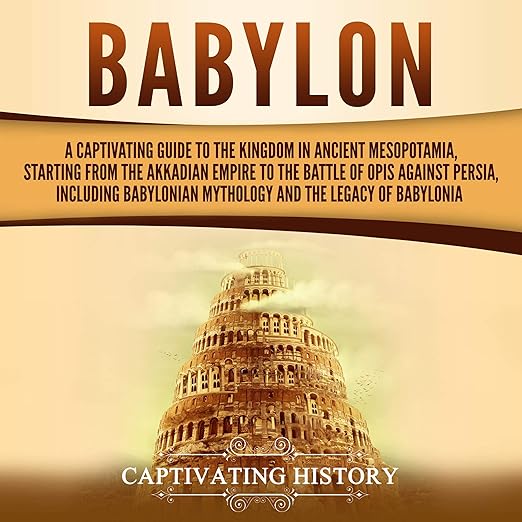
Babylon's fingerprints are supposedly on modern mathematics, agriculture, architecture, and metallurgy, so how does one audiobook cover a civilization with a legacy that wide in just over three hours? This entry in the Exploring Mesopotamia series attempts exactly that, tracing Babylon from before the Babylonians who made it famous through the empire's final absorption into the Persian and Hellenistic world.
The scope on paper is enormous: the Amorite Dynasty and the first Babylonians, the kingdom's initial fall and the rise of the Kassites, roughly three centuries of Assyrian domination from 911 to 619 BC, the Neo-Babylonian Empire, and finally the Persian conquest, all before the book even turns to religion, mythology, and what the synopsis calls, as one of its own listed topics, 'the short version of the biblical Babylonians'.
Rick's Year Near the Ruins of Babylon
That last phrase is worth sitting with, since Babylon's presence in religious and cultural memory, largely through its biblical portrayal, is arguably as significant to how most listeners already think of the city as the actual archaeological and political history is. Covering gender roles, daily life, and what the synopsis calls the place 'where superstition met science' alongside the political and military chronology gives the book a broader cultural ambition than a straightforward reign-by-reign account would.
Reviewer Rms Military Antiques Stumbo, who signs off simply as Rick, offers the single most striking piece of context attached to this listing: 'I spent a year there in the second gulf war based within site of the ruins of Babylon near the city of Al Hillah. It would have been good to have this book there with me. Very well written and a very interesting read on the history and people of the area where I was.' A history this ancient rarely gets a review grounded in that recently, and that specifically, real experience.
Reviewer bonnie DALE keck's review is less a critique than a fan note about the broader Captivating History catalog, but it does confirm something useful: this publisher has built a large, ongoing library of similarly structured regional guides, and Babylon fits recognizably into that house style, broad, accessible, chapter-driven surveys rather than single-author academic monographs with a narrower argument to defend.
Manny Paces Dynasties from Hammurabi to the Kassites
Desmond Manny narrates, and the central technical demand here is pacing: moving cleanly through multiple dynasties, centuries-spanning empires, and dense proper nouns without letting the sheer volume of names and dates blur together for a listener who is absorbing this purely by ear rather than following along with a timeline on the page. That kind of clear, briskly organized delivery is what a survey history like this one needs most.
Reviewer Reinold F. backs up the pacing assessment directly, calling the book 'fast to read, and very interesting,' and adding flatly that 'Babylon is without doubt one of the most amazing cities in history.' Reinold also notes the book pulls a reader or listener toward wanting to research further afterward, which is a reasonable marker of a survey history doing its actual job, opening doors rather than trying to close every one of them itself.
The 'Exploring Mesopotamia' series framing is also worth knowing about going in. This positions Babylon as one entry point into a broader regional history project rather than a single, isolated deep dive, which suits listeners who may want to explore neighboring Mesopotamian civilizations and empires afterward using the same accessible, briskly paced format.
For listeners without deep prior knowledge of the period, two names are worth knowing going in even beyond what the synopsis lists explicitly: Hammurabi, whose eighteenth-century BC law code remains one of the earliest and most famous written legal systems in human history, and Nebuchadnezzar II, the Neo-Babylonian king most associated with the legendary Hanging Gardens and with the Babylonian exile of the Judahites, the historical event underlying much of the book's promised 'biblical Babylonians' material.
The promised chapter on gender roles touches genuinely contested, actively studied territory: Babylonian law codes are known to have granted women certain rights unusual for the ancient world, including limited property ownership and specific protections within marriage contracts, even as broader Mesopotamian society remained deeply patriarchal in practice. A survey history that engages this material honestly, rather than flattening it into a single simple verdict, is tackling one of the more genuinely debated corners of the field.
The Kassites, credited here with rising after Babylon's first fall, are one of the more obscure names on the book's own topic list, a dynasty that ruled Babylon for roughly four centuries yet left comparatively little behind in the popular imagination next to Hammurabi or Nebuchadnezzar. Giving that long, quieter stretch of Babylonian history real attention, rather than skipping straight to the more famous names, is exactly the kind of choice that separates a genuine survey from a greatest-hits highlight reel.
Three Hours Can't Cover Two Thousand Years
The tension between scope and runtime is the book's central weakness, and it is worth naming directly. Three hours covering roughly two thousand years of political history, from the earliest Amorite Babylonians through Hellenistic absorption, plus separate sections on culture, religion, and mythology, necessarily means breadth wins out over depth almost everywhere. Listeners wanting sustained analysis of any single period, the Neo-Babylonian Empire alone, for instance, will find only a chapter's worth of attention rather than a dedicated deep dive.
Reinold's review also flags a specific, concrete weak point worth repeating honestly: the section on Babylon's origins was, in the reviewer's own words, not entirely clear. That is a fair, specific craft critique rather than a vague complaint, and it suggests the earliest, most historically contested period of the city's history is where the survey format strains hardest to stay coherent.
The three-century Assyrian domination period alone, 911 to 619 BC per the synopsis's own dates, covers roughly as much elapsed time as the entire history of the United States, compressed here into what can only be a handful of minutes given the book's total three-hour runtime. That arithmetic alone should recalibrate expectations toward breadth over depth before a single chapter starts.
Curious Generalists and the Veterans Who Served Nearby
This suits curious generalists who want an efficient, wide-angle introduction to one of history's most influential ancient civilizations without committing to a full academic treatment. It is also a genuinely strong pick for anyone with a personal connection to the region, veterans and travelers among them, per Rick's review, who want context for a place they have actually stood near rather than only read about.
Scholarly depth and primary-source argument are not what three hours of survey history can offer, so listeners wanting rigorous academic analysis, extensive citation, or sustained focus on any single Babylonian period should look toward a more specialized text instead. The origins section in particular, per Reinold's review, is the weakest point for anyone hoping for real clarity on Babylon's earliest history.
Quick Take
- Voice: Desmond Manny moves briskly through several thousand years of Mesopotamian history without losing the narrative thread.
- Big ideas: ancient Mesopotamia, empire and conquest, mythology and religion
- Atmosphere: Efficient and wide-ranging
- Worth it?: A solid three-hour survey for curious generalists, not for listeners wanting scholarly depth.
Before You Listen
How much of this audiobook covers Babylonian mythology specifically?
Religion, mythology, and creation myths make up one section among several rather than the majority of the runtime, which is split across political history, daily life, and biblical connections as well.
Is this audiobook part of a series on Mesopotamia?
Yes. It is one entry in the 'Exploring Mesopotamia' series, positioned as an accessible starting point rather than an isolated deep dive.
Does this audiobook cover the biblical references to Babylon?
Yes. The synopsis specifically includes what it calls 'the short version of the biblical Babylonians' as one of its topics, alongside the political and cultural history.