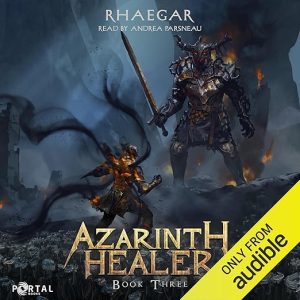
Ilea arrives at Riverwatch escorting a wayward mind weaver and working hard to ensure he does not eat anybody along the way. That is the opening situation of the third Azarinth Healer, and it tells you nearly everything about the register Rhaegar writes in: mortal danger handled as a logistics problem, with jokes. The audiobook runs twenty-nine hours and twenty-three minutes, and Andrea Parsneau is credited with the reading.
Book three picks up after the demon invasion and, for a while, allows Ilea something close to an ordinary life. She travels. She reunites with old friends. She does, in the publisher's own phrase, some light punching. Then dire news reaches her at Ravenhall, a friend turns out to be in danger, and the rest of the book follows that trail into the Empire, through dark alleys and ancient dungeons, and out past the frontiers of humanity to the ruins of a long-forgotten kingdom.
Rhaegar treats the comfortable parts as seriously as the fights, and that is what separates this series from most progression fantasy. The series description promises equal measures of slice-of-life wandering, goofy jokes and brutal combat, and this volume honors all three without letting any one of them dominate. Ilea hoards snacks. She cares about a good meal with something close to religious intensity. Then she fights creatures that would finish most protagonists, using hand-to-hand magic that heals and destroys with the same gesture.
Thomas Krick's five-star review lists what the series supplies in what is evidently the order of importance: adventure, power scaling, growth, good food and strong friends. Food arrives fourth on that list and it is not a joke, because the running preoccupation with meals is load-bearing for the tone. That reviewer also reports finishing book one and immediately buying the next three, which is about the most honest endorsement a progression series can be given.
Douglas F. Neeper identifies what makes this particular volume distinct, describing it as feeling like the beginning of a different and more expanded story after the first two books, still connected but widening outward. That matches my own sense of it. Book three is where the scope shifts from personal advancement toward political consequence, and the same reviewer records appreciating that the main character gets confronted with some of the uglier political realities of the world she has been leveling through.
What Stands Out
That runtime is the first thing to reckon with, and I want to make the positive case for it. This genre lives or dies on the pleasure of accumulation, and accumulation requires time. A tightly edited version of this book would strip out the wandering, the meals and the side conversations, which are precisely the things that make the danger register when it finally arrives. Length is a feature here, and audio is the format where length costs a reader least.
The dual-class system is the mechanical hook and it holds up. Ilea's magic heals and destroys through one discipline, every skill and class can evolve, and the series description states openly that power is measured by class, level and skills. If you like a magic system with visible rules and visible progress, this sits at the transparent end of the genre, and hearing skill descriptions spoken aloud plays differently than scanning a block of them on a page.
The cast is the other draw. This volume adds an excellent maker of cakes, a fiery fox with a sweet tooth and an unlikely historian, which is a fair sample of the prevailing tone. One reviewer, posting as Foo Bar, calls the characters complex people who are easy to care about and describes the worldbuilding as superb, adding that the arcs satisfy while the larger plot reveals itself slowly. That is an accurate account of how the series paces itself.
Things to Know Before Starting Azarinth Healer: Book Three
Begin with the obvious. This is a third volume and nothing about it accommodates newcomers. The opening picks up after a demon invasion you did not witness, among friends you have not met, escorting a mind weaver whose significance rests entirely on the previous book. All three reviewers on this listing came through the earlier volumes, one of them having followed the whole story online first. Do likewise and start at the beginning.
Second, the web-serial origin shows, and knowing that in advance will save you some irritation. One reviewer mentions having originally enjoyed the series online as it was published. Fiction written in installments carries a particular rhythm: frequent small climaxes, regular status recaps, and a plot that expands rather than tightens. Rhaegar came up through that format and the DNA remains visible, so anyone wanting the compression of a traditionally edited fantasy novel will feel the difference across a very long runtime.
Third, the numbers attached to this listing are close to meaningless. A tiny pool of ratings sits behind a 4.8 average, which for niche progression fantasy generally indicates a recently posted edition and a devoted readership rather than any broad verdict. The three written reviews are detailed and unanimous, and they discuss specifics rather than vibes. That is far better evidence than the average, and I would weigh it accordingly.
Fourth, on the recording. The narrator credit belongs to Andrea Parsneau, a familiar presence in very long progression fantasy, which is relevant experience for a twenty-nine-hour book carrying a large recurring cast. Nobody on this listing evaluates the result, so I hold no evidenced view of it. What I will say is that at this runtime the relationship between listener and narrator matters more than on almost any other kind of book, and sampling first is not optional.
Best Suited For
This is for readers already inside the series, and for the wider progression fantasy audience weighing up whether to commit from book one. If The Wandering Inn, Dungeon Crawler Carl or He Who Fights with Monsters are already on your shelf and you want another long-running world with a protagonist who levels visibly, Azarinth Healer belongs on the list. The isekai framing is entirely standard; the execution is warmer and funnier than most of its neighbors.
Give it a miss if twenty-nine hours inside one volume sounds like a chore, if you want a self-contained fantasy novel with an ending, or if skill descriptions and stat progression read to you as interruptions rather than as the point. And if slice-of-life sections make you impatient, be warned that Rhaegar spends genuine time on meals, friendships and the ordinary business of being powerful. For a large part of this audience that is the whole appeal.
What does dual-class mean in Azarinth Healer?
Ilea holds two evolving classes rather than one, which is why her magic can heal and destroy through the same hand-to-hand discipline. The series description confirms that every skill, class and ability can evolve, so progression branches instead of climbing a single ladder toward a predictable endpoint.
Was the series published online before the audiobook existed?
A reviewer here says they originally enjoyed the full story online as it appeared, which places Azarinth Healer among the web serials that later found audio editions. That history explains the episodic rhythm, the frequent status updates and the sheer accumulated length of each volume.
How does the audiobook balance combat with slice-of-life?
The publisher promises equal parts comfy wandering, jokes and brutal fighting, and this volume keeps to that mix. Expect long stretches of travel, cooking and conversation between set pieces. Listeners who want continuous action will find the quiet chapters slow; for most of the audience they are the reason to stay.