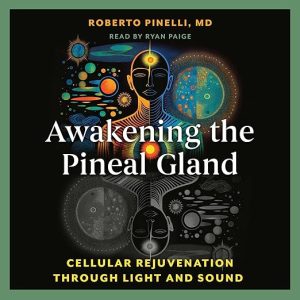
Ophthalmologist Roberto Pinelli has spent his career looking into human eyes with clinical precision, and Awakening the Pineal Gland represents his attempt to synthesize that clinical work with a much older set of questions about what eyes, light, and the tiny gland behind them might mean for human consciousness and health. This audiobook, narrated by Ryan Paige and running five hours, occupies a genuinely unusual space in the wellness and alternative medicine catalog: written by a credentialed medical professional, drawing on peer-reviewed research alongside case studies, and also engaging seriously with Egyptian, Sumerian, and Aztec cosmologies of light and perception. That combination is the book's central appeal and its central challenge.
Photobiomodulation Meets Egyptian and Sumerian Cosmology
Pinelli's method, as described in the book, involves using a combination of light, sound, and nutraceuticals to activate the pineal gland non-invasively. The science he draws on for this is photobiomodulation, the use of photons to convey vibrational energy through the eyes to targeted areas of the body. This is a real area of active research, and Pinelli's framing of his work as scientifically validated is grounded in his citation of peer-reviewed materials and case studies. The reach of his claims is significant: improved memory, mental clarity, and self-awareness, along with potential positive effects on degenerative conditions including osteoporosis, osteoarthritis, and Parkinson's disease. Listeners with strong backgrounds in evidence-based medicine will likely find these claims extensive relative to the strength of the evidence base, and that is a fair critical position to hold. The more distinctive element of the book is its engagement with ancient knowledge systems. Pinelli draws connections between his photobiomodulation approach and Egyptian and Sumerian understandings of the sun and the eye, arguing that contemporary scientific findings have corroborated what these traditions encoded in their practices and cosmologies. He also engages with the esoteric concept of the third eye, treating the pineal gland as the biological correlate of a spiritual concept that appears across multiple ancient traditions. The book additionally covers the pineal gland's role in melatonin regulation and offers practical methods for reducing pineal calcification, which are the sections most grounded in established endocrinology.
Paige Handles Clinical, Practical and Spiritual Registers
Ryan Paige's narration handles the tonal range this material requires reasonably well. The book moves between clinical description of how the pineal gland functions, practical guidance on Pinelli's specific protocols, and more expansive historical and spiritual territory covering ancient sun cosmologies and the third eye as a concept shared across traditions. Paige manages these registers without making any of them feel out of place, which matters for a book that depends on the reader accepting that these different kinds of knowledge can coexist in a single framework. The five-hour runtime is appropriate for the scope of the material: dense enough to cover its subject seriously without becoming encyclopedic. Listeners who are already interested in the pineal gland, melatonin biology, phototherapy, or the esoteric concept of the third eye will find this audiobook rewarding precisely because it does not shy away from the intersection of those subjects; it is organized around that intersection rather than apologizing for it. The audio format is also well-suited to the practical sections, where Paige's clear articulation of specific protocols and nutraceutical recommendations makes the guidance easier to follow and retain than dense print would allow.
Real Credentials, but Claims at Medicine's Edge
Critical listeners will want to be aware that the claims in this book sit at the outer edge of what mainstream medicine would currently endorse. Pinelli is a practicing ophthalmologist and the book is not pseudoscience in the sense of being entirely divorced from biological reality, the pineal gland is real, melatonin regulation is real, and photobiomodulation research is an active field. But the leap from established science to the specific therapeutic claims he makes is substantial, and the ancient history sections require the reader to accept a framework in which Egyptian and Sumerian cosmology and twenty-first-century peer review are treated as commensurable sources of evidence. For listeners who find that framework compelling, the book is a rich and unusual synthesis. For listeners who require clinical trial-level evidence for therapeutic claims, the book will read as speculative throughout. The practical guidance on pineal calcification reduction and melatonin function improvement through lifestyle and dietary approaches is more empirically grounded than some of the broader claims and may be the most immediately useful material for general wellness readers. Listeners should engage with appropriate critical awareness when evaluating specific health claims.
Occupying a Hybrid Space Between Science and Tradition
Listeners who are interested in the intersection of alternative medicine, ancient wisdom traditions, and contemporary light-based therapy will find this audiobook a rich and unusual entry in that space. It is a strong fit for readers already engaged with concepts like photobiomodulation, third eye traditions, or nutraceutical approaches to aging and cognitive health. Listeners who require health claims to be anchored in mainstream clinical consensus will find this book's reach beyond the evidence base frustrating. It is not an audiobook for reflexive skeptics, but it is also not one that ignores science entirely, it occupies a hybrid space that rewards readers willing to meet it there with appropriate critical awareness. For listeners already familiar with Pinelli's clinical work or with the broader photobiomodulation literature, this audiobook offers a synthesis of that technical background with the esoteric and historical framing that the peer-reviewed literature rarely provides. The combination is unusual enough that even listeners who ultimately reject some of Pinelli's larger claims may find the Egyptian and Sumerian material intellectually productive as a history of how human cultures have theorized light's relationship to cognition and healing. The five-hour runtime makes it a manageable investment for curious readers who want to form their own judgment rather than rely on secondhand summaries of a genuinely unusual book.
Frequently Asked Questions
Is the science in this audiobook mainstream or alternative?
It is a hybrid. Pinelli is a credentialed ophthalmologist who cites peer-reviewed research and case studies, and the biological reality of the pineal gland and photobiomodulation research is established. However, the specific therapeutic claims, including potential positive effects on Parkinson's disease, osteoarthritis, and osteoporosis, extend beyond what mainstream clinical medicine would currently endorse. Listeners should engage with appropriate critical awareness.
Does this audiobook provide practical guidance, or is it primarily theoretical?
Both. Pinelli describes his specific methods for activating the pineal gland using light, sound, and nutraceuticals, and includes discussion of approaches to reduce pineal calcification and regenerate mental and physical health. The practical sections are interspersed with theoretical and historical material rather than isolated in a single how-to section.
How does the audiobook handle the ancient history sections, are they integrated into the scientific argument or treated separately?
Pinelli treats Egyptian, Sumerian, and Aztec knowledge of light and the eye as corroborating evidence for his contemporary methods rather than as separate historical interest. Ryan Paige's narration presents these sections with the same register as the scientific material, so the integration is deliberate rather than decorative. Listeners who find this synthesis coherent will engage deeply; those who prefer their science and ancient history kept separate may find these sections challenging.
Is this audiobook appropriate for someone with no background in biology or medicine?
Yes, with the caveat that some biological terminology, melatonin, pineal gland function, photobiomodulation, nutraceuticals, appears throughout. Pinelli writes for a general audience rather than a specialist one, and Ryan Paige's clear narration makes the technical sections accessible. No prior medical knowledge is required to follow the argument.