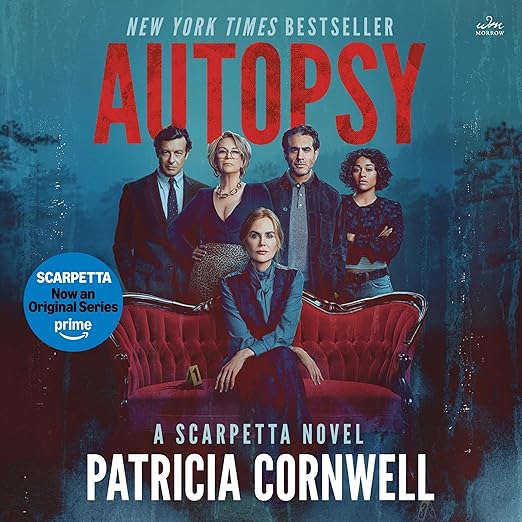
At a Glance
- Read by: Susan Ericksen is a veteran of the Scarpetta series, but a subset of fans finds her pacing in this particular installment slightly off, as if reading just ahead of her own comprehension. Functional but polarizing.
- At its heart: Institutional corruption, forensic pathology, national security intersecting with local crime
- Vibe: Dense and procedural, with flashes of political urgency
- Short version: A solid relaunch entry for established Cornwell readers, though the dual-plot structure of earthbound murder and a potential crime in space stretches plausibility for newcomers.
I came to Autopsy having not read the Scarpetta series in several years, which is apparently not an unusual position for Cornwell’s readers given that this is book twenty-five of a series that has been running since 1990. The book is marketed explicitly as a relaunch, an ideal re-entry point, and Cornwell does enough internal setup work that the listener is not hopelessly lost. But it is worth being honest: this is still a book written for people who already care about Kay Scarpetta, Benton Wesley, and the supporting cast, and much of its pleasure is derived from returning to familiar characters rather than meeting them fresh.
Susan Ericksen has narrated much of the Scarpetta series, and her voice is so associated with Kay at this point that replacing her would feel like a category error. The narration is competent and consistent, and for most listeners it will be entirely satisfactory. One notable dissenting review describes Ericksen as sounding like she is “reading the book just a few words ahead,” which is an unusual criticism but one that stuck with me enough to listen for it. There are moments where the phrasing feels slightly mechanical, but it is not a pervasive problem.
What We Made of It
Cornwell builds two simultaneous investigations in Autopsy: a body found by railroad tracks in Old Town Alexandria, throat cut to the spine, and a catastrophe aboard a classified space laboratory that may constitute the first potential crime scene in outer space. The audacity of that second premise is considerable. Cornwell has always been willing to push her protagonist into extreme territory, but “Scarpetta investigates a possible homicide in orbit” requires the listener to extend some good faith. To the book’s credit, it does not abandon the earthbound case to chase the spectacle of the space plot. Both investigations develop in parallel, and the tension between them is managed reasonably well.
The setting of Old Town Alexandria, just five miles from the Pentagon in a post-pandemic political landscape, gives the book a particular kind of contemporary anxiety. Cornwell grounds Scarpetta in recognizable institutional dysfunction: the inherited dysfunction of her predecessor, an overbearing secretary, and a medical examiner’s office that reflects the broader civil and political unrest of its environment. For readers who remember Scarpetta’s earlier incarnation, seeing her as the new girl again carries some irony that Cornwell leans into deliberately.
Why Listen to Autopsy
The forensic detail that made Cornwell’s reputation is fully present here. The scene investigation by the railroad tracks is meticulous, and the interplay between Scarpetta and the various institutional powers she must navigate, the Secret Service, the Doomsday Commission, local law enforcement, gives the book its political texture. One reader praised the “relentless investigation” quality of the book, and that is accurate: Cornwell keeps Scarpetta moving, keeps the questions accumulating, and the forward momentum rarely stalls even when the exposition is dense.
For listeners new to the series, Autopsy works as an origin relaunch in the sense that Scarpetta is herself starting over in a new position. The book does not require you to have read all twenty-four previous entries to follow the central cases. But some of the emotional resonance, particularly around Benton and the long-term supporting cast, will carry more weight for longtime readers.
What Might Not Land
The epilogue has drawn criticism for summarizing rather than dramatizing its resolution. One reviewer specifically noted wishing for one or two additional chapters to fully close the cases rather than receiving a compressed summary. This is a structural choice Cornwell makes not infrequently, and it can feel like the book runs out of runway precisely when the payoff should be arriving. If you have read Cornwell before, you may already know to expect this. If you are new to her, it is worth knowing that the ending lands with less ceremony than the setup promises.
The space investigation plot will require more suspension of disbelief than the conventional murder mystery. Readers who found earlier Cornwell books compelling precisely for their procedural realism may find the classified orbital crime scene premise a stretch too far. The book is aware of its own outrageousness at points, but does not fully lean into the absurdity in a way that would make it easier to accept.
Should You Listen to Autopsy?
This is primarily a book for established Scarpetta series readers who want to return to the character after some time away. The relaunch framing makes it accessible enough as an entry point, and it works reasonably well in that role, but the greatest pleasure it offers is to readers who already feel something about Cornwell’s world. Listeners who want a pure procedural without the science-fiction adjacent space subplot will find the first investigation, the railroad tracks murder and its links to Scarpetta’s neighborhood, the more satisfying of the two threads.