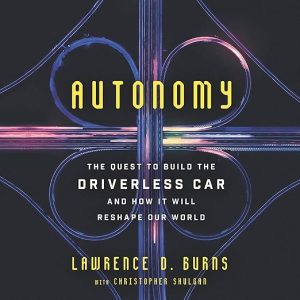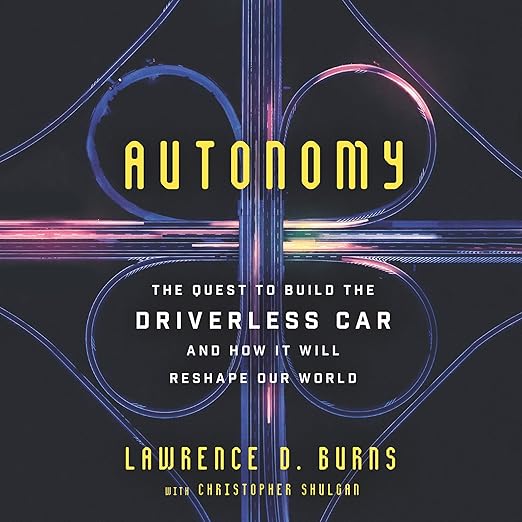
A former General Motors executive spending years trying to push his own employer toward a driverless future, only to watch Silicon Valley get there faster, is the personal history running underneath every chapter of this audiobook. Lawrence Burns held that GM insider seat and later became an advisor to Google's Self-Driving Car project, which makes Autonomy less a neutral survey than an inside account of how Google, Tesla, and Uber outmaneuvered Detroit's traditional giants, GM, Ford, Daimler, on the industry's biggest bet in a century. Narrated by George Newbern across eleven hours and twenty-one minutes, the book moves from DARPA-era competition history through the current corporate race and out toward Burns's own predictions: fewer road fatalities, a smaller carbon footprint, no more hunting for parking, and a hard reckoning for the blue-collar jobs built around human driving.
Burns's Dual Vantage as Insider and Advisor
Burns's dual vantage point is the book's real asset. Reviewer Guillaume Boisset describes him as a GM executive who spent years on the thankless task of reforming the company from within, scoring real early wins by securing GM sponsorship for autonomous-driving competition teams back in the early 2000s before institutional inertia slowed further progress. That insider history, paired with his later Google advisory role, gives Autonomy access most outside business journalists simply wouldn't have.
The book's structure runs in two directions at once, backward into DARPA-race and corporate-maneuvering history, forward into Burns's own forecasts for daily life once driverless cars actually arrive. Reviewer James Waldeck, who has followed the field since the DARPA races himself, still found the institutional and individual history genuinely clarifying, a strong signal that Burns isn't just repeating headlines a well-informed reader already knows.
DARPA's Desert Races and a Double Meaning
The DARPA competitions specifically function as the book's origin story, government-sponsored races through empty desert terrain that looked more like a novelty than an industry starting gun at the time. Burns walks through how those early contests seeded the engineering talent and institutional relationships that Google, and later a wave of well-funded startups, would eventually build entire companies around, which gives listeners without deep industry background real grounding before the book moves into more recent corporate maneuvering.
The book's title itself deserves a note, autonomy in the vehicle-engineering sense referring to a car's ability to operate without human input, but Burns clearly intends the second meaning too, the personal autonomy either gained or lost depending on which side of the disruption a listener lands on, freed from driving chores if you're a daily commuter, displaced from a livelihood entirely if driving is how you currently earn one. That double meaning runs quietly under the whole book without Burns ever needing to spell it out directly.
Cutting Fatalities Ninety Percent, at a Cost
The stakes framing here isn't small. Burns treats the driverless car as disruptive on the scale of the smartphone, reshaping daily transportation, parking, and refueling, and road safety, all at once, and the book earns that comparison by walking through concrete, specific industry maneuvering rather than abstract futurism.
Reviewer Jack B. Brown Jr., who has worked as an engineering support person at firms named directly in the book for nearly a decade, confirms the backstories are told well, while also flagging Burns's own GM, Google, and hydrogen fuel cell affiliations as a real source of bias worth knowing about before you start listening. That combination, genuine insider credibility alongside acknowledged bias, is a useful thing to go in expecting.
Burns doesn't shy away from the uncomfortable half of his own argument either, the same technology that promises to cut road fatalities by ninety percent and free up hours currently spent driving and parking will also displace a meaningful share of the workforce that currently earns a living behind the wheel. Keeping both the upside and the cost in view within the same chapters, rather than saving the job-loss discussion for a brief afterthought, is one of the more honest choices the book makes.
Insider Bias and Predictions That May Age
That same bias flag deserves real attention. Burns writes from inside the industry he's covering, so Autonomy reads more like an advocate's insider history than a skeptical outside investigation. Listeners wanting a harder critical take on self-driving hype specifically should plan to pair this with other, more independent sources.
Published amid a genuinely fast-moving industry, some of Burns's five-year predictions will read as dated or optimistic depending on exactly when you're listening. Treat the specific timeline claims as a snapshot of expert opinion at the moment of publication rather than settled fact, and the book holds up much better as history and industry analysis than as prophecy.
Newbern's Steady Pace Through a Crowded Cast
George Newbern's steady, unhurried delivery suits a book this dense with company names, executive titles, and overlapping timelines, since the narration never rushes past a detail a listener needs to keep straight. That measured pace matters more here than in a faster-moving business thriller, given how many separate corporate storylines, GM, Google, Tesla, Uber, Ford, Daimler, Burns is tracking in parallel across just over eleven hours.
Reviewer accounts across this title also skew toward listeners already embedded in the industry in some way, engineers, longtime followers of the DARPA competitions, professionals employed at the companies named directly in the text, which suggests Autonomy rewards at least some existing curiosity about the subject rather than working equally well as a cold introduction for someone arriving with zero prior interest in the technology.
Eleven hours and twenty-one minutes is a reasonable middle length for business-history nonfiction, long enough to cover real depth across multiple companies and several decades, short enough that Newbern's steady narration doesn't need the same marathon stamina test that Ferrone-style eighteen-hour biographies tend to demand, a real advantage for a listener who wants the full business story without blocking out an entire week of commutes to finish it.
Burns writes with a practitioner's clarity rather than a journalist's polish, which is a genuine trade worth naming honestly, the prose favors accurate technical and business detail over narrative flourish, so listeners drawn to character-driven business writing in the Michael Lewis mold should adjust expectations toward substance delivered plainly rather than scenes built for maximum dramatic effect.
Uber and Tesla both get treated with more skepticism than their public reputations at the time might have suggested, Burns weighing their disruptive marketing against the messier operational reality of actually deploying autonomous fleets at scale, which is a useful corrective for listeners who mostly absorbed the more triumphant press coverage each company generated for itself during the years this book covers.
Industry Insiders and Transportation Policy Readers
Recommended for anyone in or adjacent to the auto or tech industries, transportation policy readers, and listeners who want the GM-versus-Silicon-Valley business story told alongside real engineering history rather than in place of it.
Pass on it if you want a purely technical engineering deep dive into self-driving software architecture, or a fully outside, industry-skeptical investigation, since Burns writes throughout as an informed insider rather than as a critical outsider.
Quick Take
- Voice: George Newbern delivers steady, measured authority that keeps proper-noun-heavy corporate history moving without losing the listener.
- Big ideas: Driverless car development, Detroit versus Silicon Valley, disruption's human costs and benefits.
- Atmosphere: Insider, forward-looking, occasionally self-assured.
- Worth it?: Worth your time for an insider's business history of autonomous vehicles, less so if you want a skeptical outside take.
Is this audiobook biased toward the companies Lawrence Burns himself worked for?
One reviewer flags this directly: Burns's history at GM, Google, and hydrogen fuel cell ventures shapes the account throughout, which is worth knowing going in even as his access adds real value.
Does this audiobook cover the technical engineering side of self-driving cars?
Only lightly. The focus stays on industry history, corporate strategy, and social impact rather than software architecture or sensor engineering specifics.
How current are the predictions made in this audiobook?
They're tied to publication, so treat Burns's five-year timeline claims as a snapshot of expert opinion rather than settled fact by the time you're listening.
Is this audiobook more about Detroit's automakers or Silicon Valley's tech companies?
Both. The real subject is the collision between them, GM, Ford, and Daimler on one side, Google, Tesla, and Uber on the other.