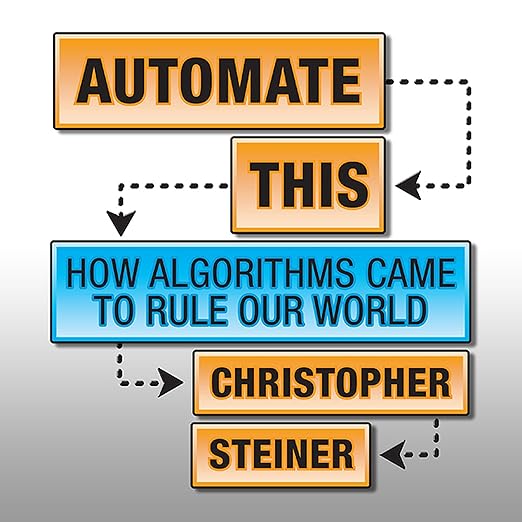
A 998-point market drop and a trillion dollars in vanished value in a matter of minutes is where Christopher Steiner grounds the opening argument of this audiobook, using the May 2010 Flash Crash as proof that algorithms had already taken control of systems most people assumed still required human judgment. Automate This traces how that kind of automated decision-making spread far beyond Wall Street trading floors into medicine, law, journalism, music composition, customer service, and even astronaut crew selection, built on the premise that skilled human expertise is being systematically replaced by code faster and more quietly than most professions have registered. Written in the years just after that Flash Crash, well before today's generative AI conversation existed in its current form, the book now reads as an early, prescient snapshot of an argument that has only grown louder since.
Dixon's Steady Narration Avoids Cheap Sensationalism
Walter Dixon narrates with the same steady, neutral authority that serves him well across other nonfiction in this vein, refusing to either sensationalize the book's more alarming material or undersell its genuine stakes. That evenness matters specifically here, since Steiner's subtitle promises something fascinating and frightening in equal measure, and a narrator leaning too hard toward either alarm or reassurance would flatten that intended tension. Dixon instead lets each chapter's specific case study, the Flash Crash, algorithmic sports journalism, automated customer service analysis, carry its own weight, moving through the book's episodic structure without over-dramatizing any single example at the expense of the larger argument connecting them all.
One reviewer, who read the print edition, outlines the book's chapter structure directly: an opening built around Thomas Peterffy's rise as an algorithmic trading pioneer turned billionaire, followed by a broader history of man and algorithms working together and increasingly in competition. That structural clarity carries over well into audio, with each chapter functioning as a somewhat self-contained case study a listener can absorb individually during a commute rather than needing to track a single continuous argument across the entire runtime. Another reviewer specifically praises how the book simplifies a potentially complex subject into terms a general reader can follow without a technical or computer science background.
Steiner's reference to identifying the next Jeremy Lin, a nod to the specific 2012 phenomenon of an undrafted, little-used player suddenly becoming a basketball sensation once given real playing time, is a sharp, concrete example of the book's larger point: algorithms increasingly claim they can spot undervalued talent before human scouts do, whether in sports, finance, or hiring more broadly. That specific, dated cultural reference is exactly the kind of detail that makes the book feel like a genuine time capsule rather than a timeless text.
Bots Writing Music Mistaken for Bach
For listeners trying to understand how the current AI moment actually got here, this offers something most 2020s AI commentary skips entirely: a grounded history of the previous decade's algorithmic disruption, before generative AI and large language models dominated the conversation, when the more immediate battles were being fought over trading floors, legal document review, and newsroom automation. A reviewer new to the subject describes the book as an accessible introduction to what an algorithm actually is and how it operates, useful specifically for listeners who feel behind on technical vocabulary but want a real, substantive entry point rather than a superficial explainer. That accessibility, combined with genuine reporting depth, keeps the book from reading as either too technical or too thin.
Steiner's specific examples, bots writing music mistaken for Bach, algorithms selecting astronaut crews, automated systems flagging the next promising athlete before scouts do, still land as vivid and slightly unsettling even years removed from their original context, precisely because so many of those same domains have since seen even more aggressive automation than Steiner was describing at the time. That makes the book a useful before picture for listeners trying to measure how far automation has actually traveled since.
The rhetorical question Steiner poses near the end, what role remains for doctors, lawyers, writers, and truck drivers once judgment itself gets automated, reads today less like speculation and more like an early draft of a debate still very much unresolved. Revisiting that specific list of professions years later, knowing which of those fields have already seen serious automation pressure and which have not, gives the book an accidental predictive-accuracy test built right into its own original framing.
An Earlier Automation Wave, Mostly American Examples
This book predates the current large-language-model era by roughly a decade, and listeners should expect a snapshot of an earlier automation wave, rules-based trading systems, early natural-language sports journalism, rather than any discussion of the specific generative AI tools dominating today's headlines. Some individual examples will consequently feel dated even as the book's broader thesis, that algorithmic systems keep expanding into domains once considered safely human, holds up well against everything that has happened since. One reviewer notes that certain technical claims may draw pushback from readers with deeper domain expertise in specific fields Steiner covers, suggesting the book prioritizes narrative accessibility over exhaustive technical rigor in places, a tradeoff generalist readers will likely welcome and specialists may occasionally find frustrating.
Steiner's reporting also leans heavily on American examples and American institutions specifically, Wall Street, US newsrooms, domestic legal practice, so listeners hoping for a genuinely global account of algorithmic disruption will find the lens narrower than the sweeping subtitle might suggest. That American focus is not a flaw exactly, the domestic case studies are well-reported and specific, but it does mean the book's claims about automation's reach should be understood as describing one country's experience circa the early 2010s rather than a comprehensive global survey, a distinction worth keeping in mind when extrapolating the book's examples to how automation has played out elsewhere.
Historical Context for Today's AI Conversation
Readers of tech-history and business-disruption nonfiction will find this a solid, well-reported entry point into how algorithmic decision-making actually took hold across multiple industries simultaneously, rather than the single-industry focus most books in this genre choose. Listeners wanting historical context for today's AI conversation, a sense of how we arrived at the current moment rather than only analysis of where things stand right now, will get real value from treating this as foundational reading. General business and finance audiobook fans looking for an accessible, story-driven explanation of algorithmic trading's rise will find the opening chapters alone worth the listen. Listeners preparing for a book club or workplace discussion on automation's history will find plenty of concrete, well-documented examples here to anchor a broader conversation about where the trend goes next.
Listeners wanting cutting-edge analysis of current generative AI tools should look toward more recent titles instead, since this book's automation wave predates that specific technology entirely.
Does the Automate This audiobook cover today's generative AI tools?
No. It was written roughly a decade before the current generative AI wave, so expect a history of earlier algorithmic disruption, trading, journalism, customer service, rather than analysis of today's specific tools.
Do you need a finance or computer science background for this audiobook?
No. Reviewers specifically praise how accessible the book is for general readers, simplifying algorithmic concepts without requiring prior technical training.
What industries does the Automate This audiobook cover beyond Wall Street trading?
Medicine, law, journalism, music composition, customer service, and even astronaut crew selection, among others, tracing how automated decision-making spread well past finance.