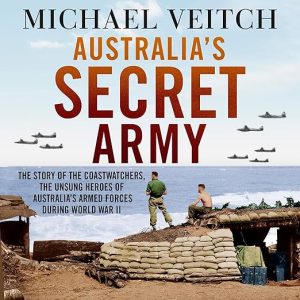
In Brief
- Voice: Michael Veitch self-narrates with a steady, research-grounded authority that neither rushes the strategic detail nor over-dramatizes the real danger these volunteers faced.
- Big ideas: WWII Pacific intelligence networks, civilian volunteers under occupation, under-told Australian military history
- Atmosphere: Measured and detail-rich, more institutional history than single-hero war memoir
- Worth it?: A substantial, well-researched account for Pacific War enthusiasts willing to follow a decentralized, many-threaded history rather than one continuous narrative.
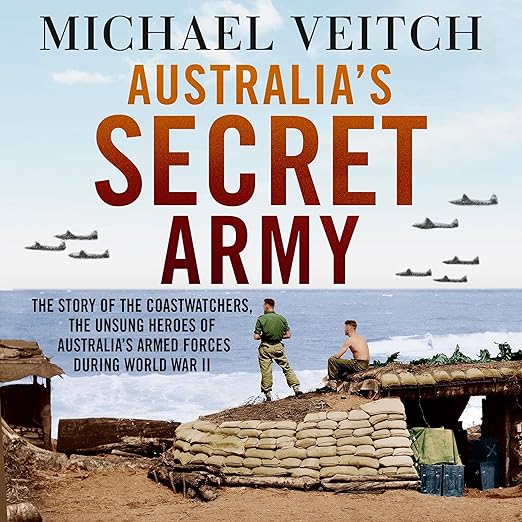
Coast Watchers is the name history gave a loose network of a few hundred unpaid volunteers, colonial officials, church workers, government patrol officers, and plantation owners among them, stationed across remote outposts in the Pacific islands under British and Australian rule at the time. This audiobook tells the story of how an intelligence-gathering group nobody expected to fight ended up doing exactly that. Michael Veitch narrates his own research here, and the premise alone is a strong hook: the Royal Australian Navy quietly set the network up not long after World War I ended, purely to watch and report on shipping movements, and the Coast Watchers became, almost by accident, Australia's secret army once Japan's advance turned the Pacific into an active war zone around them. I went in expecting a fairly dry intelligence-history account and came out with something closer to a story about ordinary people absorbing extraordinary risk.
Veitch's Own Research Powers a Quiet Courage
What makes the book work is how plainly Veitch lays out the mismatch between the Coast Watchers' original mandate and what they actually ended up doing. They were never meant to operate inside enemy-held territory or engage in combat; their entire job was observation and radio reports on enemy aircraft and ships. Once the war reached them directly, that quiet mandate collapsed, and volunteers who'd signed up to watch the horizon found themselves fully aware of what capture would mean: torture, and likely death, for men and women with no formal military protection. Veitch treats that transition, from passive observers to Australia's most exposed intelligence asset, as the real narrative engine of the book rather than a footnote to a broader Pacific campaign history.
Self-narration works in the book's favor here. Veitch isn't reading someone else's research aloud; the depth reviewers describe, one American listener says the book filled in real detail behind a story he'd only encountered in passing despite already knowing the broader Pacific campaign well, suggests a level of research investment that comes through more naturally when the person who did the digging is also the one narrating it. A steady quality carries through how he handles both the strategic context and the individual human stakes, neither rushing past the intelligence-history mechanics nor over-dramatizing the danger these volunteers were actually in.
The book also captures something easy to lose in a straightforward operations history: how isolating this work actually was. A Coast Watcher's job depended on staying hidden and largely alone for extended stretches, reporting by radio to a command structure that couldn't offer any real protection if things went wrong, a fundamentally different kind of courage than a soldier's, sustained in silence rather than in the heat of a single engagement. Veitch gives that isolation real weight rather than treating it as a minor detail on the way to the more dramatic capture-and-survival stories.
Father Goose's Comedy, the Real Wartime Stakes
This is genuinely under-told history, even among listeners who already know the broader Pacific War narrative well. One reviewer specifically connects the Coast Watchers to the film Father Goose, noting plainly that despite the film's comic tone, the book itself is not a comedy and the real stakes were life and death for the people involved. That contrast, a war story hiding behind a mostly-forgotten Hollywood footnote, is a useful way into just how under-covered this specific piece of Pacific history actually is relative to more famous campaigns and battles.
Without the Coast Watchers' intelligence, several key moments in the Pacific campaign could plausibly have gone differently, and the book makes that stakes-raising case directly rather than treating the network as a minor supporting detail. One reviewer, who stood in front of the memorial dedicated to the Coast Watchers in the Papua New Guinean city of Madang during an October 2025 visit, says plainly that he wishes he'd read the book before that trip. That's the kind of endorsement that speaks to real depth of research rather than surface-level Pacific War trivia.
The book's title itself is doing careful work too. Calling a volunteer coast-watching network a secret army is a genuine reframing, not just a punchy title: these were not soldiers, they carried no weapons training or formal rank structure, and yet the intelligence they gathered functioned at an army's strategic scale. Veitch leans into that tension throughout rather than smoothing it into a simpler story of quiet heroism, and it's a genuinely useful lens for thinking about how much of a modern war effort actually depends on people who never fire a shot.
The book's regional specificity also rewards a listener willing to picture a map while listening. Names of islands, channels, and outposts recur throughout, and while Veitch generally orients a listener well enough to follow without one, having a sense of Pacific geography beforehand, or pausing to check a location occasionally, deepens how much the scale of the Coast Watchers' coverage actually lands.
Decentralized by Design, Never One Continuous Arc
At ten and a half hours, this is a substantial, detail-dense military history rather than a breezy overview, and listeners expecting a tight single narrative thread should recalibrate: the Coast Watchers were spread across a wide swath of Pacific territory, and the book necessarily moves between different regions, personnel, and operations rather than following one continuous story. That structure serves the actual history honestly, since the network itself was decentralized by design, but it does mean the narrative momentum builds cumulatively across many smaller accounts rather than through one sustained arc.
Listeners who prefer a single-protagonist war memoir over a broader institutional history should also know that the book stays close to the Coast Watchers' own operational experience rather than zooming far out into Allied high command strategy. That's a deliberate choice, keeping the volunteers themselves at the center rather than reducing them to a supporting detail in someone else's story, but it does mean readers hoping for a wide-lens strategic history of the whole Pacific theater should look for a different, more general title alongside this one.
Patience Across Many Threads, No Single Hero
Pacific War history enthusiasts, especially those who've already covered the more famous campaigns and want the intelligence-gathering side of the story, are the natural audience, and Australian listeners with a personal or family connection to the region will likely find added resonance. The book also rewards listeners who appreciate institutional history told through many individual accounts rather than a single hero's journey, since that structure is where the Coast Watchers' real story actually lives.
If dense, decentralized military history isn't your usual pace, the ten-and-a-half-hour runtime and wide cast of regional figures may feel like a lot to track relative to a tighter single-narrative war account. This one asks for patience across multiple threads rather than delivering one clean throughline from start to finish, and listeners who know that going in will get far more out of it than those expecting a conventional single-hero war memoir.
Good to Know
Does Michael Veitch narrate Australia's Secret Army himself, and does that affect the audiobook's quality?
Yes, he self-narrates, and it works in the book's favor. The depth of research reviewers describe comes through more naturally with the person who did the digging also reading it aloud.
How long is the Australia's Secret Army audiobook, and is it a single continuous narrative?
It runs 10 hours and 33 minutes, and it's structured as an institutional history moving across many individual Coast Watchers rather than one continuous single-protagonist story.
Do I need prior knowledge of the Pacific War to follow this audiobook?
No, though some background helps with context. Veitch lays out the Coast Watchers' original mandate and how it changed clearly enough for a listener without deep prior Pacific War knowledge to follow along.