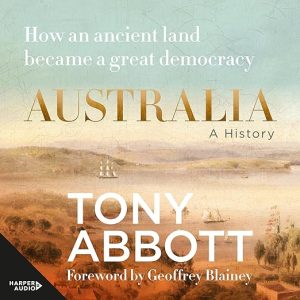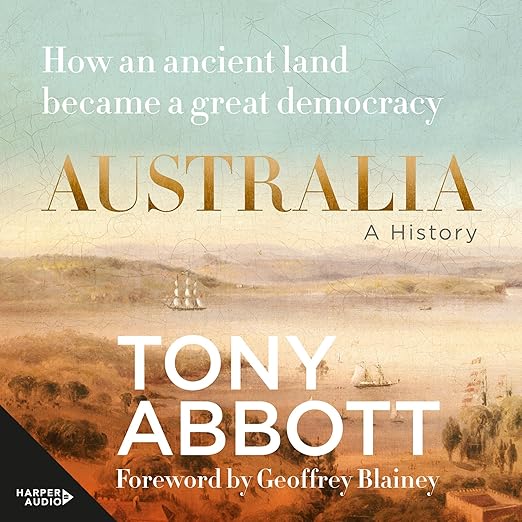
Australia: A History - How an ancient land became a great democracy places its narrator in an unusual position before a single word has been spoken. Tony Abbott is not a disinterested historian. He is a former prime minister of Australia who has made his views on Australian history, its meaning, its achievements, and its failures, part of his public identity across decades of political life. His self-narration of this audiobook, which runs 14 hours and 27 minutes, is therefore a document of two things simultaneously: a history of Australia from its pre-colonial origins to the present, and a record of how one of Australia's most consequential political figures understands and communicates that history. Both layers are worth engaging rather than treating one as cover for the other.
The book was longlisted for Best Non Fiction in the Indie Book Awards 2026, and it has attracted endorsements from a range of commentators including historians Geoffrey Blainey and Tom Holland, former prime ministers John Howard and Kim Beazley, and Nova Peris, the first Aboriginal-Australian Olympic gold medallist. The fact that Beazley, a Labor leader and Abbott's political opposite in many respects, found the book worth endorsing is a useful data point about what kind of history Abbott has written. The endorsements do not tell the full story, and the critical reviews are substantive rather than reflexive, but the spread of responses indicates a book that has engaged seriously with the material even where readers disagree with its framing.
Fifty Thousand Years, Compressed Into One Volume
Abbott's reach in this audiobook begins 50,000 years back, with what he describes as the first discoverers and pioneers who walked and paddled from the ancient Asian landmass. His argument is that from 1788, settlers, governors, and eventually citizens worked to build one of the freest, fairest, and most prosperous countries on earth, and that this achievement is undersung in the current climate of historical revision. He acknowledges mistakes and imperfections while arguing that the balance of the historical record is positive and worth celebrating. One reviewer who was not a natural Abbott sympathizer described the result as not quite the white armband version of history I was expecting, adding that they enjoyed reading it. Another found it competent but superficial, and argued that it leaves little room for complexity.
Both assessments can be simultaneously true, and the tension between them is the most honest way to frame what the book is doing. It is readable and fair-minded within its own framework, and sometimes superficial in ways that result from the compression required to cover 50,000 years in a single volume. Abbott's willingness to acknowledge that the early governors tried, by the standards of their time, to respect the original inhabitants, is real even if the reviewers who find that framing inadequate are also responding to something real and present in the text. Self-narrated history by a political figure who is also a participant in part of the history being covered is inherently a positioned document, and the audiobook is most rewarding for listeners who engage it fully on those terms.
Abbott's Unrhetorical Delivery of His Own History
Abbott's narration carries authority that a professional reader could not have manufactured. The former prime minister reading his own assessment of the country he helped govern, including the democratic achievements that his own political tradition either extended or contested, creates a specific listening experience: you are hearing someone with genuine personal investment in the narrative making their case directly to you. The delivery is confident and organized and, perhaps surprisingly for a politician, relatively unrhetorical. He trusts the material to do the work rather than constantly reaching for emphasis.
The accessibility that Abbott prioritizes translates directly and well to audio. Paul Kelly, editor-at-large of The Australian, described the book as a fresh, powerful, highly readable single-volume history, and the readability Kelly is identifying is the quality that makes the 14-hour runtime manageable rather than intimidating. Abbott writes for a general audience and narrates accordingly, providing context as he goes without assuming specialist knowledge of any period. This is not an academic monograph but a deliberately engaging narrative history intended to give anyone interested an account of Australia's past that they will actually complete and remember.
From Voting Rights to a Sky News Documentary
The political framing is present throughout and rewards engagement rather than suspension. Abbott's account of Australian democracy's development, including the expansion of voting rights, the transition from White Australia policy to multicultural civic identity, and the relationship between Aboriginal heritage and the modern nation, is argued from a specific position about what Australian success means and what the arc of the history demonstrates. Listeners who share that framework will find the argument compelling and supported by specific evidence. Listeners who do not will find areas of genuine historical engagement alongside passages where the framing constrains what the history is able to say or notice.
The companion TV documentary available on Sky News Australia extends the visual dimension of the narrative that the audiobook can only gesture toward. Listeners particularly interested in the geographical and visual aspects of Australian history may want to engage with both formats. The book does not require the documentary, but for listeners who want the fullest version of Abbott's presentation of Australian history, the documentary adds something the audio alone cannot provide.
Politically Engaged History, Best Paired With Other Voices
Australians who want a single-volume history of their country from a politically engaged and personally invested perspective will find this audiobook a genuinely readable and useful account. International listeners curious about Australia who want accessible narrative history over academic analysis will also find the accessibility Abbott prioritizes worthwhile. Listeners seeking a critical or revisionist history, one that centers Indigenous dispossession or interrogates the democratic achievement from a more skeptical angle, should look elsewhere or read Abbott alongside other voices that provide a different interpretive frame. Those willing to engage a positioned history on its own terms, to understand what Australia looks like from the vantage point of one of its recent prime ministers, will find more substance here than the political label on the cover might suggest.
- Narration: Tony Abbott self-narrates, and his former prime ministerial authority gives every historical assessment a personal stake that shapes the listening experience throughout.
- Themes: Australian national identity, Indigenous heritage and colonial settlement, democratic development
- Mood: Confident and celebratory, with honest concessions to complexity that keep it from becoming polemic
- Verdict: A readable and politically honest audiobook history from a former prime minister worth engaging for the perspective it embodies as much as the history it covers.