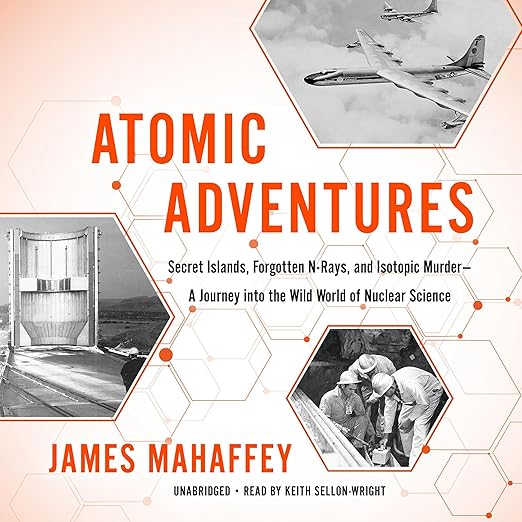
Quick Take
- Read by: Keith Sellon-Wright brings an engaged, exploratory tone to Mahaffey's writing that matches the book's curiosity-first approach. He handles both the technical passages and the stranger anecdotal sequences with appropriate shifts in register.
- At its heart: Nuclear history's forgotten experiments, the gap between public perception and scientific reality, energy futures
- Vibe: Curious and propulsive, like being shown things nobody bothered to tell you before
- Short version: Listeners who want to understand nuclear science through its most bizarre and overlooked chapters rather than its most catastrophic ones will find Mahaffey's audiobook both substantive and entertaining.
James Mahaffey has built a reputation for making nuclear science legible to people who are not nuclear scientists, and Atomic Adventures - the audiobook narrated by Keith Sellon-Wright across 13 hours and 29 minutes - is the most eccentric and arguably most enjoyable entry in that project. The book does not begin with Hiroshima or Chernobyl. It begins in the margins: lost reactors on far-flung Pacific islands, trees exposed to active fission that changed sex or bloomed in the dead of winter, and the period in history when radiation counting was a social fashion. Mahaffey's structural choice is deliberate. By starting with the forgotten and strange rather than the catastrophic and familiar, he creates space to examine nuclear science's actual complexity rather than its mythologized form. The opening pages establish the book's personality immediately: this is a scientist who finds the history of his field endlessly surprising, and who writes from that surprise rather than from a pedagogical obligation to cover the canonical events.
Is Atomic Adventures Worth Your Time?
The book's strength is its specificity. Mahaffey does not generalize about nuclear history - he tells particular stories with particular details that reward attentive listening. The account of Japan's wartime effort to build an atomic bomb is handled with the same factual precision as the American Manhattan Project, without the nationalistic framing that distorts most Western accounts of that period. The description of Lawrence's cyclotron and its role in generating crucial nuclear measurements is technical enough to satisfy physicists while remaining followable by attentive general listeners. Edward Teller's Star Wars laser program and the contested science around cold fusion both receive treatments that are skeptical without being dismissive - Mahaffey is interested in what the evidence supports, not in confirming either the enthusiast or the skeptic's prior position.
Where Mahaffey is most distinctive is in his treatment of nuclear energy's unrealized possibilities. The book covers the question of nuclear aircraft with genuine rigor - explaining not just that nuclear-powered planes were never built, but why, in ways that illuminate both the engineering constraints and the specific political decisions that foreclosed the option. This is the kind of counterfactual history that respects its subject: Mahaffey does not romanticize the paths not taken, but he ensures you understand what was actually achievable versus what was merely theorized. The same analytical discipline applies to cold fusion, where the book is particularly good at distinguishing between scientific failure and politically convenient dismissal.
One reviewer who identifies as technically knowledgeable noted that Mahaffey occasionally lost him in particularly dense chapters, while maintaining that this was appropriate given the subject and that the narrative chapters following those dense passages were always worth the effort. That is an honest characterization of the trade-off the book makes: it writes at the level of the material rather than at the level of the least technically prepared listener, which means some passages demand more active attention than others. The alternative - a book that never asks anything of its audience - would be a lesser achievement.
The Best Parts of Atomic Adventures
Keith Sellon-Wright's narration is a good match for a book that oscillates between dry history, technical explanation, and genuinely absurd anecdote. He does not play Mahaffey's stranger material for laughs - the comedy in trees blooming in December after radiation exposure is best delivered straight, and Sellon-Wright understands this. His handling of technical passages is careful and clear, and he shifts into a more energized register for the storytelling sequences without the shift feeling theatrical or imposed. The book's episodic structure gives him regular opportunities to reset tone, and he uses each of those transitions effectively.
Mahaffey's prose is described by one reviewer as having a "captivating" quality that supplies material for a dozen different narratives. This translates surprisingly well to audio. The book does not build to a single thesis so much as accumulate a picture of nuclear science as a field that has always been stranger, more contested, and more consequential than public understanding suggests. For listeners interested in the history and future of energy, the chapters on nuclear power's potential role in addressing the energy crisis and enabling long-range space travel are among the most substantive available in any popular science audiobook on the subject.
Where James Mahaffey Loses Some Ground
This is not a comprehensive history of nuclear science, and Mahaffey does not attempt to be one. The book is explicitly curated toward the overlooked and strange rather than the canonical. Listeners expecting sustained coverage of Three Mile Island, Chernobyl, or Fukushima will find those events present but not central to the book's project. The book also assumes a baseline level of scientific vocabulary - listeners who have no frame for terms like fission, isotopes, or cyclotrons will benefit from a brief primer before starting. The episodic structure means the book does not build toward a single payoff, which some listeners will appreciate as freedom to dip in and out while others will find it meandering. The audio format does somewhat challenge this episodic quality, since the natural breaks in a print edition are less marked in continuous listening.
Should You Listen to Atomic Adventures?
This audiobook is ideal for science-literate listeners with a general interest in nuclear history who are specifically tired of the catastrophe-focused framing that dominates most popular nuclear coverage. Anyone who finds the science fiction premise of nuclear-powered spacecraft more interesting than fear-based reactor debate will find Mahaffey's curiosity-driven approach genuinely refreshing. Technically trained listeners in adjacent fields - physics, engineering, energy policy - will get more from the denser passages than general science readers, but the book rewards attentive listening regardless of background level. Those seeking a comprehensive nuclear history textbook or an account focused on the major accidents and disasters should look elsewhere; this is a collection of illuminating chapters that covers the history through its least-told stories rather than its most familiar ones.