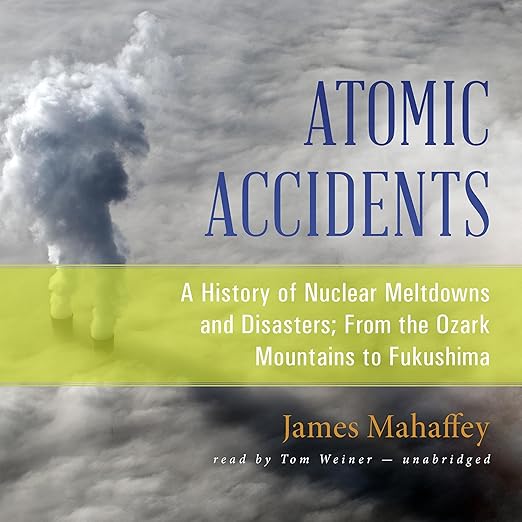
I came to Atomic Accidents in the way I come to most serious science history: sideways, through a reference in something else I was reading. A chapter on Three Mile Island had sent me looking for a more comprehensive treatment, and James Mahaffey's book kept appearing in the same recommendations. I started it on a Tuesday afternoon and found myself still listening at midnight, which is not something I anticipated from a 15-plus-hour book about nuclear accidents. The subject matter provides its own momentum, but Mahaffey's writing is the thing that sustains it.
Mahaffey is a nuclear engineer and a longtime advocate for nuclear energy research, and that combination, insider technical knowledge plus genuine enthusiasm for the subject, produces a kind of nonfiction that is rarer than it should be. He is not neutral about nuclear power's potential, and that partisanship is worth naming. But it does not compromise the honesty of his accident analysis, and one reviewer makes an interesting point: the recurring pattern of backup system failures, generators that did not start, control rods that jammed, redundant pumps that were offline, leaves the reader with a sense of systemic fragility that Mahaffey clearly did not intend to emphasize. That unintended effect is itself a kind of intellectual honesty.
The Review
The book's chronological and categorical scope is genuinely impressive. Mahaffey begins with the discovery of radioactivity in the late nineteenth century and works forward through every significant nuclear accident and mishap through Fukushima, and he does this in a way that builds rather than simply accumulates. Each incident is analyzed for cause, for what the engineers and scientists understood at the time, and for what the accident subsequently revealed about the limits of that understanding. This is the history of technology written through failure, which turns out to be one of the most illuminating ways to write it.
The treatment of laypeople without technical backgrounds is careful. Multiple reviewers note that the book makes nuclear fission comprehensible without requiring prior scientific training, which is a significant achievement across 15-plus hours of technically demanding material. The scientifically minded reader finds the accidents thoroughly explained, while the generalist listener finds the subject approachable. That range is difficult to sustain across a book this long, and Mahaffey sustains it.
Tom Weiner's narration is the right choice for this material. He has a measured, documentary quality that lets the weight of the events register without theatrical emphasis. Nuclear accidents do not need dramatic narration, the events themselves are dramatic enough. What Weiner provides is the calm authority that makes technical exposition feel trustworthy and keeps the listener oriented across a large, complex body of information. At nearly 16 hours, this is a substantial listening commitment, but the material justifies it, and Weiner's pacing does not drag.
One reviewer reread the book a year later, describing it as that good, a reliable signal that the content is organized well enough to reward return engagement. Another reviewer listened while only moderately interested in nuclear power and found the book rewarding precisely because of its encyclopedic scope and clear writing. The accessible-without-condescending quality is consistently noted.
What to Watch For in Atomic Accidents
The most substantive critique in the reader reviews comes from a listener who points out that Mahaffey omits the sinking of the nuclear submarine Thresher, which that reviewer characterizes as the biggest nuclear disaster to happen in the United States. Whether or not you share that characterization, the specific gap is worth knowing if you come to this book expecting comprehensive coverage. Mahaffey's focus is primarily on reactor accidents and power generation mishaps rather than all nuclear incidents, and some events fall outside the scope he has defined, whether by intention or oversight.
The recurring backup system failure pattern noted by one reviewer is also worth holding onto as you listen. Mahaffey's advocacy for nuclear energy means he frames each accident as a learning event that improved subsequent design, which is a defensible argument, but the pattern across incidents paints a picture of systemic reliance on safety systems that have a troubling rate of real-world failure. Both readings of the same evidence can coexist, and the book is richer for containing that tension even unintentionally.
Who It's For
This is for listeners who want a serious, technically grounded, and genuinely readable history of nuclear accidents from the discovery of radiation forward. It works equally well for people interested in energy policy, the history of science and engineering, or the broader question of how societies manage catastrophic risk. Prior technical knowledge is helpful but not required.
Skip it if 15-plus hours of detailed incident analysis sounds exhausting rather than rewarding. This is a comprehensive treatment, not a highlights package, and it asks for sustained attention in return for substantial depth. Listeners looking for a shorter, more narrative nuclear history may find other entry points more comfortable.
Does Atomic Accidents cover Chernobyl, Three Mile Island, and Fukushima comprehensively?
All three are covered, along with every significant nuclear incident from the late nineteenth century through Fukushima's 2011 disaster. The treatment is analytical rather than purely narrative, Mahaffey examines cause and what each accident revealed about safety design assumptions, so listeners wanting deeply immersive storytelling specifically about one event may find the encyclopedic approach less satisfying than a dedicated single-incident book.
Is the book accessible to listeners with no technical background in nuclear physics?
Yes, and this is consistently noted by reviewers. Multiple listeners with limited technical background found the material comprehensible and engaging. Mahaffey is clearly practiced at explaining nuclear fission and reactor design to non-specialists without losing scientific accuracy.
Given Mahaffey's advocacy for nuclear energy, is this book balanced in its treatment of accidents?
He is transparent about his position as a nuclear energy advocate, and that perspective shapes his framing, each accident is positioned as a learning event that improved subsequent design. However, readers note that the recurring pattern of backup system failures creates an unintended picture of systemic fragility. The book contains an interesting tension between its author's intentions and what the evidence suggests to an attentive listener.
At nearly 16 hours, is the pacing consistent throughout, or does the book have weak sections?
Reviews do not flag specific sections as weak, and at least one listener returned to reread the book a year later. Tom Weiner's narration maintains a consistent documentary authority that keeps the pacing from dragging. The encyclopedic scope means some incidents receive more detailed treatment than others, but the overall listening experience is described as absorbing rather than exhausting.