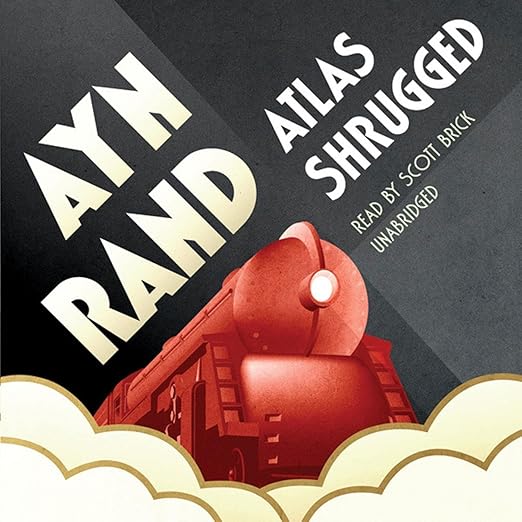
Is Atlas Shrugged even a novel, or closer to a philosophical treatise that occasionally pauses for plot? At just under sixty-three hours, this audiobook gives Ayn Rand's 1957 book more room to make its own case than almost any other format could.
Second Only to the Bible, by One Survey
Its premise is deceptively simple: the world's inventors, industrialists, and innovators start disappearing, one by one, and a mystery about who is causing it, and why, drives a plot that keeps expanding until it covers the collapse of an entire civilization. Rand's own framing, that this is the story of a man who said he would stop the motor of the world and did, gets at the book's real structure: a slow-burn conspiracy plot wrapped around Rand's philosophical arguments about capitalism, individual achievement, and the moral case Rand builds for both across the book's full length. A joint 1991 survey by the Library of Congress and the Book of the Month Club named it the second most influential book for Americans, after the Bible, and PBS's The Great American Read later nominated it among America's best-loved novels, context worth knowing before assuming this is a niche cult title rather than a genuinely mainstream cultural fixture.
A patient mystery drives that plot, more patient than a typical thriller setup: a scrap heap inside an abandoned factory holds what the book calls the greatest invention in history, left to rot, unrecognized, its inventor punished rather than rewarded. That single image, brilliance discarded rather than celebrated, recurs across the book's larger argument as industrialists and innovators vanish one after another, and Rand builds outward from it into questions the book poses directly: is the vanishing man a destroyer or a liberator, and why is his hardest fight against the very people who need him most rather than against a clear enemy.
Scott Brick Takes on Nearly Sixty-Three Hours of Rand
Scott Brick narrates, and this narrator's track record elsewhere leans heavily toward narrative nonfiction and biography, including extended, demanding multi-decade histories that require sustaining a consistent voice across dozens of hours without losing energy. That same stamina is exactly what nearly sixty-three hours of Rand's dense argumentation and shifting registers, intimate character scenes giving way to lengthy philosophical monologues, requires from a narrator, a demand the visible reader reactions never actually weigh in on, all five staying fixed on the book's politics and prose instead. Blackstone Audio produced this recording, and a nearly sixty-three-hour runtime is close to the outer edge of what any single-narrator audiobook typically attempts, roughly double the length of a substantial biography and well beyond most literary fiction, so whatever narrator takes this on is committing to one of the more demanding assignments an audiobook can offer, sustaining energy and clarity across a runtime that would exhaust a less disciplined performer well before the final chapters.
What the reviews focus on instead is the book's scale and its effect on readers over time. Warthorn calls the book "worth it" after a three-year reading process (with "one re-start 1/4 way in"), crediting Rand's "forcefulness and certainty" and the "sheer scale" of the book's many characters and big ideas, even while flagging that a number of the characters read as "shallow 2-dimensional" caricatures rather than fully realized people. Vic Mabuse describes finally committing to the book after years of "meaning to read" it, drawn in by "the current political climate," and found it "very engaging" from the opening chapters onward.
A Five-Star Review That Reads Like a Takedown
One review on this listing is worth reading twice for how it does not match its own star rating. Mark Twain 12345's review, titled "Self-indulgent and deluded twaddle that unfortunately has to be read," argues the book "has few merits in its own right," calls it "clearly too long," and describes long stretches as "political propaganda masquerading as fiction," yet the review itself is logged at five stars, the same score as several unreservedly enthusiastic reviews on the same listing. That mismatch between the written content and the star given is worth knowing about before treating the rating badge as a simple summary of reader sentiment.
E. Daniels adds a fair, practical caveat: "the language and some cultural references may sound dated," which tracks, since the book was written in the late 1950s, and Daniels recommends treating it "as a period piece" rather than judging it by current conventions. Antony Guss's review, titled "Font Size," calls the book "fabulous" but complains the "copy font too small," language that describes a print or ebook edition's formatting rather than anything about this audio recording. Worth noting too, this audiobook's own release dates to December 2008, but the five visible reviews span 2012 through early 2026, well over a decade of ongoing reader response to a book already fifty years old when this edition arrived, evidence of a genuinely sustained readership rather than a burst of attention around the original release.
Political Climate Keeps Bringing New Readers Back
Readers curious about a genuinely influential, still-debated cultural touchstone, not just Rand's core existing fanbase, are a real part of the audience here, particularly given the Library of Congress survey result and the PBS nomination cited above. Listeners who want their politics argued at length and in fictional form, rather than delivered as a short polemic, will find Rand does not hold back: entire chapters function as extended argument first and plot delivery second, and the audiobook format actually suits that structure, since a long monologue lands differently read aloud than skimmed on a page. Vic Mabuse's point about timing is worth repeating too: political climate is a recurring reason reviewers give for finally picking this book up, decades after its original publication, which suggests the book keeps finding new relevance to different readers rather than aging into pure historical curiosity.
Nearly sixty-three hours across a large ensemble cast, several of whom exist mainly to embody a specific argument rather than to read as fully rounded people, is a real commitment to weigh before starting; warthorn's own three-year, one-restart journey through the print edition is a fair preview of the kind of patience this book asks for. Everyone else gets one of the longest, most argued-over audiobooks available in this genre, for better and for worse. Mark Twain 12345's harsh review is worth reading alongside the enthusiastic ones rather than dismissing outright, since even a listener who ultimately dislikes the book's politics may recognize the same structural complaints, length, repetition, argument overtaking character, that even some five-star reviewers raise more gently.
How long is the Atlas Shrugged audiobook, and can it be split into sessions?
It runs close to sixty-three hours, one of the longest audiobooks in this genre, so most listeners work through it over weeks rather than in a few sittings. Warthorn's review describes a three-year reading process with one restart, a useful benchmark for the level of commitment involved.
Does this audiobook's rating reflect genuine reader consensus?
Not entirely cleanly. One five-star review, titled 'Self-indulgent and deluded twaddle that unfortunately has to be read,' argues the book has few merits and calls parts of it propaganda, a mismatch between the written content and the star score that is worth noticing before trusting the badge alone.
Is the Atlas Shrugged audiobook more plot or more philosophy?
Both, deliberately intertwined. A mystery about vanishing industrialists drives the plot forward, but entire chapters function as extended philosophical argument about capitalism and individual achievement, with the audiobook format giving Rand's longer monologues real room to land the way spoken argument does.
Who narrates this audiobook, and have they handled similarly long material before?
Scott Brick narrates. The broader track record on file leans toward extended narrative nonfiction and biography requiring sustained energy across dozens of hours, a demand this nearly 63-hour recording makes in full, though the visible reader reactions stay fixed on the book's politics rather than the reading.