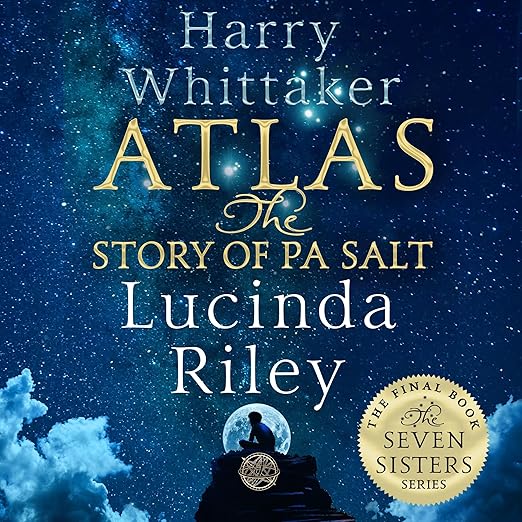
Count the narrators named in this description and then count the ones the listing credits. The copy says, in its second sentence, narrated by Richard Armitage and Tuppence Middleton, and it closes by repeating that Tuppence Middleton returns to complete the sisters' story alongside Richard Armitage as Pa Salt. The narrator field on this audiobook carries a single name. Whatever else is true about a finale running just short of twenty-five hours, on a saga the series field numbers at eight, half the cast is missing from the credits, and the missing half is the one reading the sisters.
How Atlas Holds Up
Now look at the byline, then at the second paragraph of the copy. The listing attributes the book to Lucinda Riley. The description says it was co-authored by her son Harry Whittaker, and a five-star note filed in February 2026 addresses him directly by name to thank him for taking on the challenge. Riley died before the series ended; the finale exists because someone else finished it. That is not a footnote, it is the central fact of the book, and the author field is the one place on the page that does not acknowledge it.
Testimony from May 20, 2023 captures what is strange about reading the book. That reader did not learn Riley had died until after finishing, was shocked, and reports being unable to tell the difference in writing style, calling the book as good as the seven before it and amazed that anyone could pick up another writer's work and deliver the same quality, style and tone. Coming from someone who did not know to look for a seam, that is the strongest possible testimony about the seam.
Series metadata makes its own small joke here. Seven Sisters is the series name; eight is the volume number; the description opens by gathering six named women plus a long-lost missing sister. None of that is wrong, exactly, and all of it takes a moment to reconcile. Anyone arriving at this page without the previous books will find the arithmetic of this family harder to follow from the copy than from the novels themselves.
Candor arrives on August 6, 2023, in the most useful note this page holds, and it doubles as a description of the problem the book had to solve. That reader felt the seventh volume was rushed and less intricate than the early ones, assumed after Riley's death that the series would simply be abandoned, and moved on. Then, stuck on a plane with a reading app on a phone, downloaded this one anyway, and found it brought everything together, including why Pa Salt ended up with six and eventually seven daughters. A lapsed reader who came back and was paid off is more useful evidence than any number of loyalists.
What the finale delivers is a specific list of answers, and the copy is unusually straight about it. The six named sisters and their long-lost missing sibling are gathered on board the Titan to say goodbye to their father, each holding a clue to her own past. How Pa Salt made his fortune. Why he adopted them. Why he chose them from such different corners of the world. And whether the answers were sitting in plain view across the previous seven books. Twenty-four hours and fifty-nine minutes is a considerable stretch, and a saga this size needs every one of them to close cleanly.
Scale is the other thing worth naming. Seven previous volumes each took one sister to one country and one stretch of history, which leaves the finale needing to stay legible to someone holding seven separate sets of names in mind at once. The copy's answer is to put everybody on one boat and work outward, and structurally that is the right call: a single location, a single occasion, a clue apiece. Audio benefits from that discipline more than print would, since a listener cannot flip back to check which sister was which.
Weak Spots in Atlas
December 16, 2025 holds the dissent, at four stars, and it inverts what the rest of the column concludes. That reader had anticipated this eighth and final volume for the answers it promised, got them, and was satisfied by them, but felt the writing was in an entirely different style despite the joint authorship, and docked a star for exactly that. Two careful readers, opposite conclusions, on the one question the book cannot avoid. Which of them you end up agreeing with is unpredictable, and if you are sensitive to voice at the sentence level, budget for the possibility that you will hear it.
Two smaller inconsistencies are worth naming. The title displayed here is Atlas; the copy calls the book Atlas: The Story of Pa Salt, so the subtitle that identifies whose story this actually is has been dropped from the listing. And the genre field reads romance while the tag reads Historical. A multigenerational family saga about adoption, inheritance and a father's secret is neither of those exactly, but romance is the further miss, and it will send the record to readers expecting something this book is not.
Then the obvious one: do not start here. The description names six sisters and a long-lost seventh in its third paragraph, and the entire payload of the book is the resolution of questions posed across seven previous volumes. Coming to it cold means twenty-five hours of answers to questions you never asked.
The Right Listener for Atlas
Anyone who has finished the previous seven should simply take this. March 9, 2026 calls it one of the best series conclusions that reader has encountered, with no loose ends and an optimistic future left to the imagination, and describes it as a lasting gift from the author and her family. That is the reaction of somebody who wanted one specific thing, closure, and received it in full. Nothing in that verdict depends on making allowances for the circumstances in which the book was finished, which is worth knowing before you start. Long-form saga listeners who like a story that spans continents and generations, and who have the patience for very nearly a full day of listening, are the exact audience.
Skip it if you have not read the series, if you dislike endings that explain everything, or if you want the romance the genre field advertises rather than the family history the book delivers. And if the question of whether a novel finished by another hand counts as the original author's work is one that will nag at you throughout, the column above is split on that point, which suggests it might.
In Brief
- Voice: The copy names Richard Armitage and Tuppence Middleton; the credits name one of them, so the voice reading the sisters goes unlisted.
- Big ideas: Adoption and origin, inherited secrets, a saga closing, grief on both sides of the page.
- Atmosphere: Expansive and elegiac, built for a long sit.
- Worth it?: A genuinely satisfying close to an eight-book saga, and completely useless as a starting point.