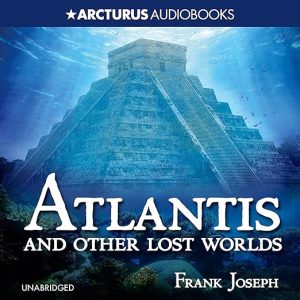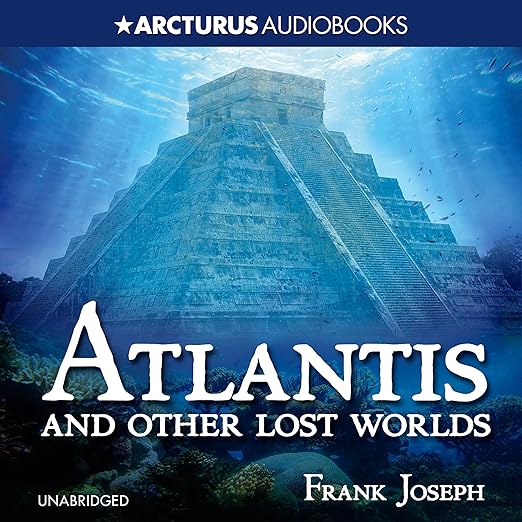
- Read by: Blake Kubena delivers the material with steady authority, giving Frank Joseph's speculative claims the tone of confident presentation without tipping into breathless advocacy.
- At its heart: Atlantis and alternative prehistory, cross-cultural pyramid building, ancient crystal technology
- Vibe: Earnest and energetic, with the flavor of a passionate case being argued rather than a verdict being delivered.
- Short version: A thorough survey of the Atlantis evidence base for listeners already inclined toward alternative prehistory, though mainstream archaeologists will find the source methodology worth scrutinizing.
Frank Joseph's audiobook Atlantis and Other Lost Worlds, narrated by Blake Kubena, positions itself from the first chapter as the most comprehensive and current investigation of what the author calls Atlantis's 'archaeological reality.' That framing matters because it signals the book's relationship to its own claims: this is advocacy for a specific interpretation of the ancient record, and it is effective advocacy at that, presented with enough detail and range to hold a listener's attention across eight hours and thirteen minutes. Whether the evidence base holds up to the scrutiny the framing invites is a separate and important question.
The argument Joseph constructs covers significant ground. He tracks alleged Atlantean cultural influence across pharaonic Egypt, Bronze Age Europe, Maya Mexico, and Inca Peru, presenting pyramid-building traditions and maritime evidence as a network of connections pointing back to a single source civilization. The 'crystal technology' claims - which Joseph frames as surpassing contemporary understanding - are the book's most speculative layer, and reviewers with backgrounds in archaeoarchaeology note that the bibliography often doesn't directly support the specific conclusions drawn. But the imaginative scope of the argument, and Joseph's capacity to synthesize material from multiple ancient cultures into a coherent narrative, is the book's genuine strength.
Loony Ideas Aside, This Ranks as the Best
One experienced reader in pre-Egyptian history who describes having waded through 'a lot of loony ideas' in the field singles out this book as 'the very best summary of what is real out there' - which suggests that within the alternative prehistory community, Joseph's synthesis represents a high-water mark for responsible handling of the available material. A separate reviewer offers the honest counter: some theories seem 'quite a bit farfetched,' dates are occasionally inconsistent, and the bibliography doesn't always do what a strictly academic work would require it to do. Both assessments can be simultaneously true, and a listener arriving with some background in the area will be better positioned to distinguish where Joseph's reasoning is careful and where it stretches.
The comparison Joseph invites with his earlier book on Lemuria - also reviewed favorably by at least one reader who found this one broader in scope - gives some indication of the author's range. He is a prolific writer in the alternative prehistory space with a developed thesis about the diffusion of ancient civilization, and Atlantis and Other Lost Worlds represents his fullest treatment of the central question. Kubena's narration across the eight-hour runtime is steady and authoritative without becoming mechanical - a challenging register to hold for material that asks the listener to treat speculative reconstruction with the same seriousness as documented archaeological finds. He manages it without tipping either into clinical distance or credulous advocacy.
Kubena Modulates Between Evidence and Speculation
The audiobook's particular strength is its range. Joseph moves from the geological arguments about sea-level change and catastrophic subsidence to the cultural parallel evidence with some fluency, and the scope of the civilizations he draws into the comparative framework - Egyptian, Mesoamerican, Andean, and European Bronze Age - gives the book a breadth that narrower Atlantis treatments lack. Kubena handles the transitions between these domains well, modulating his delivery to reflect whether Joseph is presenting physical evidence or advancing a more speculative interpretation.
The recreation of Atlantis at its described height - what Joseph calls the 'heyday of cultural splendor and imperial might' - is handled as a set piece rather than as sustained world-building, but it functions as the book's emotional center. After hours of building the evidentiary case, the moment of vivid reconstruction gives the listener a reason for the argument beyond academic interest. For listeners drawn to questions about what pre-Bronze Age civilization might have achieved and what evidence might survive a catastrophic sea-level event, Joseph provides a sustained and well-organized framework for thinking through those questions across a manageable eight-hour commitment.
Contested Dates, and Crystal Claims Without Evidence
The most contested territory in the book is the chronological material. Reviewers with existing knowledge of the field note that Joseph's dates for specific cultural events sometimes conflict with the mainstream archaeological record, and that the bibliography, while present, occasionally cites sources that don't directly support the conclusions drawn from them. Listeners who want to engage critically with the argument should treat the chronological claims as invitations to investigate rather than settled facts.
The crystal technology section is the moment where the book moves furthest from the recoverable archaeological record and into speculative reconstruction. Joseph frames it as the 'scientific genius of the ancients,' which is not an unreasonable frame for a popular audience, but the absence of physical evidence for the specific technology described is the gap that skeptical listeners will notice most acutely. The book is more persuasive in its comparative cultural analysis than in its technological claims, and listeners with a background in material culture studies will feel that imbalance acutely. The audio version allows the listener to sit with the speculative sections without the visual apparatus of footnotes that might soften or qualify the claims in print.
Eight Hours for Hancock-Collins Tradition Readers
Listeners already engaged with alternative prehistory literature - the Hancock-Collins tradition of inquiry into pre-Bronze Age civilization - will find this a useful and comprehensive reference point. It synthesizes a large amount of cross-cultural evidence into a readable framework, and Kubena's narration makes the eight-hour runtime manageable. Academic archaeologists and listeners who require strict bibliographic standards will find the methodology frustrating, and they should know that going in. For the intellectually curious listener who wants to understand the strongest version of the Atlantis-as-historical-reality argument, this is an honest and well-organized place to start, with Kubena's narration keeping the speculative material grounded in the prose rather than letting it float free.
Questions Listeners Ask
Does the Atlantis and Other Lost Worlds audiobook approach the subject from a mainstream archaeology perspective or an alternative history angle?
Firmly from an alternative history angle. Frank Joseph argues for the archaeological reality of Atlantis and its influence on multiple ancient civilizations. The book presents this case with confidence, but reviewers with academic backgrounds note that the bibliography doesn't always meet scholarly standards and some dates are inconsistent with the mainstream record.
How does this audiobook compare to other Atlantis titles available on audio?
Joseph's synthesis is broader than most, drawing comparative evidence from Egyptian, Mesoamerican, Andean, and European Bronze Age cultures rather than focusing narrowly on Plato's original account. One reviewer with years of background in pre-Egyptian history describes it as the best available summary of the alternative evidence base, which places it near the top of its specific subgenre.
Is the audiobook accessible to listeners without prior knowledge of Atlantis literature?
Yes. Joseph writes for a popular audience and Blake Kubena's narration is clear and unhurried. Listeners arriving without prior knowledge of the debate will find the main arguments laid out accessibly, though some familiarity with the ancient civilizations discussed, particularly Egypt and Mesoamerica, will help with context.
Do I need any companion materials to get full value from this audiobook?
The book was originally published with illustrations that reviewers describe as adding evidential weight to the argument. The audio edition cannot reproduce these images, so listeners interested in the visual evidence base may want to access a print or digital copy alongside the audiobook for the sections where Joseph references specific archaeological images.