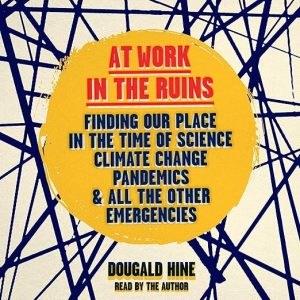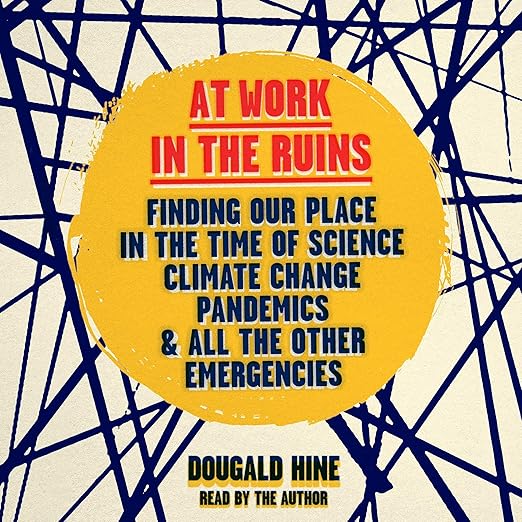
Dougald Hine co-founded the Dark Mountain Project with Paul Kingsnorth in 2009, a cultural response to ecological crisis that refused the consolation of either technological optimism or conventional activist narrative. At Work in the Ruins, narrated by Hine himself, arrives from that same intellectual position but sharpened by what happened in the years between: the pandemic, the accelerating climate emergency, and most specifically, an afternoon in the second year of COVID when Hine, who has spent most of his adult life talking and writing about ecological destruction, found he had nothing left to say. This audiobook is his attempt to understand why, and what that silence revealed about the nature of the crisis and the frameworks we use to think about it.
The self-narration is not incidental. Hine is a practiced speaker and lecturer who has been making this argument in rooms full of people for years, and the audiobook carries the quality of a very refined talk rather than a read text. His phrasing has the cadences of someone who has tested these sentences against live audiences and knows where the emphasis should fall. At 7 hours and 4 minutes, the audiobook moves at the pace of a sustained intellectual conversation rather than an academic treatise, which is exactly appropriate for what Hine is actually doing here.
When Science Becomes Belief, Questions Go Unspoken
The central argument is both simple and difficult to summarize without flattening it: our over-reliance on scientific authority as the sole legitimate lens for understanding ecological crisis has made it harder, not easier, to address the questions that science cannot answer. When science is treated as an object of belief rather than a method of inquiry, the questions that lie outside its competence, questions like how did we get here and is this the result of a particular way of approaching the world, become unspeakable rather than simply unanswered. And it is precisely those questions that determine what kind of responses we go looking for when the crisis deepens.
Amitav Ghosh's endorsement, calling the book one of the most perceptive yet written about the multiple intersecting crises now upending our world, reflects its standing in the ecological humanities conversation. Reviewer Will Richardson describes it as leaving him with a totally new perspective on this moment in time, which captures the experience of reading a book that does not add information to what you already know but reorganizes the conceptual framework you use to think about it. Hine's audiobook is that kind of work. It does not tell you more about climate science. It asks what kind of problem you think climate change actually is, and whether your answer has been shaped by assumptions you did not consciously choose.
Dougald Hine's Pandemic Afternoon of Silence
Reviewer Will Szal's note about arriving at the book through an event at the Schumacher Center for New Economics, hosted by Bayo Akomolafe, signals the intellectual community this audiobook speaks to and from: the post-growth, degrowth-adjacent, ecological humanities conversation that has been building outside the mainstream climate policy discourse for the past decade. Hine is a central figure in that conversation, and this audiobook is the most accessible and concentrated version of his argument available in audio form.
The personal dimension, specifically the pandemic afternoon of silence and Hine's own transition from activist to something harder to name, gives the argument an emotional honesty that prevents it from becoming an academic position paper. Helen Jukes's description of the book as having rare originality and depth identifies what that combination of personal experience and rigorously developed argument actually produces in practice. The reviewer who described it as sincere, poignant, and relaxing at the same time captures the paradox of a book that accepts the worst while remaining fundamentally undesolate.
No Roadmap, Only Better Questions to Ask
This is not a book that offers solutions in the conventional sense. Hine explicitly rejects the frame in which ecological crisis is a technical problem awaiting the right solution, and he does not replace that frame with an alternative set of prescriptions. What he offers instead is a set of questions about what work is worth doing and how to find bearings in a world that is already changing faster than political structures can respond to. Listeners who come to environmental audiobooks for roadmaps and action plans will find the orientation here genuinely and deliberately different from most of what is in print on this subject.
The pandemic material is integral rather than dated. Hine uses the COVID period not as a metaphor for climate crisis but as a specific experience of what it feels like when an emergency that has been predicted for years arrives and the existing frameworks for response prove insufficient in ways that nobody adequately anticipated. That specificity makes the argument more durable than books that used the pandemic as a rhetorical stepping stone to another argument.
A Natural Fit for Post-Optimist Readers
Readers who have found Robin Wall Kimmerer's Braiding Sweetgrass or Kathleen Dean Moore's work on ecological ethics rewarding will find Hine's audiobook a productive extension of that conversation into more explicitly political territory.
Readers familiar with Ghosh's The Great Derangement, Kingsnorth's Confessions of a Recovering Environmentalist, or Bruno Latour's later work on ecology and politics will find Hine's audiobook a natural companion and a productive point of disagreement in places. The reviewer who came to it through Bayo Akomolafe's events will recognize the same post-humanist, post-optimist orientation. Listeners who have found themselves frustrated by both techno-optimist climate books and doom-loop climate despair will find Hine's position genuinely distinct from both. Those who need their environmental writing to include policy prescriptions or technological solutions will find the book's horizon deliberately short of that, and should weigh whether that is a feature or a limitation before committing to 7 hours with it.
- Read by: Dougald Hine self-narrates, and this is essential. The conversational precision of his phrasing in live talks translates directly into the audiobook's rhythm, giving the argument an intimacy that a professional narrator would struggle to replicate.
- At its heart: The limits of scientific authority, ecological crisis as civilizational question, what work is worth doing
- Vibe: Quiet and unsettling, intellectually bracing without despair
- Short version: Hine's essay in crisis realism is one of the more genuinely original contributions to the climate conversation this decade, and his self-narration makes the audiobook a different experience from the print version.
Frequently Asked Questions
Does Dougald Hine's self-narration of this audiobook affect how the argument lands compared to reading the print version?
Significantly, yes. Hine is a practiced public speaker who has delivered versions of these arguments to live audiences repeatedly, and the audiobook carries the precision and cadence of a refined lecture. The intimacy of hearing the author work through his own material is one of the audiobook's distinct assets.
How does At Work in the Ruins position itself relative to other environmental audiobooks that offer solutions?
It deliberately does not offer solutions in the conventional sense. Hine's argument is that the search for technical or policy solutions to ecological crisis may itself be part of the problem. Listeners seeking a roadmap will find a different kind of value here, one centered on reorienting the questions rather than answering them.
Is this audiobook accessible to listeners without a background in environmental studies or philosophy?
Yes. Hine writes for a general educated audience, and the personal dimension of the book keeps the philosophical argument grounded in recognizable experience. Background in Dark Mountain Project writing or ecological humanities will enrich the experience, but it is not required to follow the argument.